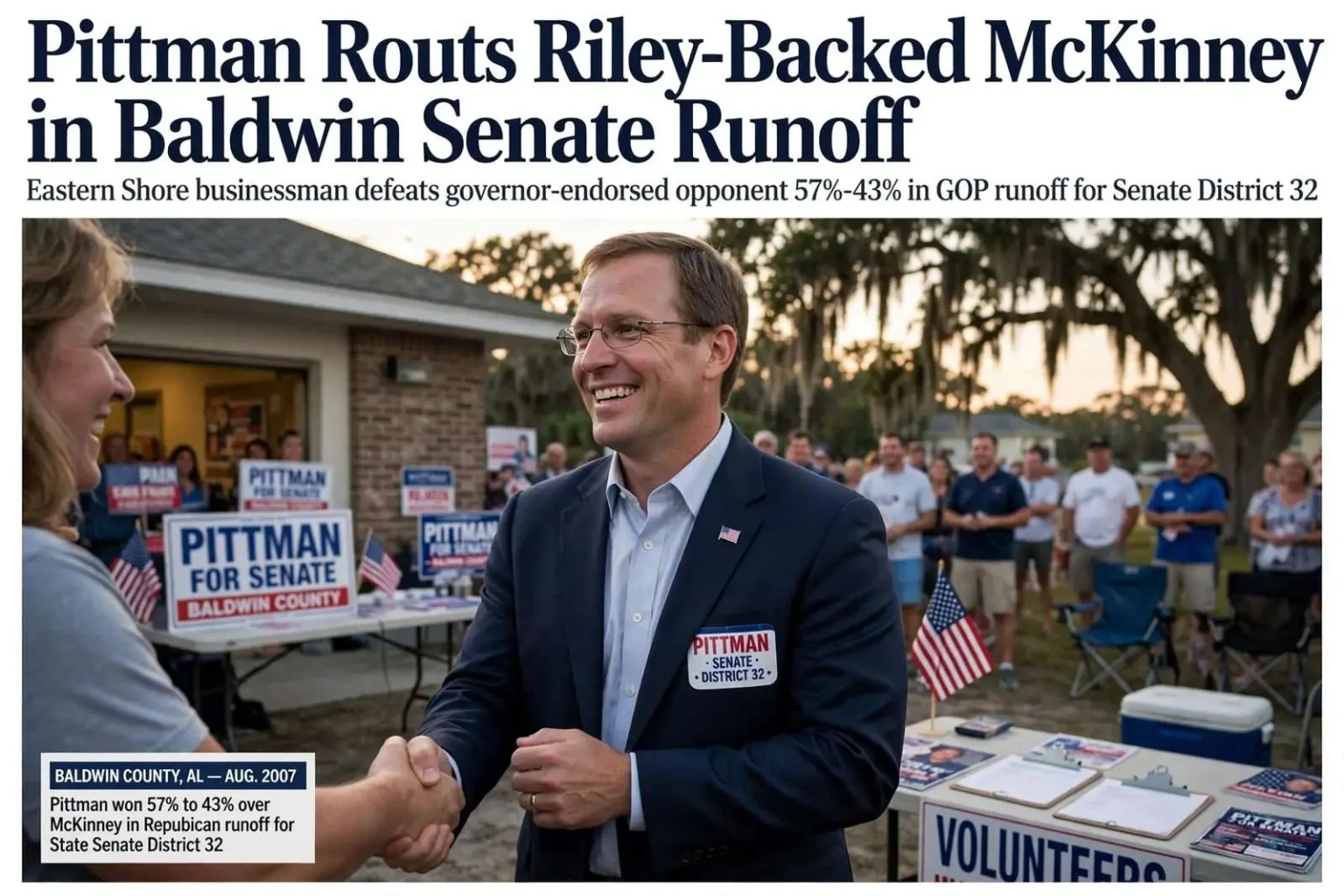
Pittman Routs Riley-Backed McKinney in Baldwin Senate Runoff
Trip Pittman's lopsided win over Randy McKinney in the Baldwin County Senate District 32 Republican runoff raised hard questions about how much a popular governor's endorsement is actually worth.
Gov. Bob Riley owns plenty of cowboy boots. After this week’s Republican runoff in Baldwin County, the open question among south Alabama Republicans was whether he owns any coattails.
Eastern Shore businessman Trip Pittman defeated Riley-backed Randy McKinney by roughly 57 percent to 43 percent in the GOP runoff for the state Senate District 32 seat — a decisive margin in the reddest corner of a red state, and one that came despite the personal intervention of a popular two-term Republican governor.
The result landed with force in both directions. Pittman, a first-time candidate running against the machinery of his own party’s establishment, had beaten not merely an opponent but an endorsement — one delivered personally by a governor whose approval within his party remained high and whose political operation had never treated a Baldwin County race as optional. McKinney, for his part, had run as the choice of the party’s leadership in an electorate that prides itself on being the leadership’s base.
McKinney, a south Baldwin real estate executive and state school board member, had been the early front-runner and embraced his ties to Riley from the opening of his campaign. In the closing days, with the race tightening, the McKinney campaign aired a television spot featuring the governor’s enthusiastic endorsement. The decision to spend scarce closing-week money on an endorsement ad reflected the campaign’s core theory of the race: that in a heavily Republican electorate, the governor’s blessing was the single most valuable currency available.
The theory had a flaw, and the runoff exposed it. Voters who resent outside involvement in local races do not distinguish between a friendly governor and a distant one, and Baldwin County’s Republican electorate has a long tradition of treating its legislative seats as local property. In for a penny, in for a pound. As events played out, in for a pounding.
The seat had come open when Bradley Byrne resigned to accept Riley’s appointment as chancellor of the state’s troubled two-year college system. The appointment had placed Byrne — the district’s sitting senator — inside the administration just as the two-year college system’s governance scandals were drawing legislative scrutiny, giving the Senate race an undertone about patronage and insider arrangements that ran directly through the governor’s office.
Pittman, who ran against the establishment and courted a grass-roots coalition, will face Democratic nominee A.J. Cooper — an Eastern Shore attorney and former mayor of Prichard — in the Oct. 16 general election. The two-week turnaround between runoff and general election compressed the schedule, leaving little time for the sort of reconciliation the runoff’s bitterness had made advisable.
Not the first time
The result echoed a pattern from the previous year. In 2006, Riley’s popularity at the top of the Republican ticket was not enough to carry GOP lieutenant governor nominee Luther Strange or Drayton Nabers, the party’s candidate for chief justice of the Alabama Supreme Court, to victory. Both races had featured well-funded, well-endorsed Republicans losing in a year when the governor himself was winning reelection by a wide margin — evidence that Alabama voters, including Republican ones, were willing to split their tickets when the down-ballot candidate fit a narrative they disliked.
The jokes started immediately. One veteran Democratic lawyer asked whether Cooper could reach 25 percent in the general election. The answer came back: “Thirty percent if Riley publicly endorses Pittman.”
No hard feelings, one official says. Republicans in Baldwin County moved quickly to argue that the episode would not fester. One county GOP official said the governor called Pittman on election night to congratulate him as soon as the results were in.
“It appears that the endorsement helped Pittman from all accounts,” the official said. “I spoke to Trip about this issue and assured him that Gov. Riley would be a Pittman man after the race. Trip responded that he knew that it was only politics and wouldn’t let that get in his way.”
“Trust me, I know that there have to be some strange feelings about this type of issue,” the official added. “However, after a couple of fights where you are on the governor’s side or he comes to your aid, it all goes out the window. Bob Riley is loyal to those who support him. Make no bones about that.”
The speed of the reconciliation effort said as much about Baldwin County Republican politics as the runoff itself. The county party’s committee members, fundraising network and legislative delegation all function through the same overlapping circles of donors, officeholders and activists, and a primary fight that hardened into factions would have complicated every race on the next ballot. The governor’s late-night call, and the official’s insistence on loyalty above all, were the standard mechanics of putting the coalition back together.
What the result suggested, however, went beyond one race’s mechanics. Baldwin County in 2007 was in the middle of a long boom — a fast-growing, heavily Republican county where a legislative seat could turn on tax appraisals, property insurance and how much of the county’s tax revenue came back from Montgomery. The Eastern Shore’s population growth had made the district one of the most competitive fundraising environments in the state, and its voters had a habit of evaluating candidates as individuals rather than as parts of a slate.
Pittman’s campaign had leaned on that resentment of the capital, criticizing the flow of Montgomery political action committee money into his opponent’s account. In an era when legislative PACs moved money among committees in ways designed to obscure original sources, the complaint had particular traction in a county whose voters routinely demanded transparency. The charge allowed Pittman to run as a conservative against the ways of Montgomery without breaking with the party whose nomination he sought.
Property insurance added its own weight to the race. Baldwin County’s coastal exposure had made premiums a defining household concern, and legislative candidates were expected to explain what they would do about it — an issue that sat at the intersection of state regulation, private markets and the growing cost of living near the water. Roads, schools and the fairness of the state’s tax structure rounded out the local agenda in a district where newcomers were arriving faster than infrastructure could follow.
For Riley, the loss was a bruise rather than a wound. He was term-limited and would leave office in January 2011, and the business of the state moved on. His administration’s agenda — from incentive packages aimed at luring industry to the state’s education and tax debates — did not depend on any single legislative seat, and Baldwin County’s delegation would remain Republican regardless of which Republican held District 32.
But the runoff left behind a live argument inside the party about whether a sitting governor should intervene in a primary between two Republicans at all — an unwritten rule that many longtime party loyalists believed he had broken. The party’s institutional interest lies in avoiding primaries among its own officeholders; its incumbent officeholders, meanwhile, have every incentive to clear the field. The District 32 result suggested that voters in at least one corner of Alabama were willing to discipline the second impulse.
The immediate practical question was whether the divided Republican electorate would reunite in time for the Oct. 16 general election against a capable and experienced Democratic opponent. Cooper’s candidacy gave the general election more substance than the district’s registration numbers alone would suggest, and a runoff that ended with sour feelings toward the governor’s operation was, at minimum, an unpredictable backdrop for it.
A district that rewards local identities
Senate District 32’s politics have long rewarded candidates with roots voters can verify. The district’s geography — the Eastern Shore communities of Fairhope, Daphne and Spanish Fort, plus south Baldwin’s agricultural and fishing towns — produces an electorate that overlaps heavily between party, church and civic organizations, where a candidate’s reputation precedes his campaign. Pittman’s standing in those networks, and McKinney’s reliance on endorsement rather than organization, mapped directly onto the outcome.
The runoff also fit a recurring Alabama pattern: the party endorsement as a double-edged sword. A governor’s support brings money and legitimacy to a candidate who can absorb it, but in a primary between a local favorite and a Montgomery-backed figure, the endorsement can become the story itself. In District 32, the television ad featuring the governor gave Pittman’s grassroots argument its most vivid exhibit — a closing-week gift that turned the race’s central question into a referendum on outside involvement.
Whatever the general election brought in October, the runoff’s lesson was already circulating through the state’s political class: Baldwin County Republicans had looked at a popular governor’s handpicked candidate, weighed him against a first-time candidate who promised to answer to the district, and chosen the newcomer by fourteen points. Coattails, it turned out, were not part of the governor’s wardrobe after all.