David Ed Bishop Ran on a Promise to Bring Baldwin’s Money Home
The Baldwin County commissioner and longtime Fairhope councilman joined the District 32 field, arguing the county sent more to Montgomery in lodging and gas taxes than it ever got back.
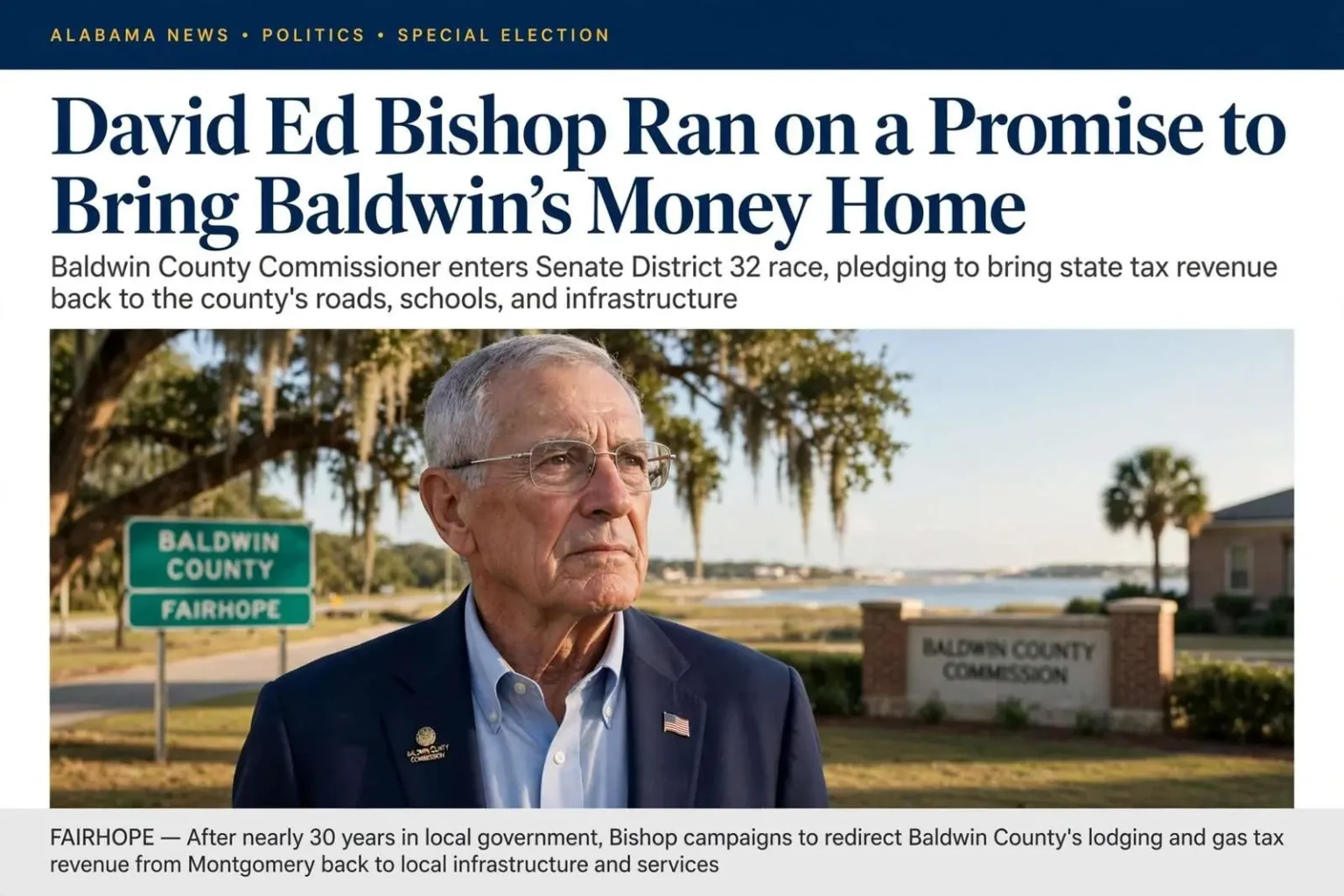
FAIRHOPE — Baldwin County Commissioner David Ed Bishop joined a crowded Republican field for the Alabama Senate seat vacated by Bradley Byrne, and he brought with him a grievance that many of his neighbors shared: Baldwin County, he argued, was sending far more money to Montgomery than it was getting back. His entry added a veteran of nearly three decades in local government to a race already drawing candidates from across the county’s rapidly growing eastern shore and central communities.
The special election followed Byrne’s departure from the Senate District 32 seat, which he left to pursue a campaign for the U.S. House of Representatives in southwest Alabama. Byrne’s exit triggered a scramble among Baldwin County Republicans, and the district — stretching across some of the fastest-growing territory in the state — became the setting for a contest shaped less by party ideology, in a county that votes reliably Republican, than by questions about growth, roads, schools and who could deliver from Montgomery.
Bishop made that argument the organizing idea of his campaign, which he summarized as a mission to “bring back what Baldwin County deserves.” “As a leader in growth for Alabama and one of the largest contributors in state lodging and gas taxes, Baldwin County needs a strong presence in Montgomery,” he said in announcing. “We should receive our fair share of state funding to re-build our roads, enhance our educational system and protect our citizens.”
The complaint he voiced was a familiar one in Alabama’s fastest-growing counties. Lodging taxes collected along the Gulf shoreline and fuel taxes paid at the pump across Baldwin County flow into state accounts, and local officials have long argued that the revenue those visitors and drivers generate is redistributed in ways that shortchange the jurisdictions that produce it. Roads clogged by seasonal tourism, school systems swelling with new subdivisions, and infrastructure maintenance bills that grow every year formed the practical substance behind the slogan.
Bishop’s pitch positioned him as the candidate of local government experience in a field that included statehouse outsiders. In Baldwin County, where commission seats and municipal offices have historically rotated among a small circle of civic leaders, the question of who best understands the machinery of growth policy — zoning, road funding, school capacity — became a central axis of the race.
Thirty years in local government
Bishop, a Fairhope resident, had served nearly five years on the Baldwin County Commission and, before that, 25 years on the Fairhope City Council — close to three decades of continuous local office. Few candidates in the field could match that length of service, and he cast that record as the qualification that separated him from his rivals.
“None of the candidates in the race for Senate 32 understand the issues facing Baldwin County better than Ed Bishop,” he declared. The claim invited comparison: rivals brought their own credentials to the race, from business backgrounds to state government experience, but Bishop argued that the day-to-day work of balancing municipal budgets, approving subdivisions, and negotiating with state agencies over roads was the training that mattered most for the Senate seat.
His years on the Fairhope City Council spanned the eastern shore town’s transformation from a bayfront community into one of the region’s most sought-after places to live, a period in which the council repeatedly weighed development pressure against the character of the town. He then moved to the county level, where the Commission’s jurisdiction over county roads, drainage and planning placed him at the center of the growth fights that define Baldwin County politics.
On fiscal questions, Bishop staked out a firm line. He said he had opposed every proposed new local tax and had pledged to look for revenue options that did not involve raising them. In a county whose voters have historically resisted new taxation even while demanding better services, that pledge aligned him with the dominant sentiment of the Republican primary electorate he needed to win.
Instead of new taxes, Bishop pointed to the state’s own revenue streams as the source Baldwin County should claim. Lodging taxes tied to the beach economy, gasoline taxes generated by the county’s commuter and tourist traffic, and the sales taxes that growth produces were, in his telling, Baldwin’s own money flowing to Montgomery — money that should return as road projects, school construction support, and public safety funding rather than being absorbed elsewhere in the state budget.
Growth, and the bill that comes with it
“There is no question that our tourism related growth has taken a toll on this community,” Bishop said. He argued that a large portion of the taxes collected in the county are transferred to Montgomery, and that the state should share more of that revenue back to help rebuild the infrastructure necessary to keep pace with the demands tourism and development place on Baldwin’s roads, utilities and services.
When he joined the commission, he recalled, the county was alarmed at the pace of growth and short of the resources to build the infrastructure that growth required. With Baldwin’s population projected to double by 2020, Bishop said, he and his colleagues had adopted a long-range strategic plan to manage it. The plan became a reference point in county government, laying out how the commission intended to sequence road improvements, manage development density, and coordinate with the county’s municipalities as subdivisions spread east from the bay and north from the shore.
Baldwin County’s growth in that era was among the fastest in Alabama, driven by a combination of retirees, Gulf Coast job growth, and the expansion of the Mobile metropolitan area across Mobile Bay. Communities such as Daphne, Spanish Fort, Foley, Gulf Shores and Orange Beach absorbed much of it, while unincorporated areas grew under the commission’s planning authority. Each new roof meant a new demand on county roads, sheriff’s patrols and school seats — and each carried the fiscal argument Bishop was making into the campaign.
The double-by-2020 projection framed the county’s debates for years, and it sharpened the point Bishop made about state support. Infrastructure built for one population cannot serve twice that number without replacement or expansion, and the costs of catching up fall on local budgets unless the state contributes. Bishop’s campaign essentially asked voters to elect someone whose first task in Montgomery would be to convert Baldwin’s growth into state investment.
Tourism’s role in that equation is distinctive. The county’s beaches along the Gulf of Mexico draw visitors whose spending generates lodging and sales tax revenue, but whose presence also wears on the roads, strains emergency services, and drives the seasonal traffic that residents experience on the county’s southern corridors every summer. Bishop’s argument that tourism revenue should flow back to the communities that host it reflected a recurring demand from Baldwin’s beach municipalities and the commissioners who represent them.
The race and the district
Senate District 32 covers much of Baldwin County, making it one of the most geographically coherent senate seats in Alabama: a single, fast-growing county whose interests are unusually aligned. That alignment gave the special election a local flavor that state races rarely have, with candidates measured against the same question — what they would bring home from Montgomery — rather than against statewide ideological divides.
Bradley Byrne’s tenure had given Baldwin County a visible advocate in the Senate, first as a local education leader and later as a two-year college system chancellor before entering the legislature, and his departure to seek the congressional seat raised the stakes of finding a successor who could match that advocacy. Whoever won would inherit a district with soaring infrastructure needs and an expectation, voiced across the county’s chambers of commerce and civic clubs, that the senator would treat state funding as the district’s primary deliverable.
Bishop’s three decades of officeholding also came with a record opponents could examine. Long-serving local officials accumulate votes — and positions — that rivals can mine, from past commission decisions to council votes in Fairhope. He answered that scrutiny by leaning on the strategic plan and his tax record, arguing that his positions had consistently favored restrained budgets and managed growth rather than the higher spending and higher taxes that growth pressure often produced.
The crowded field meant the primary would likely be decided by name recognition, organization and turnout, with a runoff awaiting the top two if no candidate reached a majority. Baldwin County’s Republican primary electorates in that era rewarded candidates with deep local networks — the civic clubs, chambers, churches and real estate communities where growth politics is discussed — and Bishop’s decades in office gave him exactly that kind of network across the county’s municipalities.
His framing of the race had a second edge as well: a challenge to his rivals’ local credentials. By declaring that none of the other candidates understood Baldwin County’s issues as he did, he made the election a referendum on experience rather than a contest of platforms, and dared voters to weigh nearly thirty years of meetings, budgets and road projects against whatever résumés the rest of the field carried.
Whatever the outcome, the campaign crystallized the fiscal argument that Baldwin County’s leaders have carried to Montgomery for years: that the state’s fastest-growing county, and one of its largest contributors of lodging and gas tax revenue, should see more of that money returned. Bishop’s candidacy put the claim at the center of a senate race, and his long record in county and city government made him one of its most credentialed messengers.
For voters in Fairhope, Daphne, Spanish Fort, Foley and the county’s beach communities, the special election offered a straightforward choice about priorities: which candidate they believed could convert Baldwin’s growth, and the taxes it generates, into the roads, schools and public safety funding the county’s strategic plan said it would need. Bishop’s answer was that the man who had spent thirty years managing that growth locally was the one equipped to fight for it in the Senate.