A Brilliant Surrender: The Provocative Case for Dissolving Mobile and Starting Over
With Mobile slipping to third-largest city in Alabama and annexation stalled, a satirical dialogue floats a radical fix: abolish the city entirely, fold it into the county and build metro government from scratch.
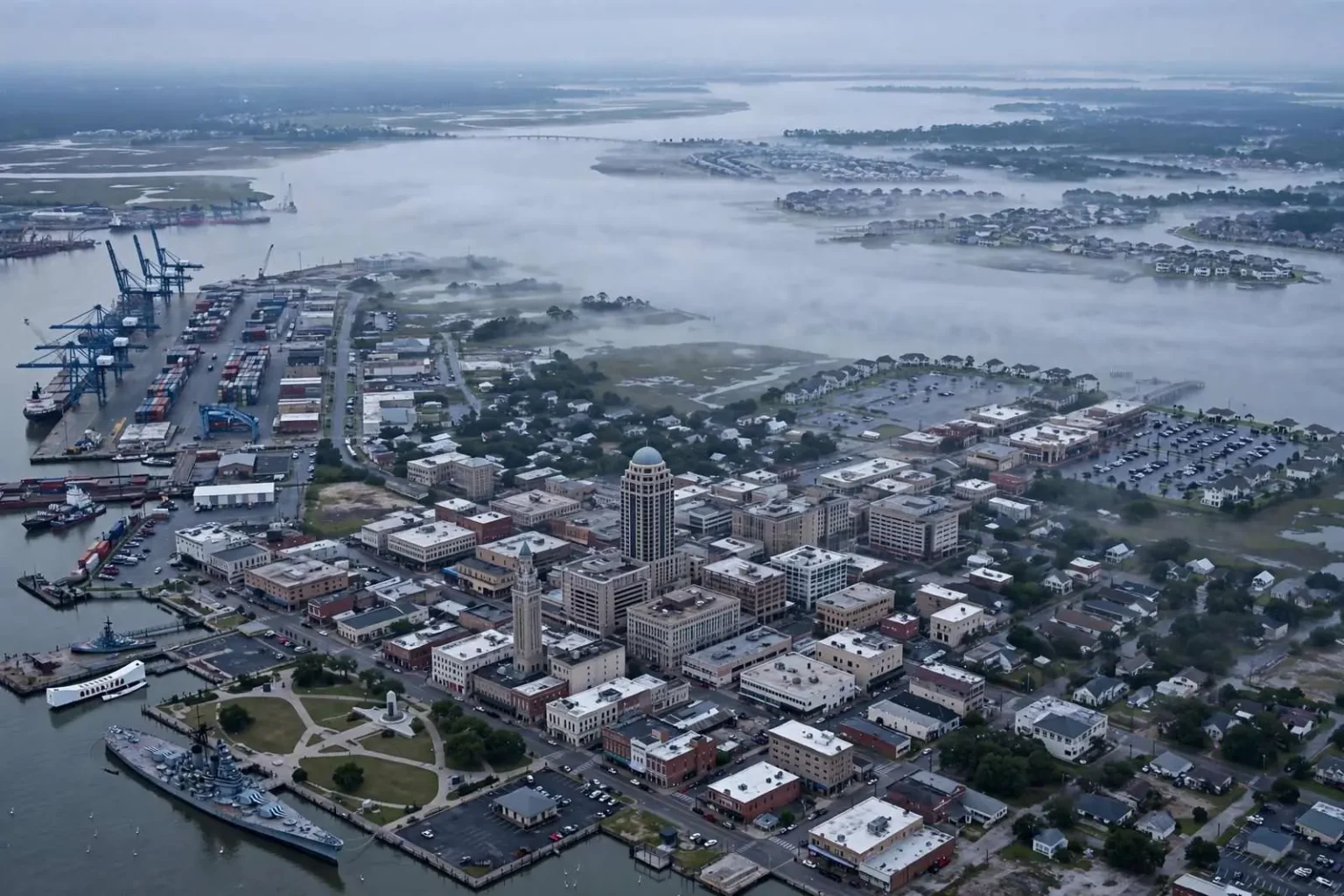
MOBILE — Mobile entered 2005 with an uncomfortable set of numbers to explain. Montgomery had passed it in population, leaving Mobile as the state’s third-largest city, with Huntsville visible in the rear-view mirror. Growth in the region was undeniable — but almost none of it was happening inside the city limits.
Instead it was landing across the bay in Spanish Fort and Daphne, and west of town in Semmes, Tillmans Corner and along the Schillingers Road corridor. Subdivisions and shopping centers were rising in places that had, so far, shown no interest whatsoever in joining the city that once claimed the region’s future as its own.
The census arithmetic behind that pattern told the story plainly. Montgomery’s climb past Mobile was not a surge of growth in the capital so much as a stall in the port city: Mobile’s population had held nearly flat for decades while its metropolitan region kept expanding outward. Huntsville’s aerospace economy was pulling it upward through the state’s rankings. And on the ground around Mobile itself, every new rooftop appeared in a jurisdiction — an unincorporated community, a neighboring city, or across Mobile Bay in Baldwin County — that collected the property taxes without inheriting the city’s service obligations.
That frustration was the subject of a pointed piece of political satire published this week, framed as an imagined conversation between a present-day Mobilian and the ghost of a departed civic figure. The device is playful. The argument underneath it is not.
The Diagnosis
The complaint is stated bluntly: the city is hemorrhaging people, and retail follows the people. Mobile is having a hard time paying for the level of service its residents once received on the cheap. Meanwhile, the unincorporated communities ringing the city insist they do not need to join — and, the piece suggests, do not entirely trust the city that keeps asking.
The fiscal logic underneath that complaint is the oldest problem in municipal finance. A city’s tax base is built on population and commerce, and when both drift outward, the fixed costs — police and fire coverage across a large footprint, aging water and sewer lines, street maintenance, pension obligations — stay behind. Mobile’s situation in 2005 was the textbook version: a central city covering miles of infrastructure for a population that had stopped growing, while the growth itself paid taxes to nobody in particular, since unincorporated areas buy county services on the cheap and pocket the difference.
Annexation has been Mobile’s standard answer for decades, and the results have been thin. Even small pockets bordering the city have declined to come in. The pitch has always been the same: lower this, better that, come on in, the water’s fine. It has not worked.
The annexation ledger explains why. Property owners in unincorporated areas pay lower municipal burdens and receive county-level services adequate to their needs, so the city’s offers — however sincerely framed — ask them to trade something for something they cannot see. The communities that have joined over the years have tended to be those seeking a specific benefit: police coverage for a booming subdivision, zoning control against an unwanted development, or utilities on terms the county could not match. Absent such leverage, the sales pitch has bounced off neighborhood after neighborhood, leaving the city’s map jagged with pockets that voted no.
The Old Cure: Metro Government
The imagined civic elder offers the answer that has circulated in Mobile political circles for a generation — consolidated metropolitan government. The outline he sketches is familiar to anyone who has followed the debate: A seven-member commission governing the whole of Mobile County. A ceremonial mayor, and, critically, a professional city manager hired by the commission — the commission’s chief function being to set policy and hire the manager who runs the government day to day.
The metro-government model borrows from the handful of American cities that actually adopted it. Jacksonville consolidated with Duval County in the late 1960s; Nashville merged with Davidson County; Indianapolis built its Unigov structure around the same idea. In each case the argument was the one Mobile’s ghost makes: stop competing jurisdiction by jurisdiction, put the whole urban region under one government, and let growth pay for services wherever it lands. The model’s critics have always answered that consolidation dilutes the central city’s voice, entrenches rural interests on a metro-wide board and freezes neighborhood identity into a bureaucracy too big to care.
In Alabama, the metro-government idea carries an extra obstacle the piece does not dodge: the state constitution’s rigidity. Changing the structure of county and city government requires constitutional amendment and legislative action, and Alabama’s Legislature has historically guarded local government structures jealously. A Mobile County consolidation would need a local amendment passed in Montgomery — a hurdle that has stopped the idea every time it has surfaced, regardless of which commissioners or mayors endorsed it in principle.
The New Cure: Start Over
The satire’s most provocative turn comes when the conversation moves past consolidation to something more radical: dissolving the city altogether and incorporating anew. The logic the piece lays out is a municipal version of bankruptcy reorganization. If Mobile’s problems are structural — a tax base that no longer matches its service obligations, a boundary map drawn by decades of failed annexations, a government built for a city that no longer exists — then the cleanest fix is not another patch but a fresh charter: dissolve, reorganize the assets and debts, and incorporate a new city with boundaries that match the population that actually wants to be governed.
It is a thought experiment, and the piece treats it as one — but the thought has a pedigree. Municipal dissolution and re-incorporation have happened in American government, generally in small jurisdictions, and the idea that a large city’s charter is a mutable instrument rather than an eternal one is a genuine strain in civic theory. What the satire gains by invoking it is candor: it admits that the incremental fixes — annexation here, a tax there, a redevelopment district somewhere else — have failed to change the trajectory, and asks whether the trajectory itself is the problem.
The imagined exchange between the present-day Mobilian and the civic ghost frames the choice in generational terms. The elder’s generation built the city’s institutions — the port authority, the utilities, the downtown civic machinery — and assumed the city would grow into them. The present-day Mobilian inherits institutions sized for a population that stopped arriving, and watches the region’s wealth accrue across the bay and along the western corridors without any mechanism to capture it. Between them sits the question the satire refuses to soften: is Mobile a city with problems, or a city whose structure is the problem?
What the region actually looked like
Grounding the argument in 2005’s map helps explain its force. Spanish Fort and Daphne, on the Eastern Shore of Baldwin County, were absorbing growth at rates that made them two of the fastest-developing municipalities in the state, with retail centers serving shoppers who commuted in from all over the region. West of Mobile, Semmes had grown into a substantial community with its own schools and identity; Tillmans Corner and the Schillingers Road corridor had filled with subdivisions and commercial strips that functioned as urban neighborhoods in every way but incorporation.
The port city itself retained assets no suburb could copy: the deepwater harbor and its industrial base, the downtown’s historic core, the medical district, the museums and Mardi Gras tradition that give Mobile its cultural identity. But assets require stewardship, and stewardship requires revenue. The satire’s diagnosis — that the city was financing yesterday’s footprint with tomorrow’s shrinking tax base — was the same conclusion business and civic groups in Mobile had been drawing in their own quieter ways for years.
The conversation the piece imagines also captures something about Mobile’s civic temperament. The city has produced generations of reform proposals — commissions, studies, blue-ribbon panels — and has watched most of them die in implementation. Satire is the genre that survives when earnest proposals do not, and its appearance in 2005 registered a mood: the ideas were all known, the obstacles were all known, and the only remaining option was to laugh at the impasse or propose something drastic.
The question the satire leaves standing
Two decades on, the piece reads as an artifact of a debate Mobile never resolved. The city has since invested in its downtown, welcomed major industrial expansions tied to the port, and watched its region keep growing in the same pattern the satire described — prosperity landing everywhere but the city limits. Baldwin County’s rise continued until its population growth made it one of the fastest-growing counties in America for stretches of the 2010s, and Mobile County’s unincorporated corridors kept filling in without joining the city.
The satire’s underlying claim — that a government should be sized to the community it actually serves — remains unanswered. Annexation still inches forward in occasional parcels; metro government remains a conversation starter rather than a ballot question; dissolution remains what it was in 2005: a brilliant surrender, proposed to make a point that no conventional proposal could land. The ghost who made it would probably say that was the idea.