Albert Lipscomb Sought a Return to the Senate Seat He Once Held
The former state senator and Baldwin County commissioner from Magnolia Springs entered the District 32 special election, campaigning on family values, opposition to gambling and managed growth.
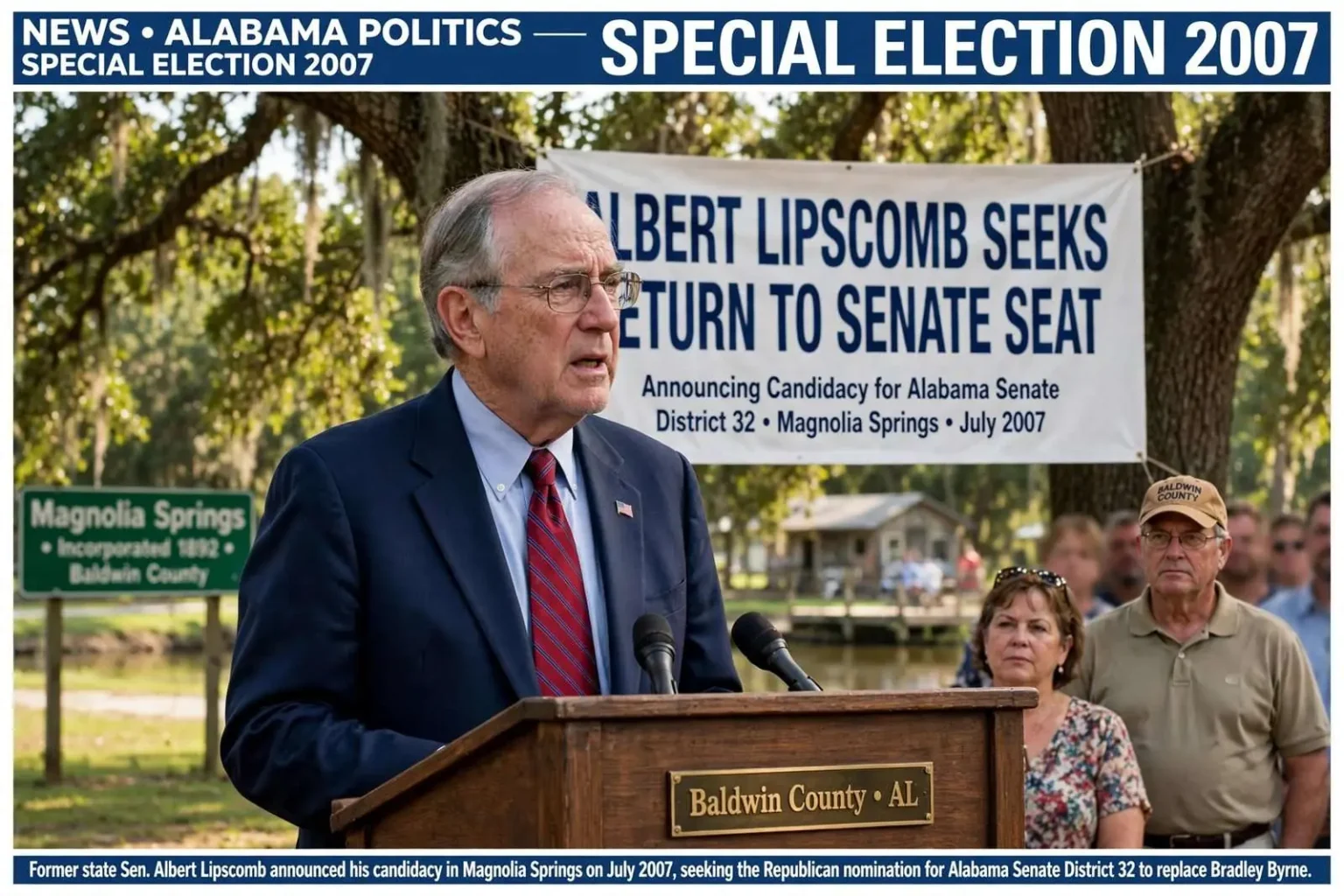
MAGNOLIA SPRINGS — Former state Sen. Albert Lipscomb announced that he would seek the Republican nomination for Alabama Senate District 32, entering a special election called to replace Bradley Byrne, who had resigned the Baldwin County seat to become chancellor of the state’s two-year college system. The announcement came from the small south Baldwin community of Magnolia Springs, and it set in motion a contest that would define Baldwin County politics through the summer.
Byrne’s move to the chancellor’s office had created one of the most consequential vacancies in south Alabama. Senate District 32 covers the heart of Baldwin County, one of the fastest-growing counties in Alabama, and its senator sits in a Montgomery chamber where Baldwin’s needs — roads, schools, coastal policy — compete with the rest of the state for attention and money. Whoever won the seat would inherit it mid-term, with no ramp-up period, in a district where growth issues dominated every conversation.
Lipscomb was seeking to reclaim ground he had held before. First elected to the state Senate in 1989, he represented Baldwin County for three terms. In June 2004 Gov. Bob Riley appointed him to the Baldwin County Commission following the death of Commissioner Mary Frances Stewart; Lipscomb won a full two-year term that November and served as chairman of the commission in 2006. Few candidates could claim both a Senate record and a county commission chairmanship; the combination covered state-level issues and the day-to-day infrastructure questions — roads, sewers, zoning — that dominate Baldwin’s rapid growth.
A case built on experience
“I believe my experience at the state and local levels of government makes me uniquely qualified to serve the people of Baldwin County once again,” Lipscomb said in announcing his candidacy.
He offered a diagnosis of the state’s politics that reached well past the county line. “What’s wrong in Montgomery is the same as what’s wrong in Washington — we have lost our moral compass,” he said. “Throughout my career in the Senate, I fought for the sanctity of the family, rights of the unborn and against the expansion of gambling.”
The three themes — family, the unborn and gambling — staked out the social conservative ground that defined Alabama Republican politics of the era, and Lipscomb’s framing presented his Senate career as a record rather than a promise. In a district where the Republican primary would effectively decide the election, that record was his principal currency.
Gambling was not an idle issue in Alabama in 2007. Electronic bingo halls were spreading across the state under a patchwork of local constitutional amendments, and the fight over whether they were legal — and who profited from them — would consume the Legislature, the attorney general’s office and the courts for years afterward. A candidate’s position on gambling was, in practice, a declaration of which coalition he belonged to: the anti-gambling wing that saw the bingo halls as casinos by another name, or the factions that viewed them as economic development for struggling counties. Lipscomb’s long public stand against expansion left no ambiguity about his side.
Growth, jobs and schools
Lipscomb paired the social conservatism of his Senate record with a growth agenda aimed squarely at a county whose population was rising faster than its infrastructure. “I will work to promote responsible and managed economic growth, to create jobs and to provide a top-notch education system for our children,” he said.
That combination — welcome the growth, manage its consequences — was the common ground of nearly every candidate in the race. Baldwin County had spent the decade absorbing new subdivisions, new schools and new traffic, and its roads and classrooms were straining under the load. The county’s growth was among the fastest in Alabama, driven by its beaches, its proximity to Mobile’s job market and the migration of retirees and families to the Eastern Shore and the coast. Every candidate understood the political arithmetic: the newcomers were the electorate, and the questions they brought — when will the road be widened, when will the school be built — were the questions the campaign had to answer.
Managed growth, in Baldwin’s context, meant a specific set of fights. The county commission and the municipalities along Highway 98 and the Eastern Shore had spent years wrestling with zoning, sewer capacity and the cost of extending services down roads that had been farmland a decade earlier. A state senator could not fix those problems from Montgomery, but the senator controls access to state road money, to the legislative delegations that shape local legislation, and to the seniority that gets a county’s calls returned. Lipscomb’s pitch was that he had already made those calls and knew where the levers were.
Deep local roots
Lipscomb came from a family that had farmed in Baldwin County for more than a century, a lineage that carried real weight in a county where agriculture remained a serious industry even as tourism and residential development reshaped the coast and the Eastern Shore. The county’s farm economy — cattle, sod, row crops and the nurseries that supplied the region’s landscaping trade — survived alongside the beach-driven growth, and a family name attached to a century of farming told voters something a campaign ad could not: that the candidate’s stake in the county predated the boom and would outlast it.
He was married to the former Rhonda Dudley. The couple had two children, Mandy and Bart, and a daughter-in-law, Jessica. The Lipscombs were members of Vernant Park Baptist Church, where he served as a deacon. For a candidate whose campaign rested on moral compass language, the biography was not incidental. Church membership, family and farming roots were, in Baldwin County’s political culture, the credentials that anchored everything else.
A crowded Republican field
The special election was set for Aug. 7, and Lipscomb was not the only Republican who saw an opening. State School Board member Randy McKinney of Gulf Shores and businessman Trip Pittman of Montrose had already announced. Others would follow, and by midsummer the Republican ballot would carry five names. In a district where the Republican nomination was effectively the election, the size of the field mattered as much as the identity of the candidates.
With five contenders splitting a small summer electorate, a runoff was widely expected — and in a runoff, the candidate with the most devoted base has an advantage that money cannot always overcome. Alabama’s runoff system requires a candidate to win a majority of the primary vote to claim the nomination outright; failing that, the top two advance. A five-way field almost guarantees the runoff, and a runoff in a special election held in early August, when much of the county’s electorate would be at the beach or out of town, becomes a turnout exercise: whoever brings their people to the polls wins, regardless of what the polls or the fund-raising totals said in June.
That was the calculation behind Lipscomb’s candidacy. He entered the race with less money than several of his rivals and with the frank acknowledgment from Baldwin political veterans that his fundraising would lag. What he had instead was three terms of name identification and a conservative constituency that could be counted on to show up in August, when much of the county’s electorate would be at the beach or out of town. Name identification is the currency that survives a crowded ballot: when voters face five unfamiliar choices, the name they have known for fifteen years gets the benefit of the doubt, and no amount of an opponent’s television spending fully erases that advantage in a short campaign.
Whether that was enough to survive a five-way primary was the question Baldwin Republicans spent the summer arguing about. The race presented a classic tension between money and base: better-funded candidates could introduce themselves to the county’s fast-growing subdivisions, where newer residents had arrived after Lipscomb’s Senate tenure ended, while the former senator worked the precincts and communities — the volunteer fire departments, the church groups, the farming families — where his name had never faded. Special elections compound the uncertainty, because no one can say with confidence who will turn out for an Aug. 7 vote that arrives in the middle of vacation season.
For the district itself, the stakes went beyond the personalities. Senate District 32’s seat would be occupied for the remainder of the term by someone who would vote on the state budgets that fund Baldwin’s schools, on transportation funding that touches the county’s congested corridors, and on the coastal and growth-related legislation that reaches Montgomery through the local delegation. Bradley Byrne’s resignation had handed the county’s Republicans a rare chance to debate those priorities openly, and the five-way field guaranteed the debate would run all summer — at fish fries, civic club meetings and the front porches of a county where, in 2007, politics was still conducted largely in person.
Whatever the outcome, Lipscomb’s entry ensured the race would carry a thread of continuity through the change. In a district absorbing new subdivisions at a remarkable pace, the question of whether the newcomer majority would embrace a candidate from a century-old farming family — or look instead to the next generation of Baldwin Republicans — was itself a fair measure of how much the county had changed, and how much it hadn’t.