Pro-Annexation PAC Raised More Than $81,000 as West Mobile Vote Neared
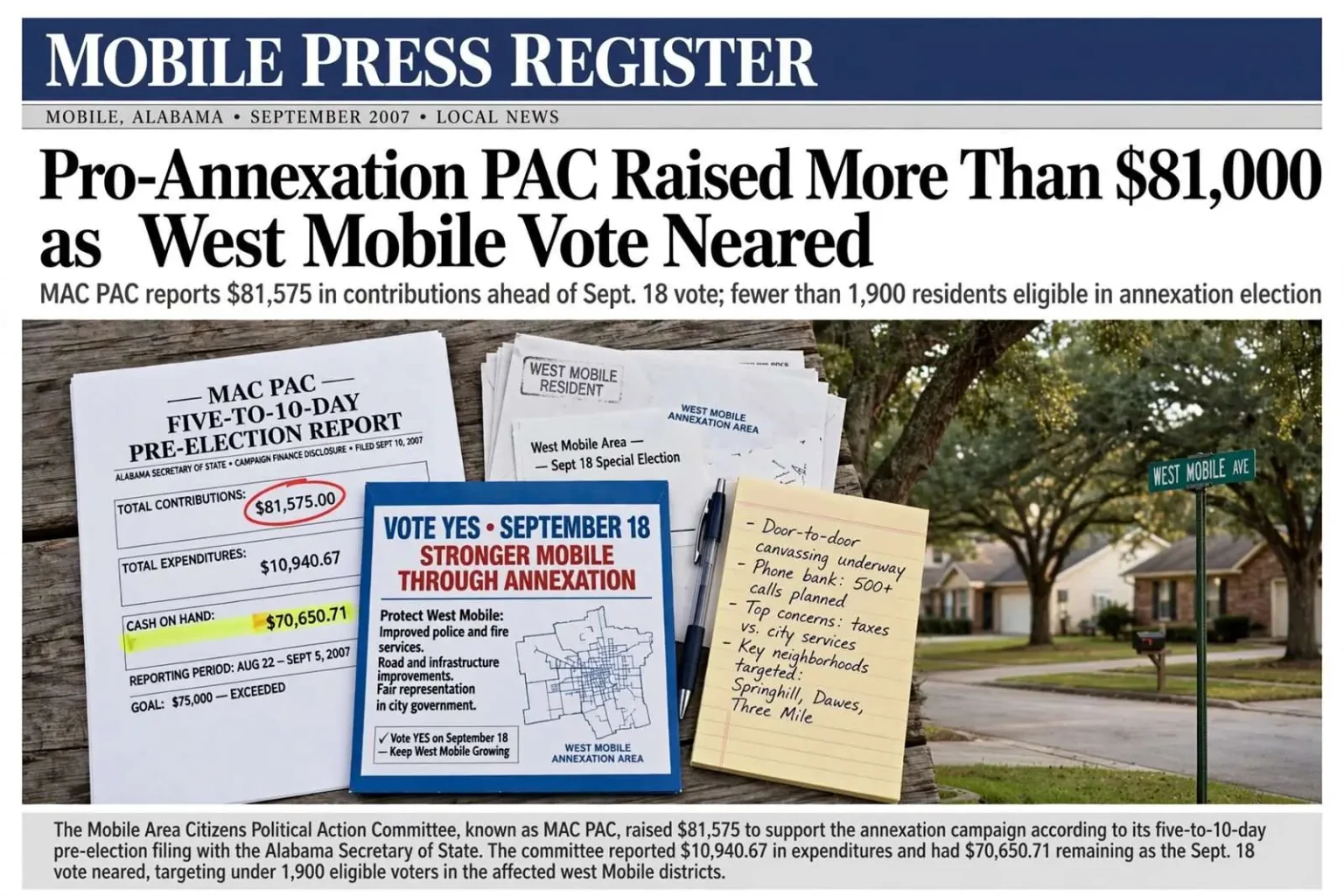
The Mobile Area Citizens Political Action Committee blew past its $75,000 goal, reporting $81,575 in contributions as the city campaigned for its west Mobile annexation vote like a political race.
In past attempts to expand its boundaries, the city of Mobile discovered that residents outside the city limits were not buying what it was selling. For the 2007 annexation push, the city changed tactics and treated the effort like a political campaign — with a political action committee, private fundraising, scientific polling, door-to-door canvassing and an organized effort to court prospective new citizens.
The vehicle for that effort was the Mobile Area Citizens Political Action Committee, known as MAC PAC, which became the fundraising and messaging arm of the annexation campaign as the Sept. 18 vote approached. The committee’s disclosures, filed with the Alabama secretary of state’s office, offer the clearest picture of who wanted the annexation to pass and how much they were willing to spend to make it happen.
Past its goal
According to the records, MAC PAC exceeded its $75,000 goal, reporting contributions of $81,575 in its five-to-10-day pre-election financial disclosure. Expenditures stood at $10,940.67, leaving a balance of $70,650.71 as the vote approached — a substantial war chest for an election in which fewer than 1,900 registered voters were eligible to participate.
The arithmetic behind that spending is worth pausing over. Spreading even the expenditures already made across fewer than 1,900 eligible voters works out to more than five dollars per voter, a figure that would be recognizable in a big-city mayoral race but is extraordinary for a special annexation election. And with roughly $70,000 still unspent, the committee had barely opened its account; the final days of the campaign, when direct mail, phone banks and canvassing reach their peak, were still ahead of it.
Why spend that much on so small an electorate? Because the election’s outcome would be decided by turnout in a handful of west Mobile neighborhoods, and because the stakes for the city ran well beyond one vote. An annexation that added thousands of residents to the city’s rolls would widen its tax base, its population count and its claim on federal and state funding — and a loss would likely end boundary expansion talk for years.
Who paid for the campaign
The donor list read as a roll call of Mobile’s business, legal and civic establishment. The largest single contribution came from Mobile Auto-PAC at $15,000, a reminder of how much of the region’s retail economy — and how much of the sales tax base the annexation would add — was represented in the car business. Organized labor and public employee groups also weighed in on the city’s side: the Mobile Firefighters Association gave $5,000, as did the United City Workers Coalition.
Engineering firm Volkert & Associates contributed $3,000 and the Frazer Lanier Co. gave $2,500. Both firms do substantial public-sector work, and both had reason to view a larger city as a larger client — a pattern that runs through the entire list of contributors, which mixes contractors, law firms, bankers, real estate interests and individual business owners.
The long list of $1,000 donors included Bestor and Katheryne B. Ward, David Cooper, J.H. Faulkner, E.B. Peebles III, John D. Peebles, Metcalfe & Company along with Adam and Matt Metcalfe, Richard Davis, Rime Investments, Robert Edington, Harris V. Morrisette, L.J. Friedman, MBI Inc., Phillip S. and Odette H. Tyus, Charles E. Story, the James Buskey Campaign Fund, Sonny Callahan and Associates, retired Maj. Gen. J. Gary Cooper, Riley Smith, Robert Donlon, James Watkins, Mobile Air Center, John C.H. Miller Jr., Susan Miller, and the law firm of Galloway, Wettermark, Everest, Rutens & Gaillard.
Reading the names, one sees the city’s interconnected leadership class at work. There are partners from major law firms, executives from banking and investment houses, developers and builders, automobile interests, figures from Mobile’s port and maritime economy, and even a campaign fund belonging to a sitting state legislator. Some donors gave for civic reasons — a bigger, stronger Mobile — while others had direct business before the city or interests that a larger city would serve. In a town where the same names recur on charity boards, economic development boards and political committees, the list was less a coalition than a consensus.
What the money bought
The campaign model MAC PAC pursued was lifted straight from electoral politics, because the organizers understood that annexation elections are won or lost like any other election. Scientific polling identified which arguments moved the target neighborhoods and which triggered resistance. Door-to-door canvassing put familiar local faces at the doorsteps of the few households that would actually vote. And the courting of “prospective new citizens” — the residents whose addresses would move inside the city limits if the measure passed — treated annexation as a product that had to be sold neighborhood by neighborhood.
The pitch itself mattered, because earlier attempts had failed on exactly the points opponents always raised. Residents outside the city have historically worried that annexation means city taxes without city benefits, loss of fire protection they were satisfied with, and zoning rules written for downtown rather than for suburban subdivisions. The 2007 campaign’s polling and canvassing were designed to find out which of those objections actually moved voters and to answer them directly, with money available to put the answers in mailboxes.
Why the election was so small
The eligibility of fewer than 1,900 registered voters explains both the campaign’s intensity and its cost-effectiveness. Annexation in Alabama is decided by the residents of the territory proposed for annexation, not by the city as a whole, so the electorate consisted only of residents of the affected west Mobile areas. A relatively modest sum could reach every one of those households repeatedly — something no citywide campaign could manage.
That also explains why the fundraising total kept climbing past its goal. With the election so cheap to influence per voter, every additional thousand dollars bought meaningful saturation in the precincts that would decide the outcome. The committee’s $81,575, aimed at under 1,900 voters, was in practice one of the most efficient per-capita political investments Mobile had seen.
The stakes for the city
The annexation push was about more than lines on a map. Mobile’s population had been essentially flat for decades while the population outside its limits grew steadily, and every suburban subdivision meant households shopping in the city, driving its roads and sometimes working for it — without paying city taxes. Annexation offered a way to capture some of that growth, broaden the tax base, and strengthen the city’s standing in state and federal funding formulas that key off population.
For the areas voting on the question, the calculation ran the other way. Residents weighed city services — police, fire, garbage pickup, street maintenance — against the taxes that came with them, and many concluded over the years that they were better off as they were. That accumulated skepticism was what earlier annexation attempts ran into, and what the 2007 campaign’s political machinery was built to overcome.
The pattern the money reveals
The MAC PAC disclosures also document something larger about how Mobile gets things done. Annexation is a public question decided by public vote, but the campaign behind it was financed privately, by the same companies and individuals who fund the city’s civic institutions. There is nothing improper in that — Alabama law allows PACs to support or oppose ballot measures, and disclosure filings make the support visible — but the pattern explains why growth debates in Mobile often feel one-sided: the resources of the establishment are organized on one side, and the opposition is made up of neighborhoods whose main asset is their votes.
It also shows the limits of money in a low-turnout election. Campaign spending can raise name identification and turn out friendly voters, but it cannot make someone want to be annexed. If the neighborhoods’ resistance ran deeper than information, the committee’s $81,575 would test whether persuasion or sentiment decided the day on Sept. 18.
What the disclosure rules allow
The five-to-10-day pre-election report MAC PAC filed is one of the standard disclosure points in Alabama campaign finance law, designed to give voters a look at who is funding each side before election day. The committee’s transparency — reporting contributions and expenditures in detail — stands in contrast to some of the state’s political spending, where money moves through layered committees and the original donors are hard to trace.
In this case, the record is unusually complete: a named committee, a stated goal, a donor list full of identifiable names, and a balance that shows how much firepower remained. Whatever the voters decided on Sept. 18, they did so in an election where the financial playbook of one side was laid out in public, dollar by dollar — and where the city of Mobile, through its allied committee, was finally running the kind of campaign its critics said past annexation efforts had lacked.