Five Republicans, One Baldwin Senate Seat and No Clear Favorite
With the special primary less than four weeks away, Alabama's interest groups had spread their money across five candidates in District 32, and the state's political veterans could not agree on a winner.
BAY MINETTE — With less than four weeks to go before Baldwin County voters chose a successor to Bradley Byrne in Alabama Senate District 32, one thing was clear: the state’s major interest groups had not settled on a single horse.
Real estate, forestry, trial lawyers, educators and evangelical organizations had all placed their bets, and they had not placed them together.
The result was a five-way Republican contest in which nearly every candidate had a plausible route to a runoff and none had a clear path to an outright majority.
Byrne had accepted Gov. Bob Riley’s offer in May to take over as chancellor of the state’s two-year college system, vacating a seat that, in the most Republican county in Alabama, would effectively be decided in the GOP primary.
Former Prichard Mayor A.J. Cooper, who was practicing law on the Eastern Shore, had qualified as a Democrat and would face the Republican nominee in the fall.
The scramble that followed Byrne’s exit compressed an entire political cycle into a summer. Senate District 32 is essentially Baldwin County — the swath of growing municipalities and coastal communities from Bay Minette through Fairhope, Daphne and Spanish Fort down to Gulf Shores and Orange Beach — and its Senate seat had become one of the most reliable Republican positions in the state. Byrne’s move to the chancellorship of the Alabama Department of Postsecondary Education’s two-year college system, at the governor’s request amid the early stages of the two-year college scandal, set the calendar: a special election with a compressed qualification window, little time for candidates to build name recognition, and a primary electorate that would decide everything.
The field
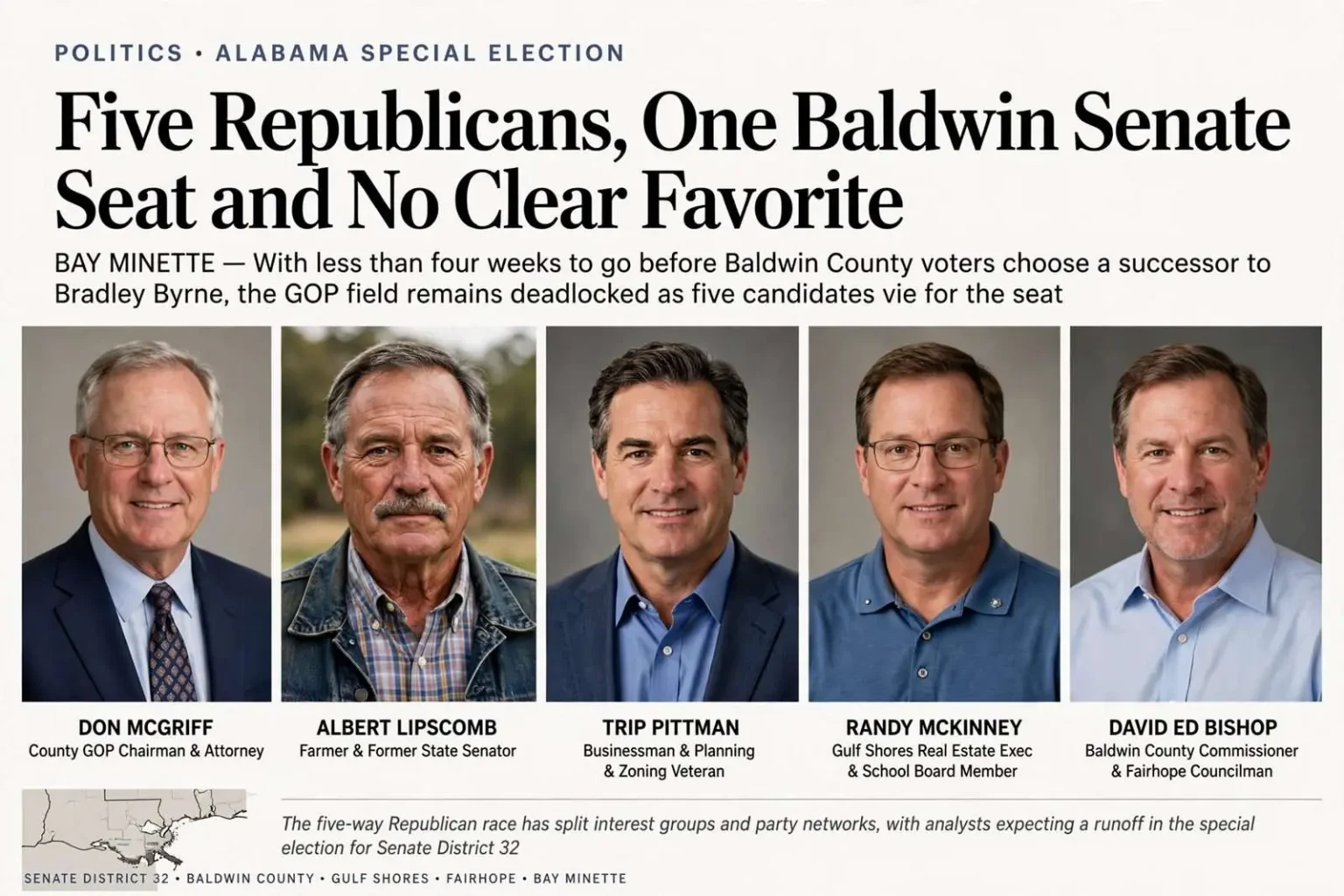
The five Republicans were:
Don McGriff, the county GOP chairman, an attorney, a former school board member and a onetime Republican nominee for lieutenant governor; Albert Lipscomb, a farmer, former state senator and former county commissioner who had also run unsuccessfully for Congress; Trip Pittman, a businessman whose appointed service included the Baldwin County Planning and Zoning Commission and the Alabama Commission on Higher Education; Randy McKinney, a Gulf Shores real estate executive, attorney and state school board member; David Ed Bishop, a Baldwin County commissioner and longtime Fairhope city councilman.
Each brought a different map of support to the same county. McGriff carried the party organization he chaired; Lipscomb carried name recognition from years in Montgomery and on the county commission; Pittman carried the business community and the appointed boards that connect Baldwin County’s growth economy to state policy; McKinney carried the southern end of the county, where real estate development is the dominant industry, along with the education constituency of a state school board member; and Bishop carried Fairhope, where his council service had made him a fixture of one of the county’s most engaged municipalities.
The short campaign amplified every difference between them. Special elections draw narrow electorates — engaged party regulars, municipal activists and the voters with a direct stake in the office — and five weeks leaves no time for the door-knocking, sign campaigns and name-building that county races usually receive. Each candidate therefore leaned on the constituency he already had: McGriff on the party apparatus, Lipscomb on older Baldwin networks, Pittman on the development and business community, McKinney on the coast and his education record, and Bishop on Fairhope’s dense, civically active voter base. Turnout in such elections is also small enough that a few hundred votes in a single municipality can decide a runoff berth — which made Fairhope, Gulf Shores and the Eastern Shore’s growing subdivisions the real battlegrounds of the summer.
Political veterans consulted about the race agreed on one point almost unanimously: with five candidates, any one of whom could plausibly take 20 percent, a runoff was close to a certainty.
Alabama law requires a majority to win a primary outright, and five viable candidates splitting a Republican electorate of Baldwin County’s size made arithmetic dictate the same conclusion from every direction. The real contest, then, was not for first place on primary night but for second — the right to advance into a head-to-head runoff against whoever led. A candidate who consolidated even a modest geographic base could reach the runoff; a candidate who spread his appeal too thin could finish first and still lose the two weeks that followed.
The handicappers disagree
Beyond that, the assessments diverged sharply.
A veteran Baldwin GOP official was blunt: “McGriff has no chance and Lipscomb’s not doing much better. The top three are McKinney, Pittman and Bishop in that order.”
That reading reflected the county’s changing geography. Baldwin County’s population growth over the previous two decades had shifted its political center of gravity south and east — toward Gulf Shores, Orange Beach, Fairhope and the Eastern Shore communities whose new residents arrived without the older networks of family and party that once organized county politics. In that electorate, candidates tied to development, education and municipal government carried advantages that a party chairman’s institutional position and a former senator’s Montgomery record did not automatically confer. Lipscomb’s history in the Senate gave him the deepest résumé in the field, but the same history reminded voters of an earlier era of Baldwin politics, before the growth wave remade the county.
Other observers pushed back on the dismissal of the lower-tier candidates. A five-way field punishes complacency, and the voters least engaged with the race — the ones who turn out for a special primary in modest numbers — often default to the most familiar names. Lipscomb, who had held countywide and district offices for years, and McGriff, whose party role put him in every Republican gathering in the county, had forms of visibility that polling in a compressed special election could easily miss. The official’s confident ordering was one analyst’s ranking, not a measurement, and the compressed calendar left little time for anyone’s ranking to be tested by the usual months of advertising and organization.
The interest groups scatter
The divided loyalties of the county’s and the state’s interest groups added another layer of unpredictability. Real estate interests split between candidates whose business backgrounds promised development-friendly service; forestry interests, a longstanding force in Baldwin County’s rural interior, weighed candidates’ records on land and taxation; the trial lawyers’ organization, nominally opposed to most of the Republican field’s positions on tort issues, nonetheless evaluated which candidate would be most reasonable in committee; educator organizations looked hardest at the one sitting member of the State Board of Education; and evangelical organizations, influential in a county where church attendance shapes both civic and political life, weighed the field’s social conservative credentials.
None of those groups coalesced. In most Alabama special elections, a single well-funded endorsement — from the business chamber, from an education association, from a social conservative network — can consolidate a field quickly. In District 32 that summer, the endorsements went different directions, and the candidates’ fundraising reflected the split: each attracted real money, none attracted enough to dominate the airwaves in the short window before the primary. That evened the playing field in a way that made the runoff scenario even more likely — and made the second-place finisher’s position more valuable, since the two weeks of a runoff favor whoever can still afford to communicate.
What the seat meant
The winner would inherit more than a safe seat. Baldwin County’s Senate delegation position carried outsized weight for a single county: the district’s senator sat at the intersection of the issues driving the county’s transformation — school funding for one of the fastest-growing systems in the state, highway capacity along the U.S. 98 and Alabama 181 corridors, coastal policy touching Gulf Shores and Orange Beach, and the constant pressure of development on farmland in the county’s interior. Growth had made Baldwin’s delegation a player in Montgomery despite the county’s small historic share of legislative seats, and whoever filled Byrne’s chair would step into that role midstream.
The fall contest, meanwhile, awaited the survivor. A.J. Cooper’s qualification as a Democrat gave the general election a genuine name — a former mayor of one of Mobile County’s largest cities, now practicing law on the Eastern Shore, the western edge of the district’s territory. But the arithmetic of a county that had gone reliably Republican in every race on the ballot left Cooper facing a steep climb, and both parties understood the real election to be the Republican primary or its runoff. That reality shaped everything about the summer’s campaign: five Republicans spending their resources against each other, interest groups hedging, and a county’s political class reading the field in the language of runoffs rather than victories.
With four weeks left, the only consensus was the one everyone had reached at the start: a runoff was coming, and nobody could say with confidence who would be standing in it.