Both Baldwin Senate Runoff Campaigns Raised More Than $100,000 in Final Weeks
Pre-election disclosures showed Randy McKinney raising more than $140,000 and Trip Pittman more than $130,000 in the closing weeks of the Baldwin County Senate District 32 Republican runoff.
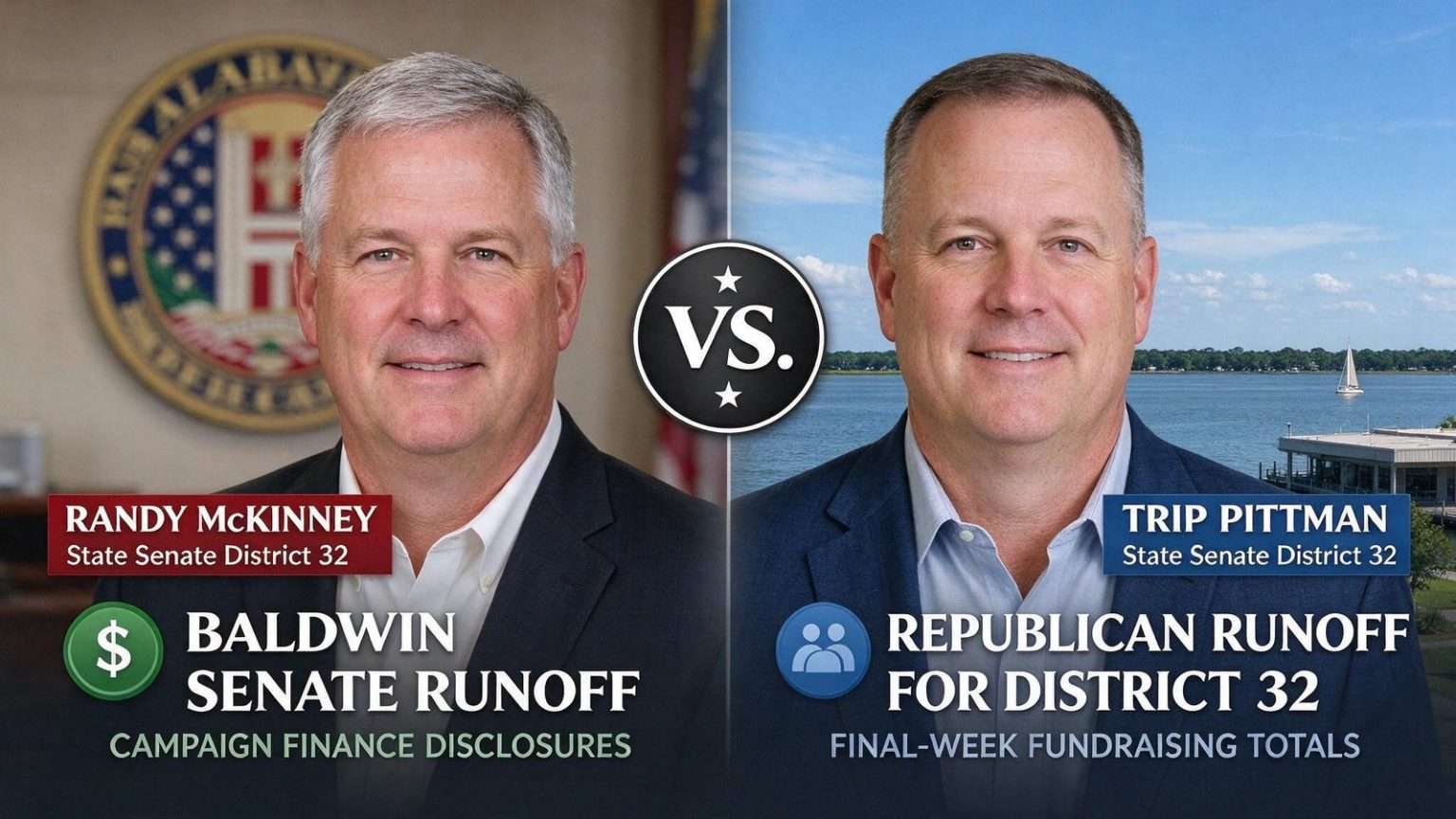
Both candidates in the Republican runoff for Baldwin County’s District 32 state Senate seat raised more than $100,000 in the five and a half weeks leading into the final stretch, according to campaign finance disclosures filed ahead of Tuesday’s election. For a legislative seat in a single county, the totals were striking — a measure of how hard-fought the contest had become and how much value both campaigns placed on the outcome.
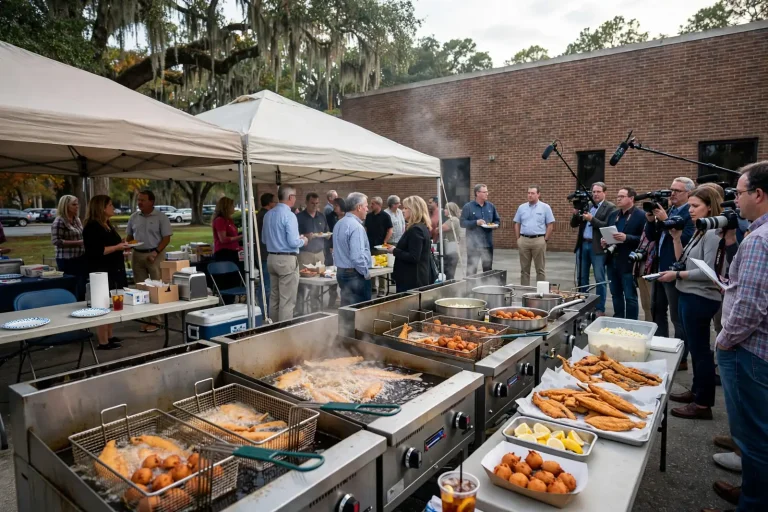
Randy McKinney, a south Baldwin real estate executive and state school board member, reported more than $140,000 in cash and in-kind contributions for the period. Trip Pittman, an Eastern Shore businessman making his first run for office, reported receipts of more than $130,000, a figure that included cash, in-kind contributions and a $25,000 loan he made to his own campaign. Neither man entered the final days at a financial disadvantage; the difference between them lay in where the money came from.
The winner would face Eastern Shore attorney A.J. Cooper, a former mayor of Prichard who claimed the Democratic nomination without opposition, in the Oct. 16 general election. In a county where the Republican nomination had become the decisive contest, the runoff’s victor was widely regarded as the heavy favorite to hold the seat.
The seat came open when Bradley Byrne resigned to accept Gov. Bob Riley’s appointment as chancellor of the state’s scandal-plagued two-year college system. The appointment pulled the sitting senator out of office mid-term and set off the special-election scramble that followed, drawing a field of ambitious local Republicans into a race none of them had planned for when the year began.
McKinney’s ledger
McKinney entered the reporting period with $45,107.15 on hand, raised almost $121,000 in cash contributions and spent $125,895.32, leaving more than $40,000 in the closing days. The pace of spending told its own story: television time, direct mail and runoff-season advertising in the Mobile market do not come cheaply, and the reports showed both campaigns had burned through cash at nearly the rate they took it in.
His donor list was heavy with Montgomery-based political action committees — a fact his opponent made a campaign issue. Progress PAC, the political arm of the Business Council of Alabama, gave $15,000, matched by Alabama Realtors PAC at the same figure. Other PAC money included Trux-PAC, Home Care PAC, VEND PAC, BizPAC and the Retailer of Alabama Political Action Committee at $5,000 each; Alabama Medical PAC at $5,000; and contributions from CAN PAC, FAX PAC, EDPAC, BIPAC, Coastal PAC, INPAC, Sun PAC, AlabaPAC, CABLE PAC, Victory PAC and the Alabama Propane Political Action Committee.
Public Affairs Strategies received multiple payments and also appeared as a contributor at $3,500, $1,500 and $1,000. FarmPAC provided an in-kind contribution of $17,745.04 for consulting and polling — one of the larger single items in either campaign’s report, and a sign of how much professional political infrastructure was working the race from Montgomery.
Individual and business donors included Robert M. Hodgson, Sherry W. Dinges, T.E. Jernigan, William E. Smith Jr., Albert L. King, the Alabama Poultry Trust, Allen Long and Tom Coker & Associates. But the institutional money was the defining feature of the report, and everyone following the race understood what it meant: McKinney had the backing of the established interest groups whose fingerprints appear on legislative campaigns across the state.
The runoff itself was the second act of a special election that had already winnowed the field once. Alabama law sends the top two vote-getters to a runoff when no candidate wins a majority, and in a race with several credible local names on the ballot, a second round was all but inevitable. Runoff electorates are small — a fraction of the voters who show up in a general election — which makes each campaign’s identification of supporters worth real money, and helps explain why both sides were spending at full tilt five and a half weeks out.
It also helps explain the presence of so much Montgomery money. A single seat in a 35-member Senate may look like small stakes, but for the interest groups whose names filled McKinney’s report, a friend in the chamber is worth the cost of a special election many voters will barely notice. The Alabama Realtors PAC and the BCA’s Progress PAC did not give $15,000 each to influence a single county; they gave it to influence a Senate where committee assignments, local legislation and the flow of state money are decided by majorities built two seats at a time.
For Baldwin County’s own political class, the race was a generational sorting. The county’s delegation had been built by men who served for decades, and the open seat offered the first realistic opening in years for a new name to begin the same long tenure. That is why both campaigns raised money at a pace usually reserved for congressional contests: the winner would arrive in Montgomery with seniority clock running from the day he was seated, in a county whose population growth was certain to bring redistricting attention with it.
The reporting requirements themselves shaped what voters saw. The pre-election filings itemize every contribution above the disclosure threshold, which is why the ledgers in this race read like a directory of the county’s businesses on one side and the state’s PAC universe on the other. Voters who cared to look could trace exactly which Montgomery committees and which Fairhope dining rooms were financing each campaign — a level of transparency that gave the runoff its unusual documentary record before a single ballot was counted.
Pittman’s ledger
Pittman began the final 45 days with $51,602.03, took in about $133,500 and spent $120,081.22, leaving $62,891.81 as Election Day approached — a larger cash reserve than his opponent held. Having more money in the bank in the closing days mattered less in a runoff already saturated with advertising, but it meant the first-time candidate had not overdrawn his campaign to stay competitive with an opponent backed by the capital’s PAC network.
His list looked different in character: long, local and dominated by Baldwin County names and family businesses rather than capital-city PACs. Contributors at $2,000 or more included Julio Corte, Robert E. James, Roger James, W.B. Simmons, Mark B. Reed, Alan Boan, John White-Spunner, Angus R. Cooper II, Curtis and Dawn Pilot, Larry C. Tomlinson, Louis Mapp, M. Stephen Dampier, Nicholas Gill, Tim Todd and the Ogletree Family Trust.
Hundreds of smaller donations came from Baldwin businesses and residents: Simon Farms, Baldwin Road Builders, Gulf City Body & Trailer Works, Malbis Plantation, Pittman Tractor Co., Robertsdale Nursing Home, Highway 181 Mini-Storage, Sand & Clay Inc., Porter Builders, Geo-Surveying, Big Red Containers, Wilson Stores, Equipment Sales of Alabama and Ben M. Radcliff Contractor, among many others. The geography of the list covered the whole county — Fairhope and Daphne on the Eastern Shore, the agricultural south, the industrial corridor along the bay — in a way the Montgomery PAC ledger could not.
The self-loan also deserves note. A $25,000 loan from the candidate to his own campaign is common in legislative races, but in a contest fought over who “owned” the seat, it let Pittman claim a share of his own funding independent of both Montgomery and the local establishment. Whatever else the reports showed, they did not show a candidate dependent on any single source — PAC money on one side, family businesses and friends on the other, and a personal stake at the bottom of both ledgers.
The argument underneath the numbers
The contrasting reports gave each campaign its closing message. Pittman used the PAC totals to cast McKinney as the candidate of Montgomery, arguing that a state senator who owed his seat to the Business Council of Alabama and the Realtors would answer to those groups before he answered to Baldwin County. McKinney’s backers pointed to institutional support as evidence he could get things done in a Senate where Baldwin County had struggled to win its share — connections, in that telling, being exactly what a fast-growing county needed in its senator.
Baldwin County was then among the fastest-growing counties in Alabama, and the seat carried real weight in fights over property reappraisals, wind and homeowners insurance, and the share of state tax revenue returned to the county. Coastal insurance costs in particular had become a defining grievance of south Baldwin voters, whose premiums had climbed while the county’s legislative delegation argued for a bigger voice in Montgomery’s decisions.
Both campaigns had spent nearly everything they raised to make that case, and the disclosures — filed under Alabama’s five-to-10-day pre-election reporting requirement — offered voters their last documented look at who was paying for it. Whatever the final margin turned out to be, the paperwork made the shape of the race plain: a Montgomery-funded incumbent-class operation against a locally funded newcomer, running to represent the fastest-growing county in Alabama.