
Mobile Lawmaker Says Silence on a Special Session Is an Affront to the Coast
State Rep. Joseph Mitchell said the Legislature's refusal to convene on coastal insurance was deliberate, warning that South Mobile County lawmakers would remember it come the regular session.
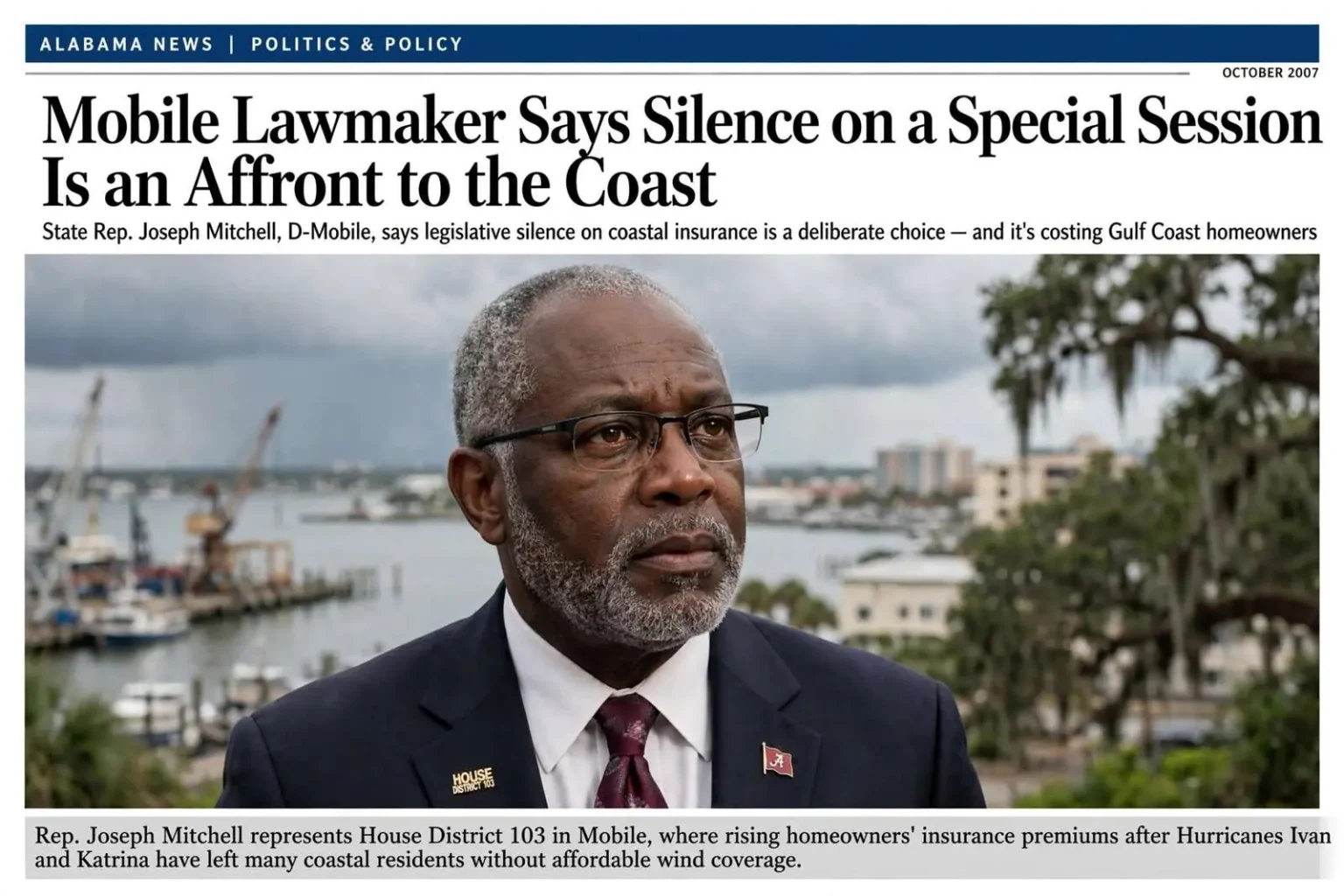
State Rep. Joseph Mitchell, D-Mobile, offered a blunt account of how the Alabama Legislature actually works, and an equally blunt warning about what its silence on coastal insurance would cost.
The Alabama House, Mitchell wrote, though it held a Democratic majority, was not a democracy — and even within that majority, democracy was not how business got done.
‘When things don’t happen, it is deliberate’
“In reality only a small group — nowhere near a majority and by no means uni-partisan — decide what will be important for legislative consideration,” Mitchell wrote. For everything that any member thought important to actually be considered, he observed dryly, “would be too much like … well, like representative government.”
Members who had served more than a term, he said, learned “to feign either intelligence or stupidity” in the hope of cajoling House leadership into supporting their local bills, simply to get them onto a calendar for consideration by the full House and then the Senate.
His description matched the structural realities of the Alabama Legislature as it operated in that era. The 140-member body — 105 House seats and 35 Senate seats — ran largely on the discretion of presiding officers and their lieutenants, who controlled calendars, committee assignments and the flow of local legislation. With a part-time Legislature, short sessions and a bottleneck of hundreds of local bills from 67 counties, calendar power was the real currency of the Statehouse, and members who crossed leadership could watch their bills die without a vote ever being recorded on them.
All of which gave a sharper meaning to the description of lawmaking as a deliberative process. “In short,” Mitchell wrote, “when things don’t happen, it is deliberate.”
The observation was more than a grievance. In a system where inaction required no vote, it also required no accountability — no record for opponents to run against. Mitchell’s point was that the absence of action on insurance was itself a decision, made by whoever decided what never reached the floor.
The insurance question
His immediate grievance was specific. The Speaker of the House had inquired whether members were interested in a special session. The Mobile House delegation, Mitchell reported, had not even met to discuss it.
On homeowner and business insurance legislation — the issue that had come to dominate coastal politics after Hurricanes Ivan and Katrina — “not a mumbling word has been heard.” That, he said, was unfortunate.
The stakes behind his complaint were concrete for his constituents. Ivan in 2004 and Katrina in 2005 had hammered the Alabama coast, and in their aftermath the homeowners’ insurance market along Mobile and Baldwin counties had convulsed: premiums doubled or worse in some coastal zip codes, major carriers quit writing new policies on the Gulf-front, and some homeowners found their wind coverage dropped entirely, leaving them with the impossible arithmetic of flood insurance on the federal side and no wind coverage at all on the private side. For a family in south Mobile County, the cost of keeping a roof insured had become as consequential as the mortgage itself.
Borrowing and adapting an old adage, he wrote: “The Speaker may not always be right, but he is always The Speaker.” And that cut both ways, he argued, since he had voted for the Speaker precisely so that the Speaker would serve his interests and, by extension, his district’s.
“To purposefully avoid a special session on insurance reform is a deliberate affront to South Mobile County,” Mitchell wrote — which, from his perspective, meant “that part of Alabama that starts just south of the center line on Government Street.”
Government Street is the old spine of midtown Mobile, and the center line Mitchell invoked was his way of naming the dividing line that mattered politically: south of it lay the older, coastal-adjacent neighborhoods — Spring Hill’s edges, the Outlet Road and Dauphin Island Parkway corridors, down toward Tillman’s Corner and the bay — where insurance costs bit hardest. His district, House District 103, sat squarely in that geography.
The Legislature, he added, had yet to offer anything beyond what passed through the state’s Department of Economic and Community Affairs from the Federal Emergency Management Agency. He drew a pointed comparison: when a tornado touched down in north central Alabama, legislators spent days deliberating how to help.
“Another natural calamity occurs and state leadership cannot see a need to meet? And since when was a consensus needed to ignore doing the right thing?”
The contrast he drew had a regional edge that Mobile legislators had long felt. North Alabama’s tornado disasters — the 1974 super outbreak most famously — had built a durable tradition of state response and federal coordination, and Huntsville and the Tennessee Valley carried considerable weight in Montgomery. Coastal hurricane damage, by contrast, was routinely treated as a Gulf problem to be handled by federal disaster declarations, local governments and insurers, without the Legislature convening to ask what state policy should do about it. Mitchell was arguing, in effect, that the state treated hurricanes as someone else’s disaster.
He closed with something between a promise and a threat. “It is not a threat to expect that the next regular session will not go smoothly,” he wrote, “as South Alabama folk just-south-of-center-line-Government Street help in the deliberation.”
That was the practical end of his argument: a member who could not get his issues calendared could still make the session itself slower, louder and more expensive for leadership. In a Legislature that ran on unanimity consent calendars and procedural speed, a member willing to object was a lever.
A parting shot about the floodplain
Mitchell appended a postscript about a proposed development along the Three Mile Creek floodplain in Mobile, and it was not a friendly one.
“Who do you think will insure homeowners in the proposed development along the Three-Mile Creek flood plain?” he asked. “Who will be able to afford to live there at some astronomically high flood insurance price? Do you think the GM&O building will ever get maximum tenants?”
The questions landed at the intersection of the two issues that most defined Mobile’s politics in that period: the cost of insuring anything near the water, and the fate of a downtown whose landmark structures — the old Gulf, Mobile & Ohio Railroad terminal among them — kept waiting for the tenants that redevelopment plans promised.
Three Mile Creek drains a broad swath of west-central Mobile into the Mobile River, and its floodplain had repeatedly figured in the city’s development fights. Building new housing inside a mapped flood zone meant federal flood insurance priced against the risk, and Mitchell’s rhetorical question — who would insure, who could afford it — was a pointed one for a city trying to attract residents back toward its urban core while premiums climbed everywhere the water could reach.
The GM&O terminal, the neoclassical railroad depot that anchored Mobile’s north downtown near Government Street, had outlived its railroad — the Gulf, Mobile & Ohio merged into other carriers decades earlier — and spent years as the emblem of downtown redevelopment’s gap between announcement and delivery. Every plan for the old depot promised offices, residences and foot traffic; every plan waited for financing. Mitchell connected the two threads: a downtown that could not fill its grandest building and a floodplain that could not insure its newest houses were both symptoms of a Gulf Coast whose risk, and whose future, the state had declined to think through in public.
Context
Mitchell represented House District 103 in Mobile. He wrote as Gov. Bob Riley was announcing that he would not call a fall special session, blaming Democratic leaders for refusing to take up ethics reform and an end to annual property appraisals.
The standoff mapped the legislature’s arithmetic of the moment. Democrats held majorities in both chambers, and Riley — a Republican who had won a second term — could not convene a special session unless leadership agreed to bring the body in. His price for a session was ethics reform and the end of the practice that let property values ride unappraised for years between reappraisal cycles, a system that shifted tax burden unpredictably and fueled recurring complaints. The Democrats’ price was their own agenda. Coastal legislators of both parties had wanted a session on insurance; they did not get one. Each side blamed the other, and the special session that everyone in south Alabama needed — the one that might have addressed premiums while they were still climbing — was the casualty of the standoff.
The insurance crisis Mitchell described did not resolve itself. Premiums on the Alabama coast continued to climb, insurers continued to withdraw from the market, and the Legislature returned to the subject repeatedly in the sessions that followed, eventually passing measures on transparency in rate-setting and incentives for fortified construction — years after the coastal delegation first demanded that Montgomery meet about it.
What the delay cost was measurable only in hindsight. The fortified-construction incentives that eventually passed encourage homes built to standards that survive hurricanes, which lowers both losses and premiums over time — but every year the program was absent, more homes were built to lesser standards on the coast, and every one of them locked in decades of higher risk. Rate transparency, likewise, gives policyholders the information to contest pricing, but it works best when the market is still writing policies; it does less for a homeowner whose carrier has already left.
Mitchell’s essay was, in the end, less about procedure than about who Alabama’s Gulf Coast counted as when Montgomery counted. His argument ran that the coast’s disaster was treated as minor league — deliberated when tornadoes hit the Tennessee Valley, ignored when premiums crushed homeowners south of Government Street — and that the Legislature’s silence was not neglect but a choice, made by the small group that decides what never comes to a vote. The years of rising premiums that followed proved the stakes of that choice for the people who live at the water’s edge.