Brooks Files Coastal Insurance Bill, Bringing Riley to Irvington to Sell It
State Sen. Ben Brooks proposed an Alabama Coastal Insurance Authority to draw private carriers back to the coast, and scheduled a news conference with Gov. Bob Riley at First Baptist Church of Irvington.
A south Alabama state senator introduced legislation to create an Alabama Coastal Insurance Authority, a market-based attempt to ease the property insurance crisis that had gripped the Gulf Coast in the years after Hurricanes Ivan and Katrina.
The bill, authored by state Sen. Ben Brooks, R-Cypress Shores, would include every insurer licensed to write insurance in Alabama and require them “to participate in the writing, the expenses, the profits and the losses that occur when insuring residential and commercial property in counties adjacent to the Gulf of Mexico for essential property insurance.”
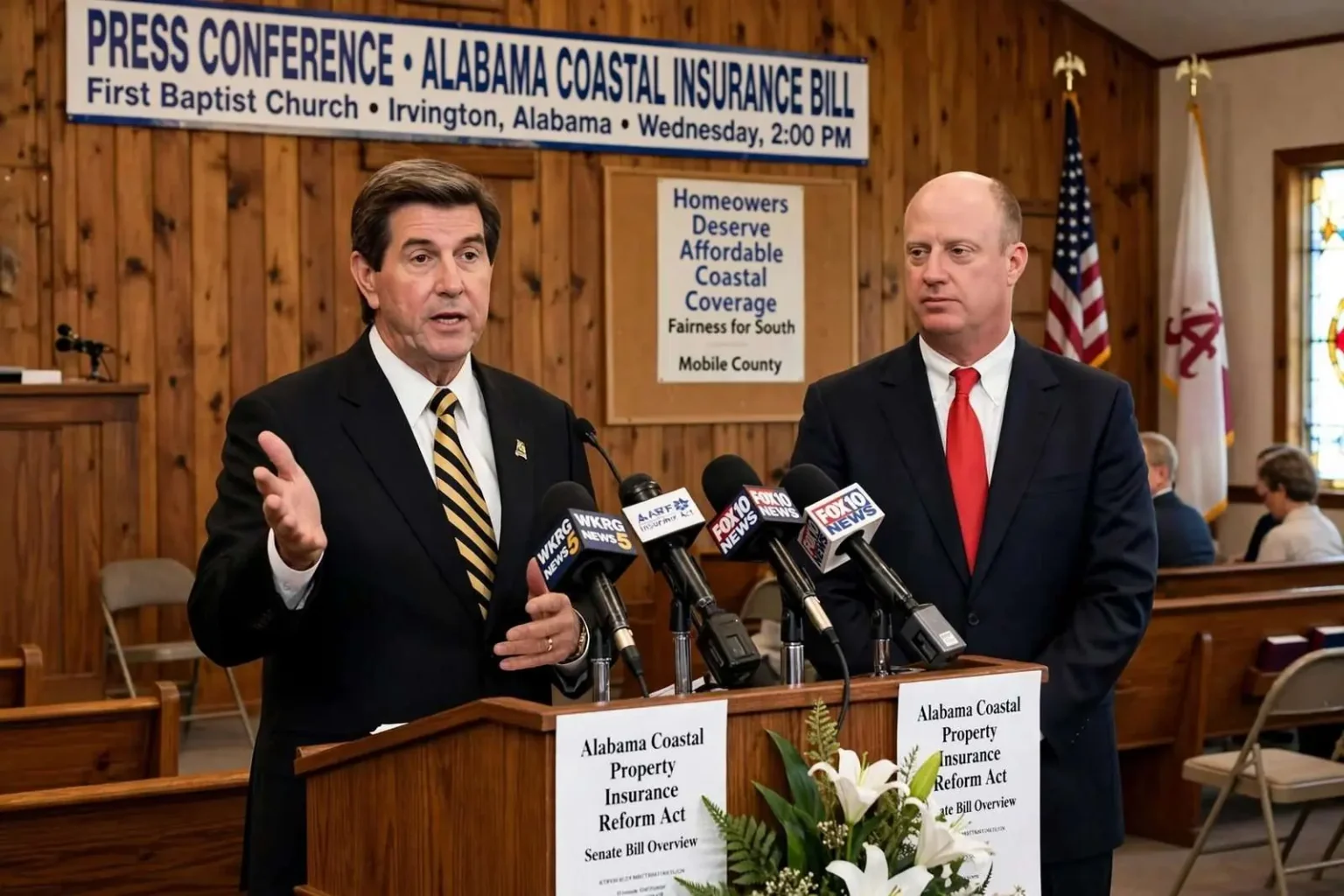
Brooks, Gov. Bob Riley and other state lawmakers were scheduled to promote the measure at a 2 p.m. news conference Wednesday at the First Baptist Church of Irvington in south Mobile County — a deliberate choice of venue in a part of the county where homeowners had seen premiums climb or coverage disappear entirely. Irvington sits in the stretch of western Mobile County where the insurance squeeze had been felt with particular force, and putting the governor’s podium in a community church hall rather than a Montgomery press room was the point: the bill’s audience was the homeowners who had been reading nonrenewal notices, not the capital’s lobbying corps.
A market, not a government substitute
Alabama’s coastal communities had been in turmoil, with property insurance rates rising as much as 300 percent and some homeowners’ policies dropped outright. The spike followed the back-to-back strikes of Hurricane Ivan in 2004 and Hurricane Katrina in 2005, which combined to rewrite the insurance map of the northern Gulf Coast. National insurers re-evaluated their exposure to the region, raised rates sharply or withdrew from coastal zip codes altogether, leaving homeowners in Mobile and Baldwin counties to choose between unaffordable premiums and no coverage at all.
Brooks said he studied how other states responded and consciously rejected the Florida model.
“I looked at Mississippi closely and Florida enough to know that was not the way I’d want to go, philosophically,” Brooks said. “It’s not what I believe in philosophically. Florida is saying the state should replace the insurance market, not encourage the private marketplace. I have a fundamental difference in philosophy, so the approach I take is to offer a certain spectrum of choices in the bill — wind pool, tax incentives, a number of things that encourage an array of choices in the marketplace.”
The distinction he drew was the central argument of the post-Katrina insurance debates across the Gulf states. Florida had responded to its own crisis by expanding a state-run insurer of last resort into one of the largest property carriers in the nation, effectively socializing hurricane risk across the state’s policyholders. Critics argued that approach kept premiums artificially low while accumulating catastrophe liabilities that would eventually have to be paid by taxpayers; supporters countered that only state intervention could keep coastal markets functioning at all. Brooks wanted neither outcome — his bill was designed to keep private carriers writing on the coast by spreading their risk and their rewards across the entire Alabama market.
He said he borrowed most heavily from South Carolina, whose program he graded “an A.”
South Carolina had confronted a similar squeeze along its own coastline and built a framework that relied on private carriers rather than a state-owned insurer, pairing incentives for writing coastal coverage with a backstop structure that spread catastrophe exposure more widely. In Brooks’s judgment, that was the template closest to what Alabama needed: a mechanism that made coastal policies profitable enough to write without putting the state in the underwriting business.
What the bill would do
Titled the Alabama Coastal Property Insurance Reform Act, the measure would establish a nine-member Alabama Coastal Insurance Authority Board appointed by the governor to oversee the new framework. The authority’s core mechanic was the participation requirement: every insurer licensed in Alabama would share in the writing, expenses, profits and losses of coastal property coverage, rather than leaving the burden on the handful of carriers willing to stay on the coast and letting the rest of the state’s insurers harvest risk-free premiums from inland markets.
The bill also contained the elements Brooks listed in his summary of choices — a wind pool and tax incentives — each aimed at a different part of the problem. A wind pool addresses the hardest coverage to buy: windstorm-only protection for homes whose carriers exclude hurricane wind damage from their policies, a gap that had become acute along the coast after the 2004 and 2005 seasons. Alabama already maintained a limited windstorm facility for the beachfront, but the gap extended well beyond it, to homes miles inland that had never flooded yet could not find wind coverage after the back-to-back storms. Tax incentives, meanwhile, would reward carriers for writing or retaining coastal policies, softening the financial penalty that had driven them out of the market in the first place.
The structure reflected an economic reality that homeowners rarely see: property insurance in hurricane-exposed states is priced from the cost of reinsurance — the coverage insurers themselves buy to spread their risk to global markets. When a catastrophic season like 2005 hits, reinsurance prices spike worldwide, and those costs pass directly into Gulf Coast premiums regardless of whether any particular homeowner ever files a claim. That is why a quiet stretch of years does not, by itself, bring rates down, and why Brooks’s bill reached for structural solutions rather than simply asking carriers to charge less.
Who the bill was written for
The constituency was visible in the venue choice. South Mobile County — the communities stretching from Irvington and Grand Bay down to the bayou country around Bayou La Batre and Coden — had absorbed some of the sharpest premium increases and policy cancellations in the state. These were towns where a house payment and an insurance premium could approach parity, and where a nonrenewal letter meant not just higher costs but the practical inability to sell or refinance a home, since mortgage lenders require coverage.
Homeowners in that position had few alternatives. The state-backed windstorm facility could cover wind exposure in limited areas, but many residents fell outside its boundaries or still needed to buy a separate policy for the rest of their risk. Private-market options had thinned to a few surplus-lines carriers charging rates that functioned as a form of controlled retreat from the coast. The bill’s premise was that this retreat was not inevitable — that with a shared participation structure and the right incentives, Alabama’s full insurance market could be persuaded to keep writing the coast.
The politics of the push
Governor Riley’s appearance at the Irvington news conference signaled that the measure had backing from the administration, not just the delegation of coastal legislators who had been pressing the issue since the 2005 storm season. Insurance had become one of the defining constituent complaints in south Alabama legislative offices — the letters that arrived in sacks, as legislators liked to say — and a governor aligning himself with a market-based fix positioned the issue for the legislative session ahead.
Brooks, a first-term senator with a professional background in insurance law, had approached the drafting as a policy exercise first: he surveyed the other Gulf and coastal states, catalogued what had worked and what had distorted their markets, and imported the pieces he judged soundest. His public framing emphasized that philosophy — the state should encourage the private marketplace, not replace it — and the bill’s mechanics were built to that specification.
The obstacles were familiar ones for any insurance bill. Carriers licensed in Alabama but writing little or no coastal business would face new obligations they had not priced, and their lobbying muscle in Montgomery was considerable. Others would question whether a board-appointed authority added a layer of governance the market did not need. And the underlying cost driver — global reinsurance pricing — would remain whatever the state did; the bill’s bet was that Alabama could blunt its impact locally rather than wait it out.
What it meant for the coast
For the residents the bill targeted, the stakes were concrete. A 300 percent premium increase converts a $1,200 annual policy into a $4,800 one — a second car payment attached to a house the owner already financed. Dropped coverage is worse: without a policy, closing on a sale becomes difficult or impossible, and the property’s market value erodes with it. In communities along Mobile Bay’s western shore, where incomes are modest and much of the housing stock predates modern wind codes, the insurance squeeze threatened not just budgets but the basic ability of families to stay in homes their grandparents built.
The bill’s answer was collective: make the whole Alabama market share the coast’s risk, so that the burden of a hurricane-exposed policy is spread across every insurer writing in the state and, in the long run, across every premium payer. Whether that structure could survive the session’s negotiations would determine whether south Mobile County homeowners saw relief in the next renewal cycle or another year of letters from carriers pulling out.