University of South Alabama Mobile
Bubba, Mayer, Mr. Mitchell: Friends Recall a Mobile Life of Outsized Reach
Friends and colleagues remembered Mayer 'Bubba' Mitchell, the Mobile developer and philanthropist who died at 74, as a man whose influence ran from Leinkauf School to the White House.
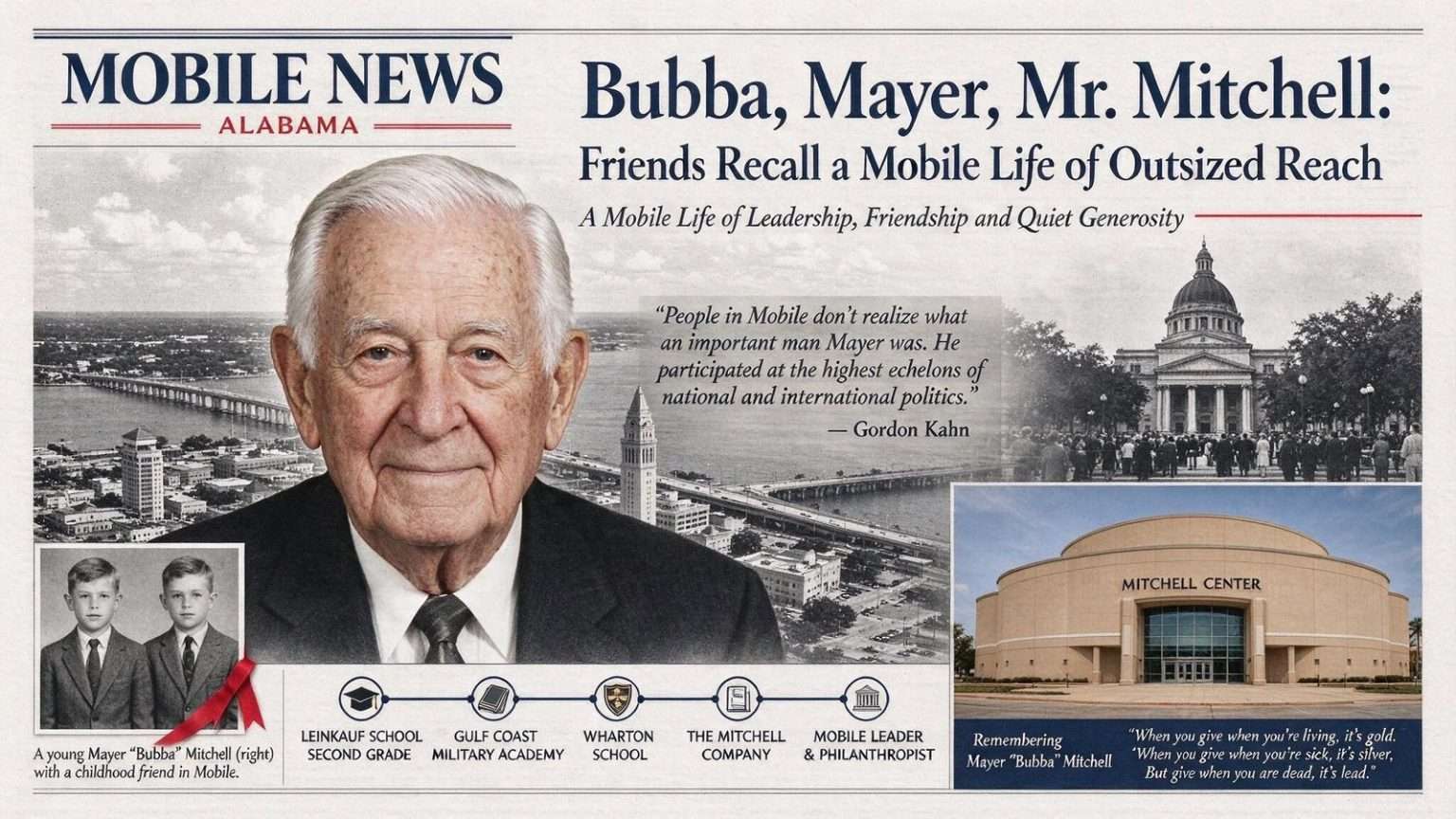
Everybody said Mayer Mitchell was smart, and there was no shortage of evidence: the corporate jets, the shopping centers, the apartment complexes, the jaw-dropping charitable gifts, the parade of political and business leaders who sought his counsel. But when Gordon Kahn said “Bubba” was smart, he was talking about the A’s he brought home in the second grade at Leinkauf School.
“He was just smart by always being smart,” said Kahn, a retired federal bankruptcy judge and longtime Delwood neighbor of Mitchell and his wife, Arlene. Mitchell died in Mobile early Wednesday at 74.
“I’ve known him all of his life and he’s known me all of mine,” Kahn said. “My mother and his mother were best friends.” Jewish children growing up in Mobile in those years were tightly knit, he said — together at school, together at Hebrew school afterward, together at the synagogue.
Mitchell went from Leinkauf to Gulf Coast Military Academy, then Riverside Military Academy in Georgia, then the Wharton School. “People in Mobile don’t realize what an important man Mayer was,” Kahn said. “He participated at the highest echelons of national and international politics. To use his own words, he was an ‘upfront Jew.’”
Known in Washington
U.S. Sen. Jeff Sessions said Mitchell was “the best known private citizen in Alabama” inside the Senate, on a first-name basis with leaders such as Mitch McConnell, Trent Lott and Jon Kyl. President George W. Bush, he said, called him Bubba and phoned to check on his health.
“People would sometimes ask, ‘What do you call him, Mayer or Bubba?’” Sessions recalled. One aide’s wife answered: “I don’t know what you should call him. I call him Mr. Mitchell!”
Mitchell was a leader of the American Israel Public Affairs Committee, and friends said his work for Israel was as consuming as his business. “No one did more for the Jewish people in Israel and the state of Israel in this country than Mayer Mitchell,” said neighbor and business associate Bert Meisler. “He lobbied and worked for funds for Israel, for its defense and for humanitarian funds.”
Former Mobile Mayor Mike Dow remembered being in Mitchell’s office when the phone rang. “Mayer said, ‘Excuse me, Mike, it’s the president.’ The conversation related to Israel.”
The politician’s politician
Former Congressman Jack Edwards recalled that when word spread in 1982 that he would not seek re-election, Mitchell brought Arthur Outlaw and Don Bigler to Washington to talk him out of it. They argued that leaving mid-term would make the seat harder to hold, and that a Republican running with Ronald Reagan in 1984 would fare better. Edwards ran once more; Sonny Callahan then won the seat and held it 18 years. “I always argued that Mayer was a better politician than I was,” Edwards said.
When a University of Alabama System trustee search committee asked Edwards for a nominee, he named Mitchell. They asked Mitchell, and he named Edwards. “Once again he proved that he had more clout than I did.”
The boss, the mentor
Sports analyst Danny Sheridan first met Mitchell at 12, sent to him for misbehaving in Sunday school, where the 26-year-old Mitchell was principal. “I never knew fear until I met him,” Sheridan said — and he was never sent back.
Years later, when Sheridan left the Mitchell Company to start his own business, he sought Mitchell’s counsel. The advice: “Do it, and make sure you continue to make your family and us proud of you and if it doesn’t work, always know that that door that you’re about to leave swings both ways.”
Real estate executive Don Kelly said Mitchell took particular pride that the three owners of The Mitchell Company — John Saint, Chuck Stefan and Kelly himself — had all been hired at entry level and risen under his tutelage.
Advertising executive Richard Sullivan pointed to a quieter legacy: the company’s affordably priced single-family homes. “With a Mitchell house, $100 and move in, and back then people could get a house and afford the note. They built equity and improved their lot in life and continued to move up. That’s a tremendous contribution.”
Giving, and giving quietly
Financial adviser Chuck McNeil met Mitchell while both were undergoing cancer treatment. During a bad relapse, McNeil said, Mitchell appeared in his hospital room unannounced with a print of a painting of a famous Alabama-Tennessee finish. “It meant a lot to me that Mayer thought about me and that game.”
Attorney Irving Silver called him “a rare philanthropic visionary” who, with Arlene and his brother Abe, strengthened a long list of charitable, educational and religious institutions.
Mitchell’s favorite proverb on giving, Sheridan said, ran: “When you give when you’re living, it’s gold. When you give when you’re sick, it’s silver. But give when you are dead, it’s lead.”
Matt Metcalfe recalled a meeting of civic leaders on the proposed mayor-council form of government for Mobile that broke up with someone declaring the task impossible. Walking to the parking lot, Mitchell told him: “Matt, I’m not willing to accept defeat.” The bill passed.
University of South Alabama President Gordon Moulton told mourners that “there were thousands of acts of kindness that most of us never knew about.” A remembrance service was held at the Mitchell Center on the university campus, the arena that carries the family name.
The Mitchell name at South Alabama
Mayer and Abe Mitchell founded The Mitchell Company in Mobile in 1958 after studying at the University of Pennsylvania’s Wharton School. The firm grew into one of the Southeast’s largest real estate developers; by Mitchell’s own count it built more than 25,000 houses, 20,000 apartments and 175 shopping centers before the brothers sold their interest in the mid-1980s and turned much of their attention to philanthropy.
Mitchell served on the University of South Alabama’s board of trustees for more than three decades. Besides the Mitchell Center arena, the family’s gifts to the university are marked by the Mitchell College of Business, renamed in 1999 when Mayer, Arlene and Abe Mitchell endowed it, and the Mitchell Cancer Institute, named for the family in 2006 in recognition of a $22 million gift toward the cancer research program. The university says the family has given more to a single public university than any other family in Alabama’s history.