Nodine’s Blunt Talk to Mobile Civic Leaders Exposes a Widening Split Over Annexation
Newly elected Mobile County Commissioner Stephen Nodine acknowledged a spirited and forceful exchange with civic leaders at a December 2004 meeting, exposing deep divisions over annexation and city spending.
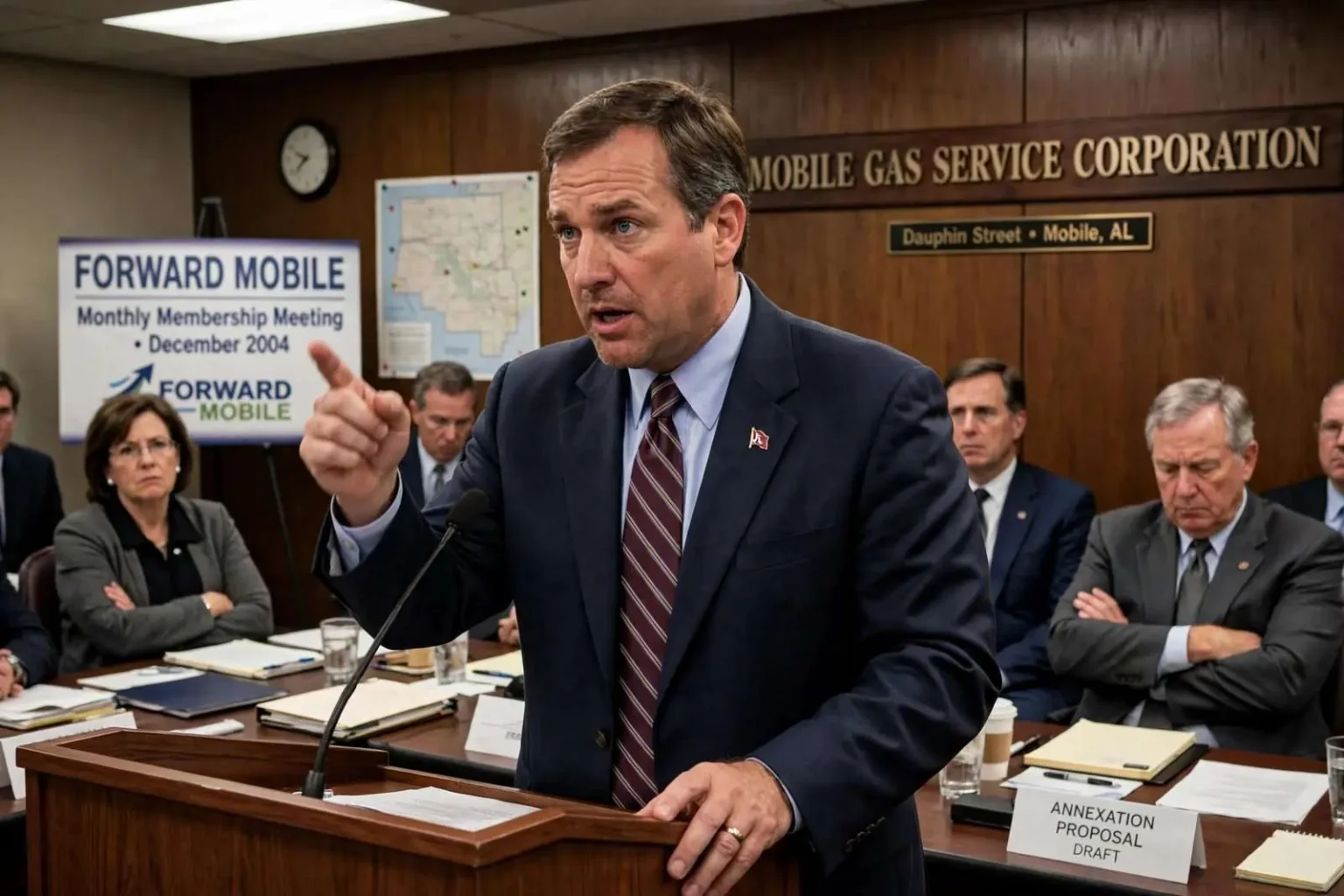
Newly elected Mobile County Commissioner Stephen Nodine acknowledged in December 2004 that he had delivered what he called a “spirited” and “forceful” message to a gathering of prominent Mobilians associated with the civic group Forward Mobile — a message that left several of those in the room distinctly cold. The meeting took place on a Monday evening at the Mobile Gas Service Corporation offices on Dauphin Street.
Attendees described a presentation that struck them as abrasive and, at moments, beside the point, one that seemed to foreclose rather than invite future cooperation. One person present, who asked not to be identified, said Nodine’s remarks veered into territory that appeared to stem from personal grievance rather than policy.
Nodine did not entirely dispute the characterization. “I was told the meeting was confidential and I want to respect that, but if someone there said something about it, then I guess it wasn’t completely confidential,” he said.
“Sure, I was a little forceful in my views. I can do that with people who simply refuse to understand that there are some changes coming.”
A Campaign That Left Scars
Part of the heat, by Nodine’s own account, was residue from a bruising campaign.
Days before the Republican primary earlier that year, a group of Black elected officials held a news conference in front of Government Plaza demanding an apology from Nodine, alleging he had used racial slurs during a late-night confrontation at a Waffle House in Mobile. Among those present were state Sen. Vivian Figures, County Commissioner Sam Jones, school commissioners Hazel Fornier and David Thomas, city councilmen Fred Richardson and Thomas Sullivan, and state legislators Yvonne Kennedy and William Clark. Nodine denied that the incident ever occurred.
He said he had no wish to reopen the dispute, but his resentment over the accusation — and over what he saw as the absence of any consequence for his accusers — was plainly unspent. A former city councilman who clashed frequently with Mayor Mike Dow, Nodine had been elected five weeks earlier to a four-year term on the Mobile County Commission.
Annexation as the Fault Line
Personal anger, however, sat atop a genuine philosophical divide. Nothing illustrated it more sharply, Nodine argued, than annexation — the long-running effort by the City of Mobile to bring unincorporated west Mobile County communities inside the city limits and onto the city tax rolls.
“We have been divided east and west,” he said. The residents of the areas targeted for annexation, he contended, “want nothing to do with the city of Mobile. They have seen the city year after year just throw away its money.” He rejected the notion that opposition to annexation was rooted in prejudice, calling that portrayal a rich irony. “Annexation is a moot point,” Nodine said.
“You don’t have a plan. You don’t just go out and grab their money. If you want annexation, start by approaching them in a professional and intelligent way. Don’t insult them as rednecks, all of ’em waving Confederate flags. Show them a plan. Show them a plan for police and fire protection. Show them a plan for paving roads. Show them a plan for parks and recreation. Show them some respect.”
Parks, Pavement and Priorities
Nodine returned repeatedly to what he described as the city’s skewed spending priorities. Representing District 7 on the council, he said, he had been reduced to scrounging private donations to improve Lavaretta Park and Langan Park in west Mobile.
“When I first took office, every park in the district looked like crap,” he said. “They didn’t even cut the grass.” Ziegler Boulevard, he added, had languished for years without repaving.
“Yet we’ll spend $3 million on a Mardi Gras Park downtown,” he said. “And they wonder why everyone doesn’t just want to hop aboard.” His broader complaint was fiscal.
“You don’t suck money out of your capital budget year after year after year and put it in employees,” he said. “When government is becoming your biggest employer, you better think of something fast.” He acknowledged his reputation — “Yeah, Steve’s a loose cannon” — and argued that if leaders would simply listen to the people he represented, “I wouldn’t go off on them.”
A Republican Commission and an Anxious Establishment
Nodine framed his arrival as the leading edge of a partisan and philosophical shift at the county level.
“You will now see a Republican county commission,” he said. “This will result in some tense days for the old guard. The beliefs that they have are not all the same as mine.” He described the session as cordial nonetheless, saying he had laid out a road map for where he hoped to see the community go over the next four years. Those reported to have attended included J. Gary Cooper of Commonwealth National Bank, Sydney Raine of Mobile Works, Howard Bronson of the local daily newspaper, Cheryl Thompson of Alabama Power, philanthropist Mayer Mitchell, Keith King of Volkert Engineering, retired Degussa executive Charlie Story and Harris Morrisette of Marshall Biscuits. Several did not immediately return calls.
“People aren’t stupid even if other people obviously think they are,” Nodine said. “Yeah, this community’s got some healing to do.”
About the County Commission
The Mobile County Commission has three members, each elected from a single-member district to a four-year term. Nodine won the District 2 seat after defeating Ralph Buffkin in a Republican primary runoff in June 2004.