Insiders Weigh a Racially Divided Mayor’s Race, and a Long-Shot Fix for Annexation
In December 2004, Mobile political insiders privately weighed the risks of a Peavy-Jones mayoral race dividing the city along racial lines, and floated a retail development as an annexation icebreaker.
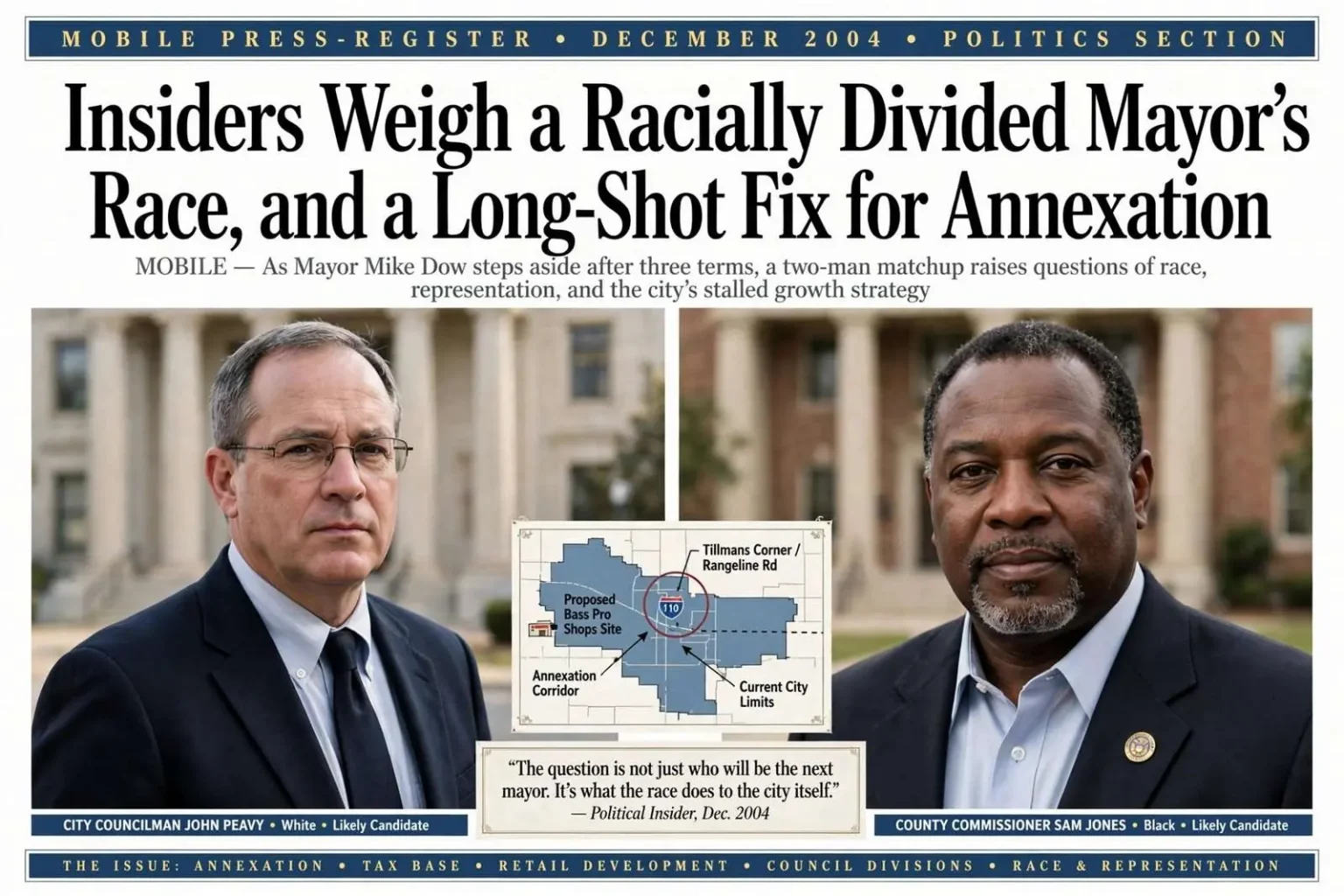
MOBILE — As December 2004 closed in on a municipal election year, the question consuming Mobile’s political class was not simply who would be the next mayor. It was what a wide-open race would do to the city itself. With Mayor Mike Dow expected to step aside after three terms, the likely field had narrowed quickly to City Councilman John Peavy, who is white, and County Commissioner Sam Jones, who is Black. Among political insiders and observers, that pairing prompted a mix of fascination and dread — and a candid, off-the-record assessment of what the campaign might unleash on a city that had spent years trying to move past its racial fault lines.
The Arithmetic Nobody Wanted to Say Out Loud
The consensus among those handicapping the race was blunt. Neither man, they believed, would run a racially divisive campaign; both had support that crossed racial lines, and both were regarded as serious, experienced public servants. Yet the fear was that race would nonetheless decide the outcome, with the vote breaking roughly along the racial composition of the city electorate — not because the candidates sought it that way, but because undecided voters so often resolve a two-man race along the most visible line of identity.
One veteran insider projected that a white candidate would finish with somewhere between 55 and 60 percent of the vote in a two-man runoff. Jones, this person acknowledged, expected significant crossover support based on his long record in county government, where he had built a reputation for competence and accessibility that reached well beyond Black precincts. The difficulty was one of exposure: the white leadership class in Mobile knew Jones well and admired him, but the average white voter across the city did not know him and was unfamiliar with his record. Leadership, this insider noted dryly, is small in number and rarely united in any case — a nod to the reality that Mobile’s business and civic establishment, however influential, could not deliver a citywide electorate on its own.
Both candidates were thought capable of raising the half-million dollars a citywide race would require, a sum that reflected the cost of reaching voters across Mobile’s sprawling geography, from Spring Hill to Toulminville to Tillmans Corner. Money, however, was not expected to be the decisive variable it usually is. In a race with two well-funded, well-known figures, the campaign’s shape — not its war chest — was the question.
The longer-term worry ran deeper than any single election. A campaign perceived as a racial referendum, several observers argued, could poison consensus-building in the next administration, harden divisions on the City Council and doom the city’s central strategic ambition: annexation of the growing unincorporated areas to the west. Mobile’s tax base had been effectively frozen inside lines drawn for a smaller city, while commercial growth boomed just outside them. Every year the lines stayed put, the imbalance grew worse.
The Case for a Referendum on Government, Not Race
The alternative framing that insiders hoped for was an election fought over the size and role of city government rather than the identity of the candidates. In that scenario, they suggested, a Peavy victory might actually improve annexation prospects, particularly if he could carry the argument into the Semmes, Tillmans Corner and Schillingers Road corridors — the heavily developed unincorporated communities where resistance to city annexation ran strongest — while preserving working relationships with Black council members.
Peavy’s relations with those colleagues were considered a genuine asset. Council politics in Mobile had long required coalition-building across district lines, and Peavy’s ability to work with Black colleagues on the council suggested he could govern a city even after a racially charged election. A mayor who arrived at Government Plaza without a racially polarized council, even after a racially polarized vote, might have room to maneuver that a more divisive figure would not — room to sell reluctant westside communities on the benefits of city services, police and fire coverage, and coordinated planning.
There was also open speculation about a third candidate — someone running an outsider, plain-spoken campaign that might scramble the two-man arithmetic entirely — though no one could name a plausible contender. The odds of such an entry were put at roughly one in ten. Mobile’s mayoral races had historically drawn occasional self-funded outsiders, but mounting a serious citywide campaign required name recognition and money that few private citizens possessed, and the filing window had a way of winnowing ambitions.
The Bass Pro Gambit
The most intriguing idea circulating in those conversations concerned retail, of all things. Word had spread that a Bass Pro Shops development planned for Spanish Fort in Baldwin County had fallen through. If true, one observer argued, that created an opening — and like so many opportunities in Mobile at the time, it ran through David Bronner, the head of the Retirement Systems of Alabama, whose investments had reshaped the downtown waterfront with projects including the RSA towers, the Battle House hotel restoration and the RSA Trustmark building.
The proposal was this: use RSA’s resources to sweeten the deal and attract the outdoor retail giant to the Rangeline Road and Interstate 10 area near Tillmans Corner. A major, high-visibility development there, delivered as a joint city-RSA production, could serve as both a symbol and an icebreaker for annexation — proof, delivered in concrete and steel, that becoming part of Mobile brought tangible benefits. The catch, and the point of the whole exercise, was that no suitable site for such a project existed inside the city limits in that corridor. Annexation of at least the development area would therefore be mandatory; otherwise, the argument went, Tillmans Corner might incorporate as its own municipality and claim the asset for itself, taking its sales tax base with it.
Bass Pro representatives had reportedly looked at land near Hank Aaron Stadium off Interstate 65 and come away unimpressed: the site itself was fine, but the I-65 location, the roundabout access and the surrounding demographics fell short of what the company wanted for a flagship destination store. From Mobile’s perspective, a stadium-area store would still be preferable to losing the project across the bay to Baldwin County — but it would carry none of the annexation-icebreaker value, since the stadium area was already inside the city.
Why Bronner Might Care
The insiders made a further argument: annexation was as much in the Retirement Systems’ interest as the city’s. Bronner had wagered hundreds of millions of dollars on downtown Mobile — office towers, a landmark hotel, infrastructure — on the theory that the city would grow into its new skyline. Without a broader tax base, Mobile faced a shaky fiscal future, and a shaky city put at risk the very investments RSA had made. A larger, healthier Mobile was the collateral behind Bronner’s bet, and widening the city limits to capture the commerce of Tillmans Corner was one of the few structural remedies available.
Annexation of Tillmans Corner would not live or die on a single retail project. The corridor’s growth — subdivisions, strip centers, interstate interchanges — had been building for decades, and the fiscal case for incorporation into Mobile had been debated in civic circles for years. But in the winter of 2004, with a contentious election approaching and the window for cooperation narrowing, the idea looked to some like the best opening the city was likely to get: a lever that could pull a retailer, an election and a boundary line in the same direction.
As one participant put it, quoting the old maxim: may you live in interesting times. For a city whose next mayor would inherit both a divided electorate and a stalled growth strategy, the remark captured the moment precisely. The months ahead would determine whether Mobile’s political class could keep race out of the arithmetic — and whether a fishing retailer’s site-selection team could do what a decade of civic persuasion had not.
The mayoral arithmetic also had to reckon with Mobile’s council structure, in which seven of the nine members represented single-member districts while two ran citywide. A polarized mayoral race would inevitably bleed into council politics, where district alliances decided budgets, zoning and the crucial question of how city services would be extended — or withheld — in newly annexed areas. Insiders who had watched previous administrations negotiate with a divided council worried that a racial mandate for either candidate would leave the next mayor with allies on one side of the chamber and adversaries on the other, precisely when pragmatic deal-making would matter most.
That was the backdrop against which the Bass Pro idea gained its audience. It offered something rare in municipal politics: a project that could give every faction a win. The city would gain a sales-tax-producing destination store and, potentially, a long-sought foothold in Tillmans Corner. RSA would reinforce its downtown investments with a healthier, larger city. Westside residents, long wary of annexation, would get a flagship retailer and the services that came with joining the city rather than forming their own government. And whichever candidate won the mayor’s office could claim the project as the first fruits of a new administration — proof that Mobile’s growth story did not have to end at the city limits sign.