Mobile County Dedicates Liberty Park Downtown, Opening a Year of America 250 Programming
A $1.6 million pocket park between Government Plaza and the County Annex has been dedicated as Liberty Park, honoring the 250th anniversary of the Declaration of Independence and a fallen court officer.
Mobile County Dedicates Liberty Park Downtown, Opening a Year of America 250 Programming
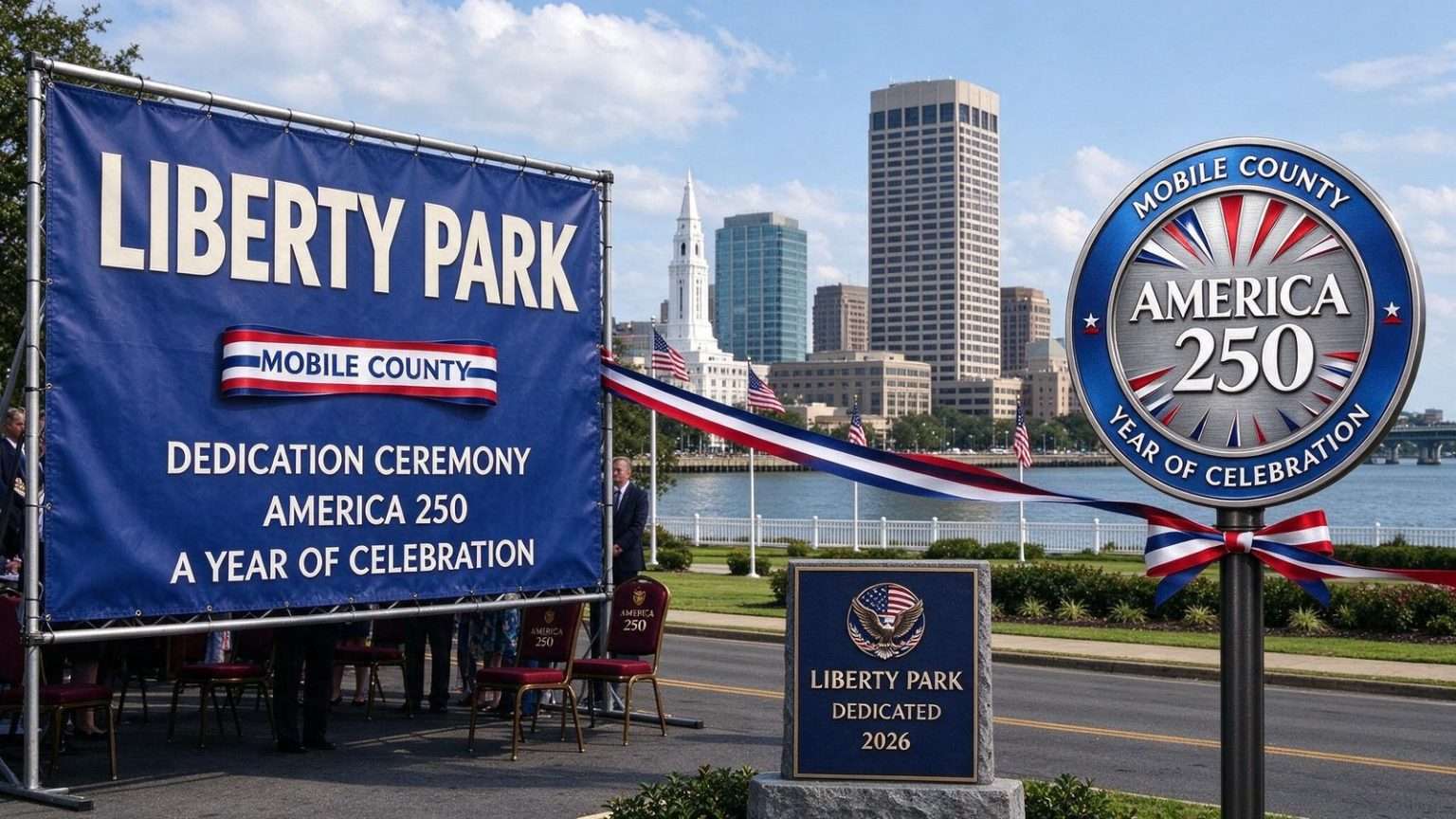
An underused courtyard in the heart of downtown Mobile has been given a new name, a new purpose and a new place in the county’s civic life. Mobile County officially dedicated its Mobile Government Plaza pocket park as Liberty Park on Wednesday, July 1, tying the ceremony to the 250th anniversary of the adoption of the Declaration of Independence.
The dedication did two things at once. It opened a genuine public gathering space in a part of downtown that had little of it, and it launched a slate of Mobile County programs marking the nation’s semiquincentennial that will continue through 2026. Downtown Mobile’s government district has long been a destination for business rather than leisure — courthouses, offices and parking structures that empty out at the end of the workday — and the county’s move treats public space as part of the district’s basic furniture rather than an afterthought.
The Ceremony
Commission President Connie Hudson presided over the dedication, which included a presentation of colors, the National Anthem, remarks from county leaders and the unveiling of the Liberty Park dedication plaque. A portion of the park was set aside as the Meditation Garden and dedicated to the memory of Court Police Officer Charles Craig Greenwald, Sr., who was killed in the line of duty at Mobile Government Plaza in 1996.
Three decades later, a quiet corner of the building where he served now carries his name, a gesture that gives the park a weight beyond landscaping. The Meditation Garden’s location — inside the very plaza where Greenwald worked and died — turns a commemorative gesture into something residents and courthouse visitors will encounter daily, whether or not they know the story behind it.
“Liberty Park is more than a beautiful public space,” Hudson said. “It is a lasting investment in our community and a reminder that the freedoms we enjoy today were secured by generations who believed in civic responsibility and public service.” She said the county hopes the park inspires residents to reflect on shared history, engage in their community and help shape the future of Mobile County.
What Was Built, and Why
The $1.6 million project was spearheaded by District 2 Commissioner Connie Hudson and funded through the American Rescue Plan Act of 2021. It transformed the courtyard between Government Plaza and the County Government Annex, a space that had never lived up to its position, into a welcoming public area for employees, residents and visitors. Federal pandemic relief money, which arrived with broad allowable uses, gave the county a way to convert a forgotten courtyard into a permanent civic asset.
The design responded directly to a lesson learned during the COVID-19 pandemic: people need accessible outdoor space, and cities that lack it feel the absence acutely. The new pocket park offers somewhere to gather, eat lunch, decompress or simply sit outside during a workday.
The practical audience is substantial. Roughly 20,000 people are employed in downtown Mobile, including nearly 1,000 in Government Plaza and the County Government Annex alone. For those workers, and for anyone with business at the courthouse, Liberty Park adds something downtown had been missing — a place to sit between appointments, meet outdoors, or take a break within sight of the buildings where the county’s business is done.
“One of our responsibilities is to leave Mobile County better than we found it,” said District 3 Commissioner Randall Dueitt. “Liberty Park takes a space that wasn’t reaching its full potential and turns it into something the public can enjoy every day. It will be a permanent reminder of the ideals upon which our nation was founded 250 years ago, of how far we’ve come, and how important it remains that citizens are engaged with local government.”
A Kick-Off Party, and an Honest Frame
Following the ceremony, the community gathered for Mobile County’s America 250 Kick-off Party, featuring live music, performances drawn from Chickasaw Civic Theatre’s production of 1776, food trucks and family activities. Winners of the county’s America 250 Youth Civic Reflection Contest were also recognized, putting young residents’ own words about citizenship at the center of the celebration.
District 1 Commissioner Merceria Ludgood used the occasion to frame the anniversary in candid terms. “The United States’ story has always been shaped by ordinary people whose courage, perseverance and sacrifice moved our nation forward,” she said. “As we commemorate the USA’s semiquincentennial, we also recognize that Mobile County’s history is complex, diverse and still unfolding.”
She said the hope is that the programming encourages people of all ages to learn local history, appreciate one another’s stories and see themselves as part of what comes next. It is a notable posture for a commemoration: not a pageant of settled glory, but an invitation to keep reckoning with a history that includes both founding ideals and the long, uneven work of extending them.
What Comes Next
County officials announced that additional America 250 programming is planned throughout 2026, combining civic education, historical interpretation and community engagement while highlighting the people, places and events that shaped Mobile County. The kick-off party was funded in part through an America 250-Alabama grant administered by the Association of County Commissions of Alabama.
The grant structure points to how the commemoration will likely unfold: counties across Alabama are drawing on the America 250-Alabama program to fund local observances, and Mobile County’s slate — built around civic education and historical interpretation rather than a single headline event — gives residents a calendar to follow through the anniversary year. The youth civic reflection contest that debuted at the kick-off party is the kind of program designed to continue, giving students an annual reason to write and speak about citizenship.
A Park With Work to Do
Liberty Park’s first summer will test how well the space works in daily use. Pocket parks succeed when they become routine — the lunch spot, the waiting spot, the meeting point — and the county’s placement of the park between Government Plaza and the County Government Annex puts it exactly where the 1,000 employees of those two buildings and the thousands of downtown workers around them will pass it every day. The Meditation Garden gives visitors a reason to pause rather than pass through, and the dedication plaque anchors the park’s story for anyone who stops to read it.
The park also adds to a downtown that has been assembling its civic amenities piece by piece. Mobile’s government district, anchored by Government Plaza — the combined home of city and county government — now includes a public green space that can host ceremonies, observances and the kind of informal gatherings that concrete plazas never invite. Whether future America 250 events, naturalization ceremonies or commemorative programs find their home there, the county has created the venue for them.
For residents of Mobile, Chickasaw, Prichard, Saraland and the communities beyond, the practical takeaway is straightforward. There is a new green space downtown, it is open to the public, and the county intends to keep programming it. Liberty Park is worth a visit on the next trip to Government Plaza, if only to sit for a moment in the Meditation Garden and consider the officer whose name it carries.
The Semiquincentennial in Alabama
Mobile County’s observance is part of a national effort that will run through July 4, 2026, when the country marks 250 years since the Declaration of Independence was adopted in Philadelphia. Congress established the national America 250 commission years in advance, and states followed with their own bodies — including the America 250-Alabama program that county commissions across the state can tap for grants supporting local observances.
Alabama’s contribution to the story is substantial on its own terms. The state’s founding-era sites — from colonial Mobile, the oldest community in the state, to the sites of the Creek War and statehood-era Montgomery — give counties a range of history to interpret, and Mobile County’s framing acknowledges that its own past spans French colonial rule, Spanish periods, the antebellum cotton economy, the civil rights movement and the port city’s modern transformation.
The county’s decision to pair the commemoration with a physical civic space reflects the way such anniversaries tend to leave their mark: not in a single parade, but in the lasting public infrastructure and ongoing programming a community builds around the date. The park dedication and the youth contest both fit that pattern — one permanent, one repeatable — and both are designed to outlive the anniversary year itself.
The dedication’s July 1 date also placed the park’s opening squarely inside the anniversary’s run-up year, when communities across the country are building toward the 2026 observance. For Mobile County, the sequencing is deliberate: establish the venue, launch the programming, and let both accumulate meaning as the semiquincentennial approaches — an approach that treats the anniversary not as a single day to plan for, but as a multi-year invitation to civic participation.