University of South Alabama Mobile
Mobile Mayor Mike Dow Poised to Step Aside, Clearing the Way for a Peavy-Jones Contest
Sources said in December 2004 that Mobile Mayor Mike Dow did not intend to seek a fifth term, setting up an expected 2005 mayoral race between City Councilman John Peavy and County Commissioner Sam Jones.
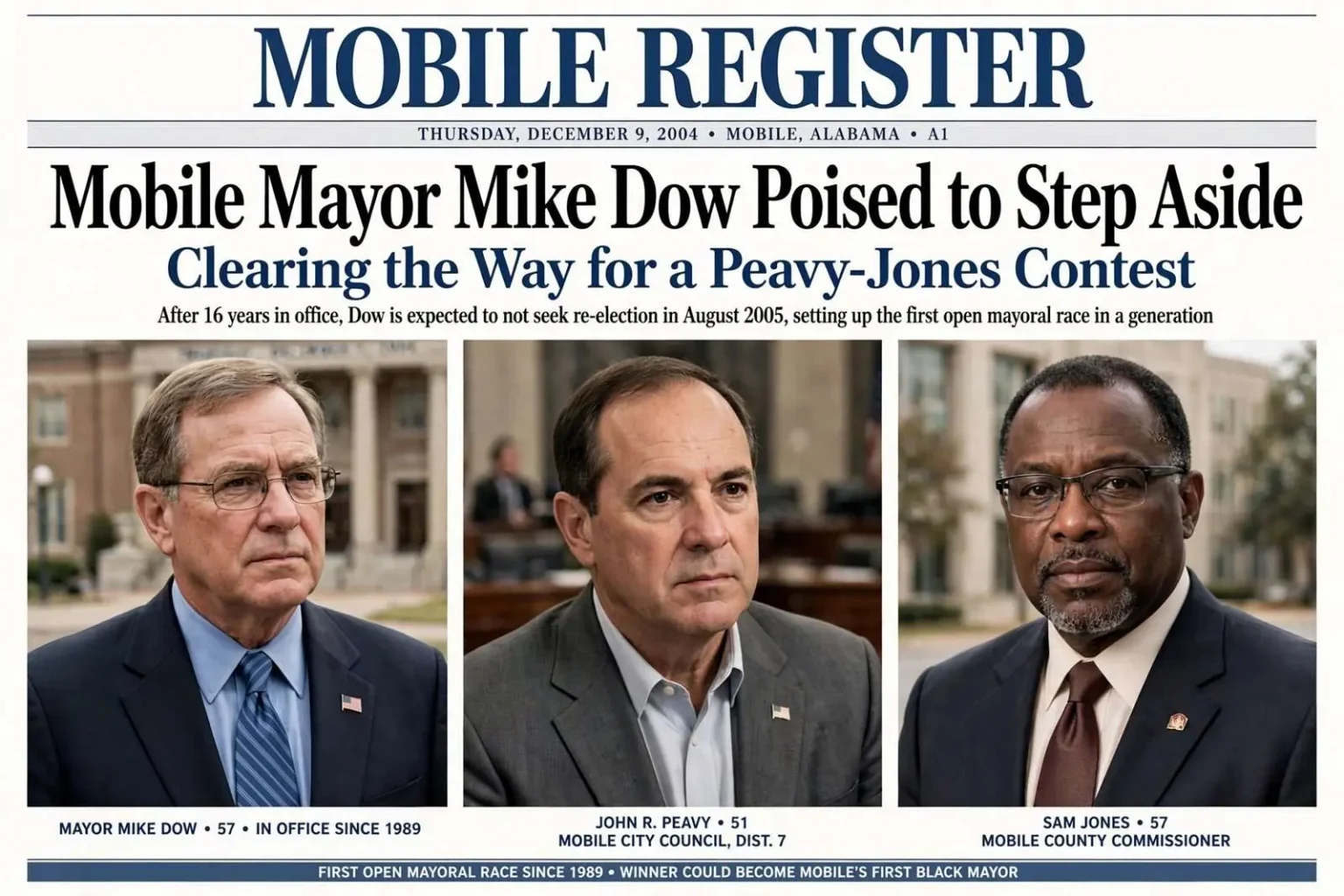
The longest tenure at the head of Mobile city government in modern times appeared to be drawing to a close in December 2004, as multiple people close to Mayor Mike Dow said privately that he did not intend to seek re-election in the municipal elections scheduled for the following August. Dow, 57, would not confirm the reports.
In keeping with a formula familiar to officeholders across Alabama, he said he was running for mayor until the day he said he was not. The calculation was straightforward: an incumbent who announces his departure too early surrenders his leverage and becomes a lame duck long before he has to.
Still, numerous sources insisted the mayor had shared his intentions with close associates, confidants and colleagues at City Hall. If the reports held, Dow’s exit would end 16 years in the mayor’s office and open the first genuinely wide-open race for Mobile City Hall in a generation.
Two Candidates Already Laying Groundwork
The vacuum was already being filled. Mobile City Councilman John R. Peavy and Mobile County Commissioner Sam Jones were both quietly building the foundations of mayoral campaigns. Officially, Peavy was organizing a re-election campaign for his District 7 council seat.
But people close to the 51-year-old construction company executive acknowledged that his ambitions ran to the mayor’s office, and an announcement was expected within weeks. Jones, 57, had also discussed a candidacy with figures around the community.
He was careful, however, to condition his interest on the incumbent’s decision. “He has not said to me that he was not going to run,” Jones said of Dow.
“If he’s not running, I would certainly have an interest.” The mayor, he added, had told him only that he was weighing personal considerations that would shape his course. “If he’s staying, that’s good. I’m supportive of him, as I’ve always been.”
The mayorship, Jones said, was “probably the only other political office that I would have an interest in.” Should he win, Jones would become the first Black mayor in the city’s 300-year history — a milestone that hung over every conversation about the coming race.
A Mobile native and a resident of Toulminville since 1993, Jones had just been re-elected to the County Commission a month earlier. Whether he would have to surrender that seat to run, or could take what politicians call a free shot and return to the commission if he fell short, was not yet clear.
What Comes After City Hall
Dow had been expansively vague about his plans. He had mentioned a possible look at the 2006 governor’s race. He had mentioned opportunities in the private sector.
He liked to close the subject with a joke that 15 years at Mobile City Hall had qualified him to run away and join the circus as either a ringmaster or a lion tamer. The likeliest landing spot, according to those around him, was a return to business alongside his brother-in-law, Jim Busby, at CentraLite Systems. The two had built Quality Micro Systems (QMS) into a New York Stock Exchange–listed printing technology company that was ultimately acquired by Minolta.
The Dow Record
Dow arrived in office in 1989 by defeating incumbent Mayor Arthur R. Outlaw, an upset that announced a political career few had anticipated. A three-tour Vietnam veteran who served as a helicopter door gunner, he used the G.I. Bill to earn undergraduate and graduate degrees at the University of South Alabama.
As mayor, he pointed to a set of accomplishments that had reshaped the city’s self-image:
- Downtown revitalization under the banner of the “String of Pearls,” a tourism and redevelopment strategy built around linked civic attractions.
- Modernized city operations, including technology upgrades, business management systems and in-house strategic planning.
- Sports and recreation expansion, from a college bowl game to the BayBears, the Mysticks, the Revelers and the Wizards, along with a large tennis complex, a Robert Trent Jones golf facility and new stadiums, parks and recreation centers.
- Economic development, through the Mobile Area Chamber of Commerce, the Alabama State Port Authority and the state Commerce Commission, where he chaired the trade subcommittee.
The Challenger’s Resume
Peavy’s roots in city government ran deep. His late father, Thomas K. Peavy, served 25 years as Mobile’s public works director and city engineer; his grandfather was Mobile County engineer.
Peavy himself sat on the City Council from 1985 to 1993, chairing the finance committee, before stepping away. He first sought office in 1982 in an unsuccessful bid for finance commissioner and later lost a school board race in 2000.
A self-described fiscal conservative who treats the budget as the central instrument of municipal management, Peavy is secretary-treasurer and co-owner of Peavy Construction Company. He holds degrees in political science and public administration from the University of South Alabama.
Jones, for his part, spent nine years in the U.S. Navy and led Mobile Community Action from 1980 to 1987 before winning his County Commission seat in July 1987. He is a past president of the Association of County Commissions of Alabama.
With the incumbent silent and two serious candidates in motion, Mobile entered the winter of 2004 facing a municipal election unlike any in its recent past.
What Happened Next
Dow did not seek re-election. Jones won the 2005 mayoral election to become Mobile’s first Black mayor, and he served two four-year terms before losing to Sandy Stimpson in 2013.