A Cullman Upset Set South Alabama’s Political Class Arguing Over What It Meant
James Fields' lopsided win in a north Alabama special election, in a district that is roughly one percent Black, prompted Mobile-area Republicans and Democrats to draw sharply different conclusions.
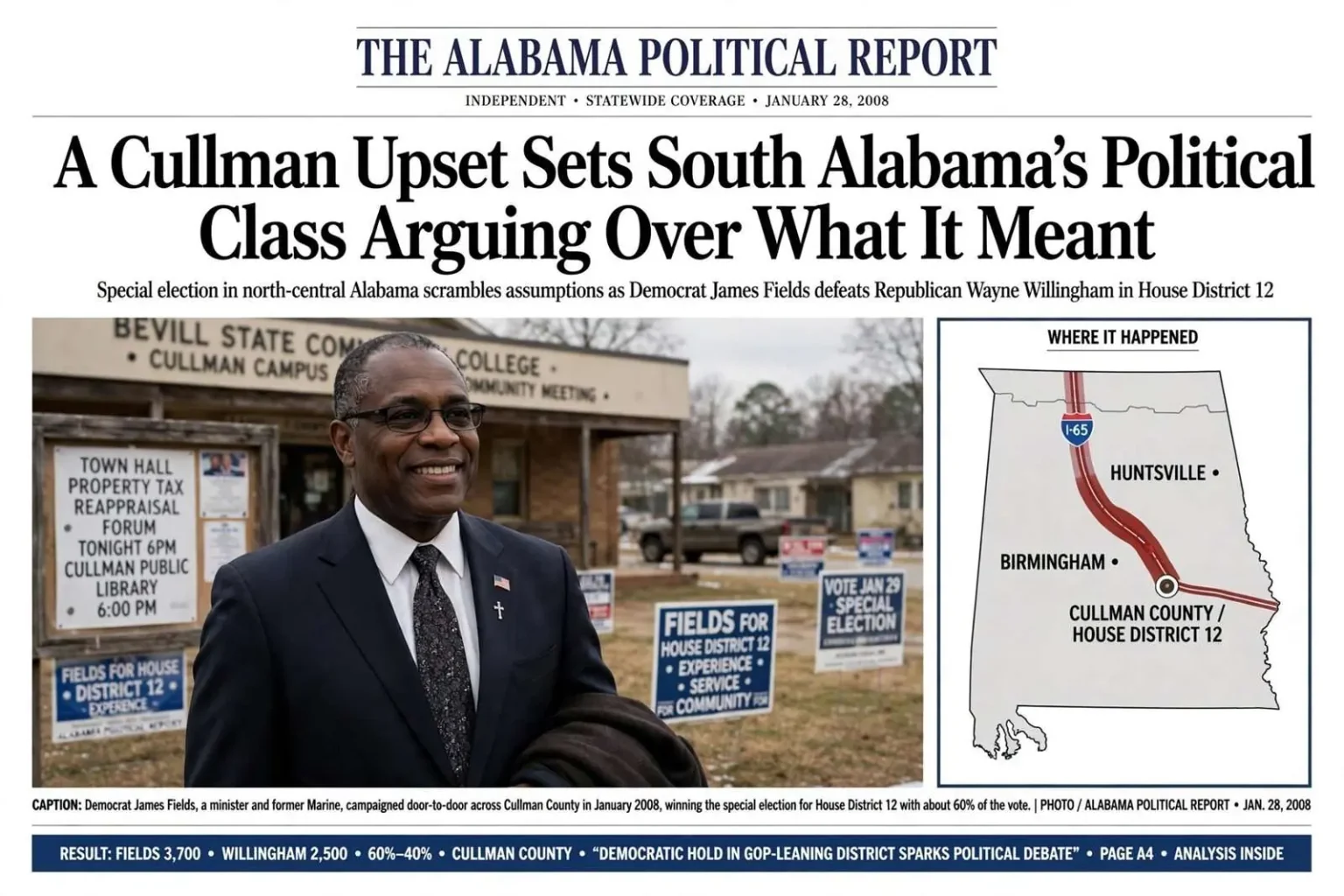
The special election that decided House District 12 was held hundreds of miles from Mobile Bay, but the argument it produced ran straight through south Alabama’s political circles. In late January 2008, Democrat James Fields defeated Republican Wayne Willingham by roughly 3,700 votes to 2,500 — about 60 percent to 40 percent — to fill the Cullman County seat vacated when Democrat Neal Morrison resigned to become interim president of Bevill State Community College.
House District 12 sits in the hill country of north-central Alabama, anchored in Cullman County along the Interstate 65 corridor between Birmingham and Huntsville. It is country that had voted Republican in nearly every federal contest for a generation — and it became the setting for a result that, for a few weeks at least, scrambled the assumptions both parties carried into the 2008 legislative elections.
Why the Result Surprised People
The seat had been in Democratic hands, so the outcome changed no arithmetic in Montgomery. What made it remarkable was the district itself. Cullman County’s population was more than 96 percent white and about 1 percent Black, according to figures from the county’s economic development agency. Fields is Black. Republicans had regarded the seat as a live pickup opportunity in a state where the GOP was steadily building toward legislative control. Fields, a minister and former Marine widely described as an exceptional retail campaigner, won anyway — and won comfortably.
The result was a study in the limits of demographic arithmetic. A candidate who should have been, by every conventional measure, an underdog in a nearly all-white north Alabama county instead swept the contest by twenty points — in a special election with no presidential race on the ballot to swell or reshape turnout. Retail campaigning, door by door and church by church, had carried Fields where a party’s conventional map said no Democrat, and certainly no Black Democrat, could go.
Two Readings of the Same Returns
Democrats treated the result as evidence that the Republican march on the Legislature was overstated. Republicans, for the most part, tipped their hats to the candidate and declined to read anything larger into it.
A Republican legislator from Bayou La Batre called the loss disheartening and said his party might need to reexamine itself at the state and national levels, arguing that the GOP message was not reaching working-class conservatives. He had heard, he said, that Republicans were not united after their primary while Democrats were, and that annual property reappraisal — an issue Fields tied to Gov. Bob Riley — had hurt. The reappraisal issue mattered precisely because it was local and personal: homeowners in a middle-income county were watching property values climb on tax notices, and Fields connected the incumbent administration to their grievance in every appearance he made.
A state Republican official from Theodore was blunter about the strategy: the seat was a Democratic hold, it was uphill on the demographics, and it had not been among the party’s top 15 target districts. Their candidate, he added, was very good. A Republican consultant said flatly that the outcome was a reflection of one man. A Mobile attorney called it remarkable, saying Fields had transcended stereotypes through personal strength as a candidate.
A Birmingham communications professional went further, calling the loss an embarrassment for Republicans who, he argued, had assumed they would win on race alone, and comparing the moment to the 2005 election of Sam Jones as Mobile’s first Black mayor. Jones’s election in a city where Black voters were a majority of the electorate was a different kind of result, but the comparison captured what struck observers most: Alabama voters, in both cases, had judged candidates individually rather than by the categories of the state’s old political arithmetic. Others urged caution. A Republican state senator from Birmingham predicted the race would not be long remembered and said the corruption indictments then rumored in Montgomery would shape the 2010 legislative races far more than any special election. A former Mobile legislator asked the practical question: could Fields hold the seat in a general election, or would he prove to be a special-election phenomenon?
The Larger Current
The Cullman vote landed in the same week that Mobile and Baldwin county voters cast early ballots in Alabama’s presidential primary. A Mobile political consultant, surveying precincts on election day, predicted turnout of about 30 percent and hit it almost exactly. He also reported seeing out-of-state volunteers working for Barack Obama in south Alabama, and noted that Democratic turnout appeared to be running roughly 5,000 votes ahead of Republican turnout locally.
His conclusion was that Alabama politics had become less about race than it had been — pointing to Jones’s election in Mobile and to Obama’s momentum nationally as evidence of the same shift that produced the Fields result. The 2008 Democratic primary, with its contested field and its historic candidacies, was drawing new and infrequent voters to the polls across the state, and the consultant’s precinct surveying suggested the surge was real even in south Alabama’s down-ballot contests. If a Black presidential candidate was out-polling the Republican field in Mobile County precincts, and a Black minister could win a nearly all-white north Alabama House seat in the same season, the old rules of Alabama elections plainly no longer applied in their familiar form.
How It Aged
Fields held the seat in the November 2008 general election, then lost it in the 2010 Republican wave that finally delivered the Alabama Legislature to the GOP after 136 years of Democratic control. Both readings of his 2008 win, in other words, contained some truth. He was an unusually strong candidate. And the Republican advance, delayed in Cullman for one January, arrived on schedule two years later.
The 2010 wave that swept Fields out was part of the same realignment the Cullman special election had briefly concealed. Across Alabama that November, Republicans captured both legislative chambers, the congressional delegation’s remaining Democratic seats fell, and candidates who had survived 2008 on personal strength were caught in a tide that no amount of retail campaigning could outswim. The special election’s lesson about individual candidacy was real; so was the lesson of what followed. Alabama politics in those years was moving through both a generational opening on race and a partisan realignment of historic size — and for one late January week in Cullman County, the first current ran faster than the second.
For south Alabama’s political class, the argument over what Cullman meant never quite resolved, because both sides proved partly right. Democrats who read Fields’s win as proof the GOP’s legislative march had stalled were mistaken by two years. Republicans who dismissed it as a one-off candidate effect were wrong about the candidate — he won a full term — but right about the underlying current. The January result had been, in the end, exactly what the state senator from Birmingham predicted: a race not long remembered, except by those who understood that its two lessons — the power of an exceptional candidate, and the relentlessness of realignment — had both been true at once.
Fields’s personal story was the engine of the upset. A minister with a congregation’s worth of speaking experience and a former Marine with the discipline of a military career behind him, he ran the kind of campaign that old-fashioned Alabama politics rewards: unscripted, personal and everywhere. Voters in a county where most candidates can count on party loyalty had to be persuaded one by one, and by every account of the race he did the persuading himself — in living rooms, at civic meetings, across the ideological gap that the district’s registration numbers suggested was unbridgeable.
Willingham, the Republican nominee, ran into a constituency that was more divided than its registration totals implied. The primary fight that preceded the general contest left the GOP side working from behind, and the reappraisal grievance gave undecided voters a kitchen-table reason to break for the Democrat regardless of party labels. In a low-turnout special election, those localized dynamics outweighed the national climate — a lesson that special elections across Alabama have taught in both directions over the years, since a small electorate rewards candidates who can mobilize personal networks over those relying on party tide.
Bevill State Community College, the institution whose presidency drew Morrison out of the seat, connected the contest to the two-year college system’s sprawling presence in rural Alabama. Bevill serves a multi-county stretch of west-central and north-central Alabama from campuses that anchor small-town economies, and its interim presidency was a significant post in a system then under public scrutiny over its governance. The vacancy it produced set the January special election in motion and, indirectly, produced the result that south Alabama’s political class spent February arguing about.
The argument itself spread through the informal network that moves Alabama political talk — legislators and lobbyists, county chairmen and consultants, the attorneys and communicators whose observations filled the week after the returns. What made the Cullman discussion unusual was its reach: a House special election in the state’s hill country had, within days, generated pointed commentary from Bayou La Batre to Birmingham and become a referendum on the GOP’s entire legislative strategy. Whether the seat’s voters knew their January choice was being read that way hundreds of miles away is doubtful. But the political class was certain of one thing — a result that surprising could not be ignored, whatever it eventually turned out to mean.