Mobile County Voted First: Primary Day on the Coast, and an Obama Operation ‘On Fire’
Because Super Tuesday collided with Mardi Gras, Mobile and Baldwin voted a week early. Democratic organizers reported heavy turnout in Republican strongholds and out-of-state volunteers working the county.
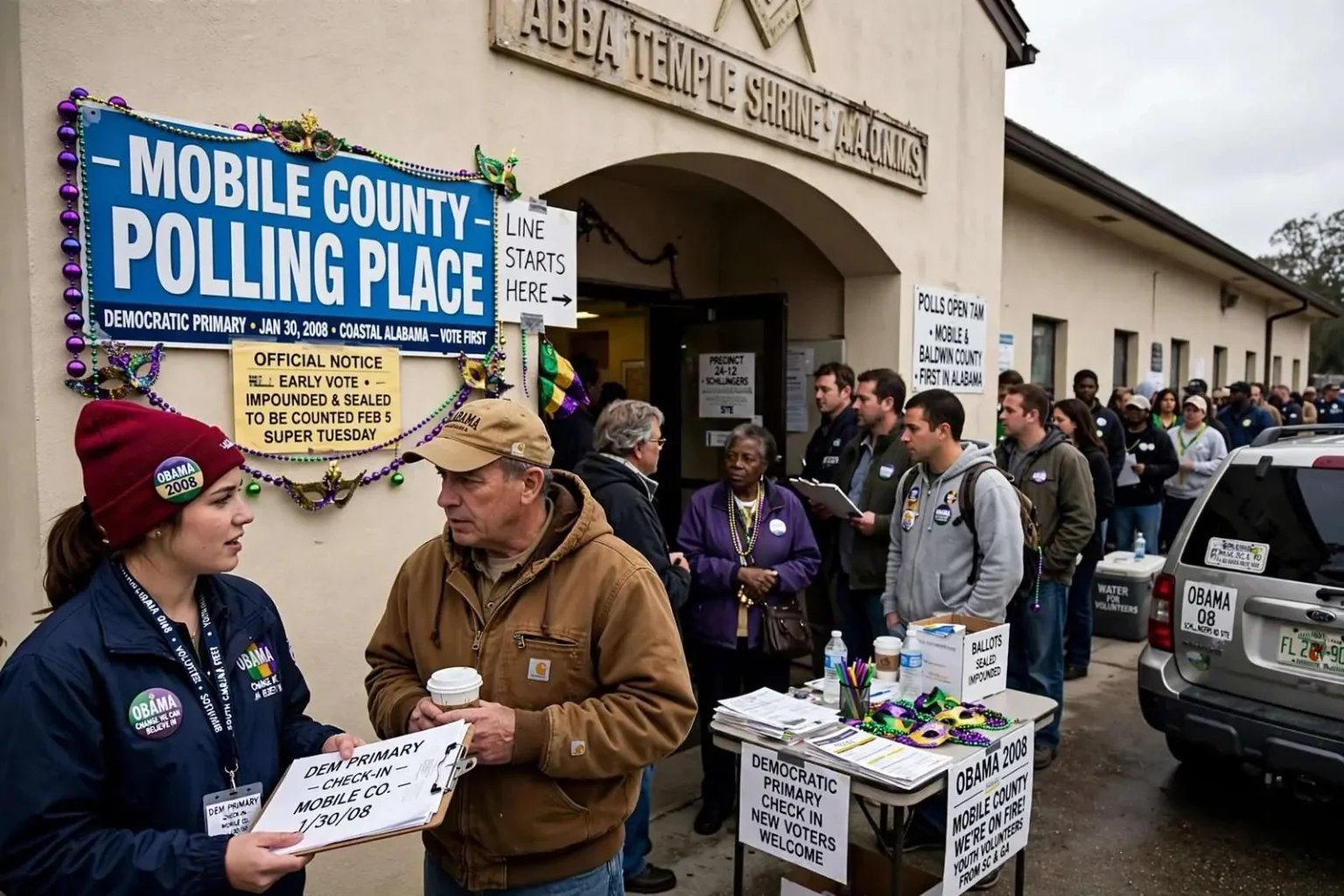
On Wednesday, Jan. 30, 2008, Mobile and Baldwin county voters did something no Alabamians had done before: they cast the first ballots in a competitive presidential nomination fight, a full week ahead of the rest of the state. The reason was Mardi Gras.
Alabama had moved its presidential primary to Feb. 5 to join the sprawling Super Tuesday field, the coast-to-coast jumble of contests that both parties had scheduled to compress the nomination fight into a single evening. But Feb. 5 that year was Fat Tuesday, and in the two coastal counties where parades effectively close the streets and much of civic life, holding an election was impossible. Local officials moved the vote to Jan. 30.
The ballots were cast early and impounded, to be counted with everyone else’s on Feb. 5. Voters in Mobile and Baldwin went to the polls while the rest of Alabama was still being courted, and the campaigns treated the early coastal vote as a proving ground for their operations in the rest of the state.
A calendar built around Carnival
Mardi Gras is not a side event on the Alabama coast. Mobile claims the oldest Carnival tradition in the country, and by the time Lent arrives each year, downtown Mobile belongs to the parades. Schools in the city build their calendars around the season, businesses close, and turnout logistics for anything held on Fat Tuesday would be hopeless. Election officials faced a simple choice: ask coastal voters to vote amid the crowds and street closures of Carnival day, or move the election earlier.
They moved it earlier, and in doing so they created an experiment. For one cycle, Alabama’s presidential primary had an early voting window, and both parties got an advance look at the energy their campaigns were generating on the Gulf Coast.
Democrats report a surge
On the Democratic side, the early vote came amid reports of an operation running far hotter than anything local organizers remembered. The chairman of the Mobile County Democratic Party, who was also a prospective delegate for Barack Obama, described the Obama operation in the Mobile area as “on fire.” He said the campaign had brought 40 young volunteers down from South Carolina specifically to work Mobile County on election day.
What struck him most, he said, was where the Democratic votes were coming from. Working the polls at the Abba Temple Shrine facility on Schillingers Road — in west Mobile, traditionally Republican territory — he reported Democrats turning out in strong numbers in precincts where the party had rarely competed. Those precincts, dominated by suburban and transplanted voters, had for years been reliable territory for the other party, and Democratic poll watchers had rarely had reason to spend election day there.
That observation matched what other local operatives were seeing. One consultant, touring precincts with a Republican counterpart, later estimated that roughly 5,000 more Democratic than Republican ballots were cast in the county, and he predicted Obama would carry Alabama. He was right on both counts.
New faces in familiar places
The surge showed up in ways that had little to do with any single candidate’s field operation. Voters who had never pulled a Democratic primary ballot before were asking for one at precincts across the county. Party officials who had spent years manning sparse tables outside polling places described steady lines at mid-morning, a sight they associated with general elections rather than primaries. For a party accustomed to running against its own apathy in down-ballot years, the 2008 coastal vote looked like the arrival of something new.
The Clinton campaign works the state
The Clinton operation was not conceding Alabama. Former President Bill Clinton was scheduled to campaign for his wife in Huntsville that Saturday, with a fundraising brunch followed by a public event, according to a Clinton campaign representative in the state. The former president remained one of the most potent campaign assets in Southern politics, and the campaign was deploying him to the Tennessee Valley in the final stretch before Super Tuesday.
The former president’s north Alabama itinerary reflected the campaign’s read of the map. Hillary Clinton’s strength in Alabama lay with older white Democrats, party regulars and the organizational networks built over decades — assets concentrated in the Tennessee Valley and the Black Belt courthouse machinery, less so in the coastal counties where new voters were flooding into the process. Huntsville, with its aerospace workforce and its network of established Democratic officeholders, was the kind of terrain where that coalition could be rallied in person.
The campaign also worked the state through its regulars: county chairs, legislators, courthouse figures whose endorsements signaled to traditional Democrats which candidate deserved their ballot. That machinery, built over decades of one-party dominance that had since flipped, remained formidable wherever it was intact.
Out-of-state energy
What made the coastal primary unusual was the visible presence of volunteers who had no reason to be in Mobile. Cars with Florida plates carried Obama signs. Organizers arrived from South Carolina and Georgia. In a state whose primaries were normally decided before anyone bothered to campaign there, the sight of out-of-state canvassers knocking doors in Mobile County was itself the story.
Alabama had spent decades as a late primary afterthought, its delegates spoken for long before the ballot. The compressed 2008 calendar changed that arithmetic for one season, and the campaigns behaved accordingly. Local Democratic officials had spent months predicting that the 2008 cycle would pull people off the sidelines, and they pointed particularly to women and younger voters. Republicans, watching the same trend, were less impressed, noting that the long-promised youth surge had failed to appear in Alabama before.
The skeptics had history on their side. Alabama’s young voters had been the subject of mobilization drives in previous cycles, and the drives had reliably produced less than their organizers promised. What the skeptics could not account for was the combination of a genuinely contested nomination, a candidate drawing first-time participants, and an early vote timed to a week when the entire political world was watching the Gulf Coast.
An impounded ballot box
Because the coastal ballots could not be counted until Feb. 5, the candidates and their staffs spent the intervening week knowing only what the precinct observers had reported: turnout patterns, voter traffic, the moods of poll workers. The actual result waited in sealed custody, a somewhat surreal arrangement for campaigns accustomed to election-night numbers. When the count finally arrived, it would either confirm or puncture the anecdotal reports — and both parties had spent the week talking as though the anecdotes favored the Democrats.
The result
When the ballots were finally counted on Feb. 5, Obama carried Alabama’s Democratic primary, powered by overwhelming support among Black voters and strong showings in urban counties, including Mobile. The early coastal vote that had produced so much chatter in the week before Super Tuesday turned out to be an accurate preview of the state’s Democratic result.
On the Republican side, Mike Huckabee won the state — the Southern strength that local Republicans had predicted for him — while John McCain accumulated the delegates that would ultimately decide the nomination. Alabama’s Republican electorate, long reliable for candidates with conservative credentials and Southern appeal, gave Huckabee a headline win that did little to slow the delegate math working in McCain’s favor across the national map.
That contrast — a headline win that changed little against a grind of delegates that decided everything — became the story of the Republican side of Super Tuesday, and Alabama fit the pattern exactly. Huckabee’s organizers in the state had done what Southern organizers always promised, and McCain’s national operation had built the sort of durable, broad-based coalition that translated into delegates whether or not a given state’s voters picked its winner.
What the early vote proved
For Mobile and Baldwin, though, the memorable part was the calendar. For one election, the coast voted first, and the campaigns came to them.
The experiment left its traces. County election officials had demonstrated that an early, impounded vote could be run cleanly alongside the rest of the state’s, and party operatives on both sides got an advance read on the year’s electorate. Democratic operatives pointed to the west Mobile precincts as evidence that their party’s new voters could be found in places the party had written off; Republicans noted that a presidential year with a contested nomination on their side had produced its own robust turnout.
The deeper lesson was about Alabama’s place in the nominating process. A state accustomed to irrelevance found itself, for one week, the first word in a national contest, and the campaigns spent real money and real people there because of it. Whether the coincidence of Carnival and Super Tuesday would ever repeat — whether the primary would again fall on Fat Tuesday — was a question for future legislatures and future calendars. But in 2008, the coast voted first, the votes sat sealed while the rest of the state caught up, and when everything was counted, the early reports from Schillingers Road had told the story accurately.
In the years that followed, operatives on both sides would point back to that January day as the moment Alabama’s coastal counties demonstrated what a competitive presidential primary could look like: out-of-state volunteers on the doorsteps, unfamiliar lines at the polls, and a Democratic margin in Mobile County that veteran observers had not believed possible until they saw the precinct-by-precinct numbers.