Dow Raises Nothing, Peavy Banks $100,000: Mobile’s Campaign Finance Reports Land
Mayor Mike Dow reported zero contributions for all of 2004 and $18.47 in spending. Councilman John Peavy opened a mayoral account that hit six figures in five days, most of it from a single PAC.
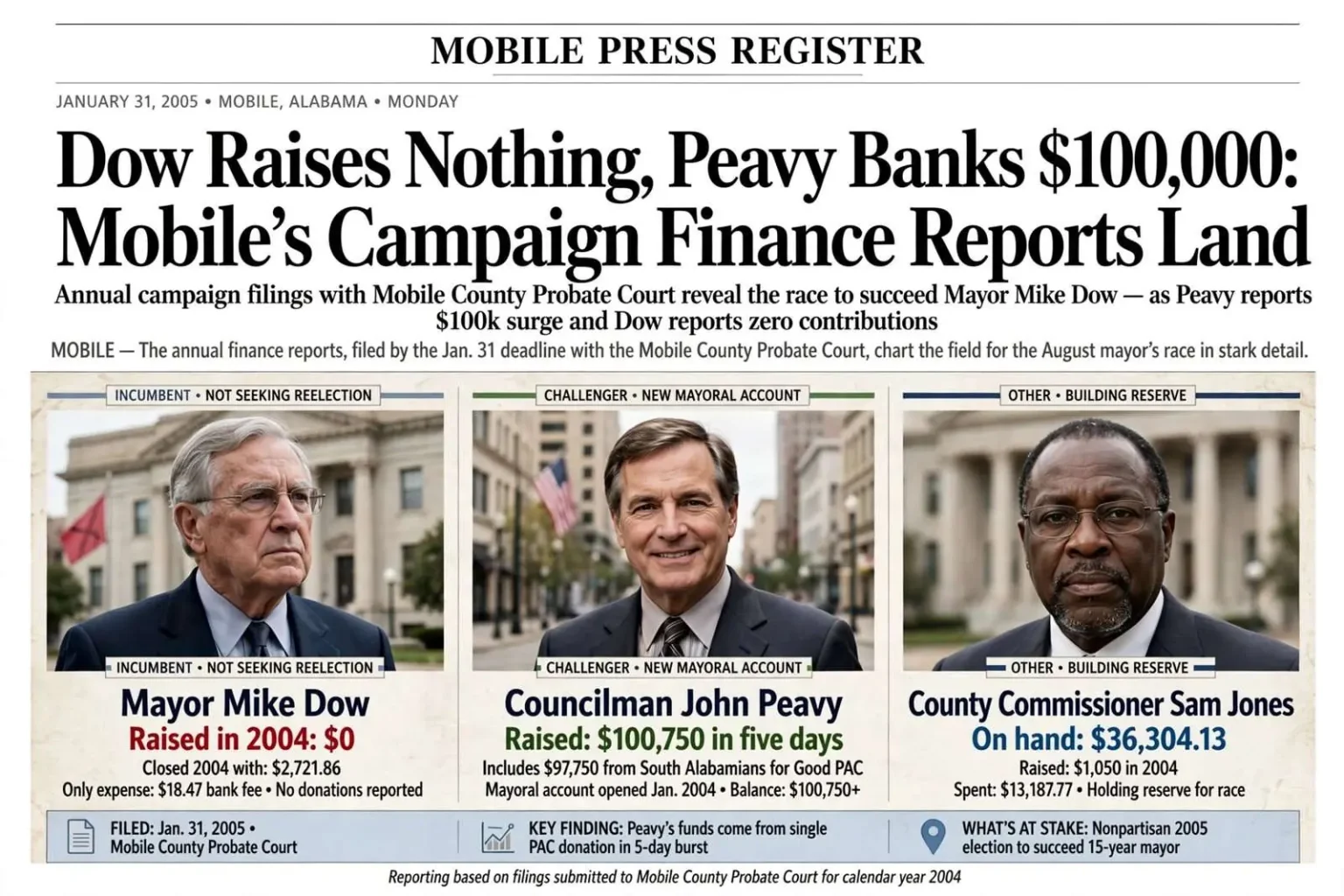
MOBILE — The annual campaign finance reports filed with Mobile County Probate Court told the story of the coming mayor’s race more clearly than any announcement had. Mayor Mike Dow raised no money at all in 2004. Councilman John Peavy opened a mayoral account and put more than $100,000 in it within five days.
Annual year-end filings are a routine obligation for Alabama candidates, and they are filed with the county probate judge rather than a state commission because Mobile’s municipal races run under local rules. But because the reports are cumulative and dated, they often answer questions that campaigns would rather leave vague — whether a candidate is seriously running, where the money is coming from, and who has already committed. This year’s batch did exactly that.
The mayor’s empty ledger
Dow’s report, filed by Monday’s Jan. 31 deadline, showed contributions of zero. Expenditures totaled $18.47 — a bank fee for maintaining the campaign checking account. The account opened the year at $2,740.33 and closed at $2,721.86.
Dow was first elected in 1989 and won re-election three times. He had issued no formal announcement of his plans, but he was widely reported to be forgoing a fifth term in the August city elections, and a campaign that raises nothing in a year is not a campaign preparing to run. The mayor was on vacation and unavailable for comment.
The arithmetic spoke for itself. A four-term mayor with an open reelection account raising no money — not even a token event — in the twelve months before a municipal election is the financial signature of a retirement in progress. Donors do not give to dormant accounts, and candidates do not let accounts idle if they intend to defend the office. Mobile’s political class read the filing as confirmation of what had been circulating for months: that the man who had led the city since 1989, through the closing of Brookley Air Force Base and the rebuilding that followed, was preparing to step aside and let a successor fight for the job.
Peavy’s six-figure week
Peavy, who won a special election in September for the District 7 council seat he first held from 1985 to 1993, filed two reports — one for the council campaign, one for a prospective mayoral bid. The council account showed a balance of $568. The mayoral account showed more than $100,000, virtually all of it arriving in a five-day burst.
The dominant contribution was $97,750 from a committee identified on the filing as “South Alabamians For Good” — believed to be South Alabamians for Good Government, a political action committee that had supported Gov. Bob Riley and Ralph Buffkin, and to a lesser extent Buffkin’s successful Republican primary opponent for Mobile County Commission District 2, Stephen Nodine. The PAC’s roots trace to Riley’s gubernatorial campaign.
Rounding out the six figures were $1,000 apiece from Gavin Bender, the firm SJ&L, Michael Thompson and the Republican Senate Victory PAC.
The scale and the sourcing were both notable. A single PAC transfer of nearly $98,000 into a not-yet-declared mayoral campaign signaled that a substantial share of the state Republican donor network had settled on a candidate in a nominally nonpartisan municipal race.
Money moves like that does not accumulate by accident. Political action committees gather contributions from dozens of individual donors and business interests, then deploy the pooled funds where they will do the most good, and a five-figure transfer days after an account opens means the committee’s leadership had already made its choice. In a city election where ballots carry no party labels, the practical effect was to give one candidate the war chest of a well-funded partisan operation months before the field took shape.
Peavy himself was a familiar figure in Mobile politics. He had represented District 7 — a district covering portions of west Mobile — for eight years in the 1980s and early 1990s, left the council, and returned through the special election held after the seat’s occupant moved on to the County Commission. That return gave him both a current platform and the claim of a veteran officeholder, and the money suggested he intended to use it for something larger than retaining a council seat.
The council campaign
Peavy’s District 7 council campaign opened the period with $12,930, raised $28,300 and spent $40,661.34.
Contributors included Preserve Mobile PAC ($10,000 and later $5,500), Alabama Realtors PAC ($2,000), Alabama Builders PAC ($1,000), Mobile Auto-PAC ($1,000), Bob J. Williams ($1,000), shipping executive David J. Cooper ($1,000), and a long list of smaller donations from Mobile business and professional figures — among them Clarence M. Ball Jr., Braxton C. Counts III, Edward S. Sledge III, Dwain G. Luce and Regions Financial Corp.
Spending fell into two broad buckets. Advertising took the largest single share, led by $17,529.85 to the firm Timbes & Yeager, with additional sums to Cumulus Broadcasting, the J. Rodgers Agency and two sign companies. The rest went to a wide roster of consultants, pollsters and get-out-the-vote workers paid in amounts ranging from $16 to a few hundred dollars each, plus $4,352.36 to the Tyson Organization. The remainder covered transportation, food, administration, utilities and fundraising.
The donor roster mapped neatly onto the city’s business establishment. Industry PACs representing real estate, construction and auto dealers give to council candidates because zoning, permitting and signage decisions land on the council’s desk, and a candidate who later runs for mayor brings those same relationships with him. The get-out-the-vote spending — the Tyson Organization is a Texas-based professional turnout firm — and paid advertising in a low-turnout district race showed a campaign operating at a professional standard even for the seat it was only holding temporarily.
The seat’s recent history
Peavy defeated Rick Collins to serve the final year of the District 7 term vacated by Stephen Nodine. Nodine had been appointed to the seat previously held by former County Commissioner Freeman Jockisch, who was convicted in federal court of mishandling his campaign finances, and Nodine went on to win a full four-year term in November’s general election.
The chain of events behind one council seat illustrates how Mobile County’s offices changed hands in those years. Jockisch’s conviction created a vacancy on the County Commission; Nodine, who had held the council seat, moved up to fill it; and the resulting special election drew Peavy back into the district he had once represented. By the time the finance reports were filed, Nodine had secured a full term at the courthouse, and Peavy held the council seat only until the next city election — which made his mayoral account, not his council account, the one worth watching.
Jones, and the rest of the field
County Commissioner Sam Jones — the other major figure positioning for the mayor’s office — reported an opening balance of $47,692.24 and a closing balance of $36,304.13, with cash contributions of $1,050 and total expenditures of $13,187.77.
Several of the same field organizers and consultants who worked for Peavy also assisted the Jones campaign as administrators during 2004.
Jones’ numbers told a different story than Peavy’s. A sitting county commissioner carrying nearly $48,000 into the year and spending carefully, he was building gradually rather than in bursts — paying down race-year expenses while holding a reserve. The overlap in consultants and field organizers between the two campaigns suggested that the city’s small professional political class was hedging, working for the candidate with the sudden six-figure fund while quietly maintaining ties to the commissioner with the long record and the steady balance.
Two other prospective candidates had surfaced: former City Councilwoman Bess Rich and former state legislator Ann Bedsole. Neither had an active account. Rich’s most recent filing, after her unsuccessful 2001 challenge to Dow, showed a zero balance.
Bedsole’s most recent filing dated to Jan. 17, 1995, following her failed bid for the 1994 Republican gubernatorial nomination — a campaign that spent nearly $1.2 million, drew $992,463.97 from loans, interest and other sources, and ended with a balance of zero.
The absence of filings from Rich and Bedsole was itself a signal, though an ambiguous one. Neither woman was a stranger to Mobile politics: Rich had served on the council and had come within reach of the mayor’s office four years earlier, and Bedsole had been a state senator, a candidate for statewide office and a fixture in Alabama Republican politics for decades. Both would eventually enter the 2005 race. What the January reports showed was that as of the new year, none of them had put money in motion — meaning the field had not yet formed, and the only funded candidacy belonged to Peavy.
Read together, the filings sketched the race to come. An incumbent stepping aside, a councilman armed overnight with state-level Republican money, a county commissioner with a seasoned organization and a modest bankroll, and two well-known figures waiting on the sidelines. City elections in Mobile are officially nonpartisan, but the money told the partisan story underneath: a Republican donor network, built through statewide campaigns, choosing its horse for a municipal office.
What the filings could not show was how voters would weigh the candidates’ records against the money. Peavy’s five-day windfall would become a talking point in its own right — evidence of establishment backing to supporters, evidence of outside influence to critics. Jones would argue that a decade of constituent service at the courthouse mattered more than a single contribution. And Dow’s quiet ledger would stand as the quietest line in the whole file: eighteen dollars and forty-seven cents, spent on a bank fee, by a mayor whose fifteen years in office were coming to an end.
Editor’s note: Mobile’s 2005 mayoral election was ultimately won by Sam Jones, who became the city’s first African-American mayor.