The Front-Runner in Mobile’s Republican Circle
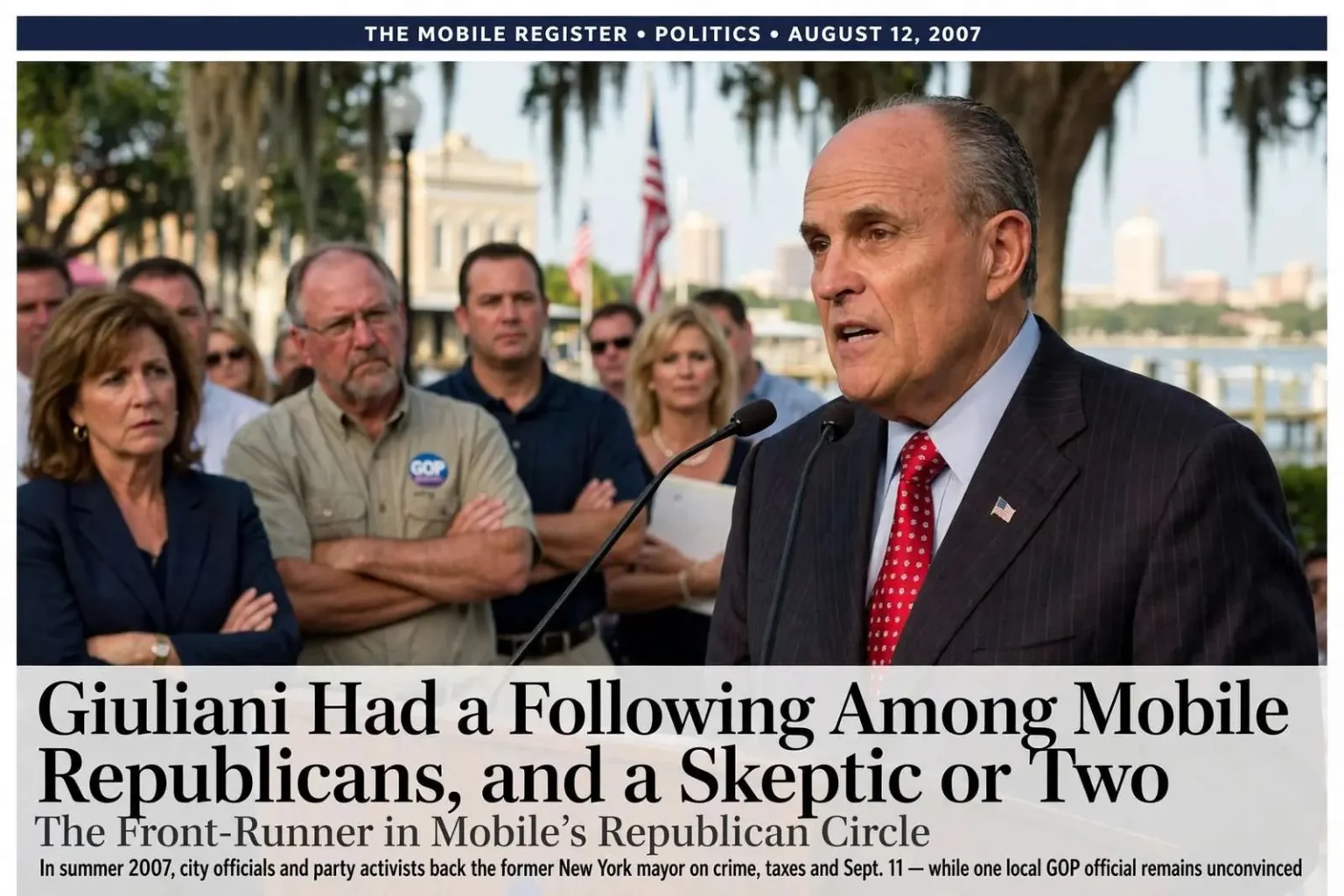
If there was a front-runner among Mobile’s Republican establishment in the summer of 2007, it was the former mayor of New York. Asked whom they favored in the coming presidential race, a striking share of the city’s Republican officeholders and activists named Rudy Giuliani — and they named him for the same reasons, again and again: crime, taxes and Sept. 11.
The consistency of those answers said something about how Giuliani was traveling through the summer of 2007, when he led national polling for the Republican nomination and cultivated an image built on his mayoral record. In Mobile, the appeal crossed the city’s Republican officeholding class, from council members to party officials, and rested on the same three-legged case his national campaign was making: that he had transformed the country’s largest city, and that the man who did that was the right answer to terrorism.
What made the responses interesting was not the consensus but the dissent inside it.
The case for Rudy
Former Mobile city councilwoman Bess Rich made an argument built almost entirely on Giuliani’s record as a municipal executive. “I really like his stand on taxes and how they affect our economy,” she said. “He did a fabulous job of turning around New York City by reducing taxes, not a simple job.” She admired that he had returned a $10 million donation from a Saudi official after the Sept. 11 attacks, calling him “a man of conviction who you will always know where he stands.”
For a former councilwoman, the tax argument carried professional weight. Municipal executives live inside the arithmetic of budgets and revenue, and Rich’s praise focused on the rarest of municipal achievements, cutting taxes while governing a city whose finances were famously difficult. The donation anecdote she cited became a staple of the Giuliani campaign’s character argument: that a mayor who handed back $10 million in the days after the city’s worst attack was showing the kind of conviction voters could count on.
City Councilwoman Connie Hudson made a similar case in a lawyer’s register. Giuliani’s zero-tolerance approach to crime, she said, had cut New York’s homicide rate by around 60 percent during his tenure, and he was “a proven fiscal conservative who is dedicated to lowering taxes and reducing the size and cost of government.” She believed he was capable of the strong leadership the country needed on terrorism and national security.
Hudson’s citation of the homicide statistic reflected the centerpiece of the Giuliani record, the crime decline that made him a national figure long before the presidential race. For local officials who governed public safety budgets themselves, the notion that a mayor could bend a city’s crime curve through management and enforcement was the most persuasive evidence he could offer of executive ability.
The most elaborate endorsement came from Jerry Lathan, a Republican official and Theodore roofing contractor, who laid his reasoning out in numbered points. Winning, he argued, was paramount, and Giuliani was the Republican most likely to do it — carrying every state George W. Bush had won while putting New Jersey, Pennsylvania and possibly New York, Michigan and Wisconsin in play.
Lathan’s map was the strategic argument that kept Giuliani atop national polls through 2007, the claim that a moderate Republican could expand the electoral map rather than merely defend it. The states he listed — New Jersey, Pennsylvania, New York, Michigan, Wisconsin — were the Northeastern and Rust Belt battlegrounds where a law-and-order former New York mayor could, in theory, compete where conventional Republicans could not.
Lathan did not pretend the differences were imaginary. On abortion, he wrote, “Frankly he is just wrong on this issue.” But he argued that what mattered in practice was judicial appointments, and that Giuliani “simply will not appoint liberal activist judges.”
That reasoning became the standard answer socially conservative Republicans gave for supporting a candidate who supported abortion rights: that presidents shape the courts for decades, that a president’s judicial appointments are constrained by governing realities, and that electability in the general election mattered more than the nominee’s position on a single issue. It was a pragmatic case, and Lathan made it explicitly, weighing the policy disagreement against the electoral calculation and choosing the calculation.
The Republican who wasn’t buying it
A Republican official who asked not to be named made the opposite case, and made it bluntly. “As with many G.O.P. activists, nobody has really caught my eye yet,” he said.
He had looked at Mitt Romney “until I investigated the ‘flip flops.'” Mike Huckabee and Duncan Hunter were closer to his thinking but were long shots. Fred Thompson interested him, but Thompson’s history of cancer gave him pause.
His comments trace the conservative grass roots’ 2007 almost exactly. Romney’s repositioning on social issues between his Massachusetts campaigns and his presidential run was already the subject of opposition research and activist skepticism. Huckabee, a former Arkansas governor and Baptist minister, and Hunter, a California congressman who championed border enforcement, appealed to movement conservatives but polled far behind the front-runners. Thompson’s entry into the race that summer excited conservatives looking for an alternative, while his health history gave wary activists one more reason to hesitate.
What genuinely puzzled him was his own side’s enthusiasm for the front-runner. “I am really surprised at some of the conservatives supporting Giuliani. He is the closest thing to a Republican liberal, especially on the life issue. He could not beat Hillary in New York for Senate, and withdrew, so how could he beat her nationally?”
The question rested on a real episode. Giuliani had run for the Senate seat against Hillary Clinton in 2000, launched a campaign, and abandoned it — citing his prostate cancer diagnosis and, at the time, a collapsing personal situation — leaving the race to Rick Lazio, who lost to Clinton badly.
It was, in retrospect, the most accurate prediction in the batch. Giuliani’s campaign, for all its early polling strength, collapsed the following winter without winning a single early state.
The unnamed skeptic had identified the structural weakness the rest of the 2007 field spent the year discovering: Giuliani’s national polling lead was not built on the activists, donors and caucus-goers who actually choose nominees, and his strategy of deferring the early states caught up with him once actual voting began. The Mobile consensus, meanwhile, evaporated with the polls.
Democrats keeping their options open
The Democrats consulted were mostly uncommitted and cheerful about it. State Sen. Roger Bedford of Russellville reported that he had not fully decided but had lunched with John Edwards in Montgomery that day: “He handled the issues very well.”
The lunch was the kind of retail politics presidential campaigns do in Alabama during the long year before the state’s primary, when candidates with modest national operations still make the rounds of Democratic officeholders seeking endorsements and introductions. Bedford’s verdict, that Edwards handled the issues well, reflected the former North Carolina senator’s standing among Southern Democrats, who remembered his 2004 vice presidential candidacy and his emphasis on economic issues that played in manufacturing regions.
Mobile attorney Vance McCrary saw an embarrassment of riches. “Clinton, Obama and Edwards all offer intelligent, creative and refreshing ideas that give me great confidence in them,” he said. “I still think Gore could be a formidable candidate as well.”
The possibility of a late entry by Al Gore, fresh from an Oscar and on his way to a Nobel Prize, hung over the Democratic race all summer. It never materialized.
The Gore speculation was the Democratic equivalent of the Giuliani bandwagon, a candidate whose polling support existed largely in the imagination of a public that had not been asked to vote for him. The Oscar and the Nobel recognition that followed made Gore the most decorated non-candidate in either party, and uncommitted Democrats like McCrary kept the draft effort alive. Gore’s decision not to run resolved the question the following autumn.
A district attorney doing his homework
Mobile County District Attorney John Tyson Jr. described an approach that was less about endorsement than reconnaissance. “I have been hoping to hear more from General Wesley Clark,” he said. “This year is a once in a lifetime opportunity to meet presidential candidates and I intend to meet everyone that comes to Alabama. So far I have met three and had in depth conversations with two.”
Both, he said, were impressive. “It promises to be an exciting couple of years.”
Tyson’s method stood out for its refusal to commit. A district attorney’s endorsement carries weight with law enforcement audiences but costs a candidate nothing to withhold, and Tyson treated the campaign season as an educational opportunity rather than a selection process. His interest in Clark, the former NATO supreme allied commander, fit the pattern of officeholders drawn to military credentials in a post-Sept. 11 cycle.
Not every officeholder was playing. A spokeswoman for Alabama Secretary of State Beth Chapman had a one-line answer: “Secretary Chapman has not made an endorsement in the presidential race.”
The 2007 snapshot in hindsight
Read across the group, the Mobile responses captured the Republican Party’s 2007 dilemma in miniature. Its establishment, represented by the council members and party officials who backed Giuliani, was prepared to trade social-issue disagreements for electability and executive record. Its grass roots, represented by the unnamed official, could not square that trade with movement priorities and kept searching for an alternative. The tension resolved the following year when a candidate acceptable to neither faction of the Mobile snapshot won the nomination, a reminder that party establishments and primary electorates are often choosing on different criteria.
The Democrats’ uncommitted cheerfulness aged differently. The Clinton-Obama-Edwards field McCrary praised so evenly would spend 2008 fighting to the convention’s doorstep, and his inability to choose among them proved durable — Alabama Democrats, like Democrats nationally, split their affections across the same field for months. Tyson’s reconnaissance, meanwhile, turned out to be the most prescient posture of all, in a cycle when every candidate he might have endorsed came with an expiration date.
For Mobile, the survey was a small window on a large process: how a city’s political class sorts a presidential field years before most voters pay attention. The Giuliani consensus, the conservative dissent, the Democratic fence-sitting and the one-line refusal from the secretary of state’s office were all, in their way, forecasts. The most accurate came from the skeptic nobody named.