University of South Alabama Gulf Shores
Oral Histories, a Climate Teach-In and a Bridge Reopening: Mobile’s Late-Winter Calendar
A national oral history project came to Mobile's libraries, students organized a global warming teach-in at South Alabama, tourism officials courted snowbirds, and the Navco Road bridge neared reopening.
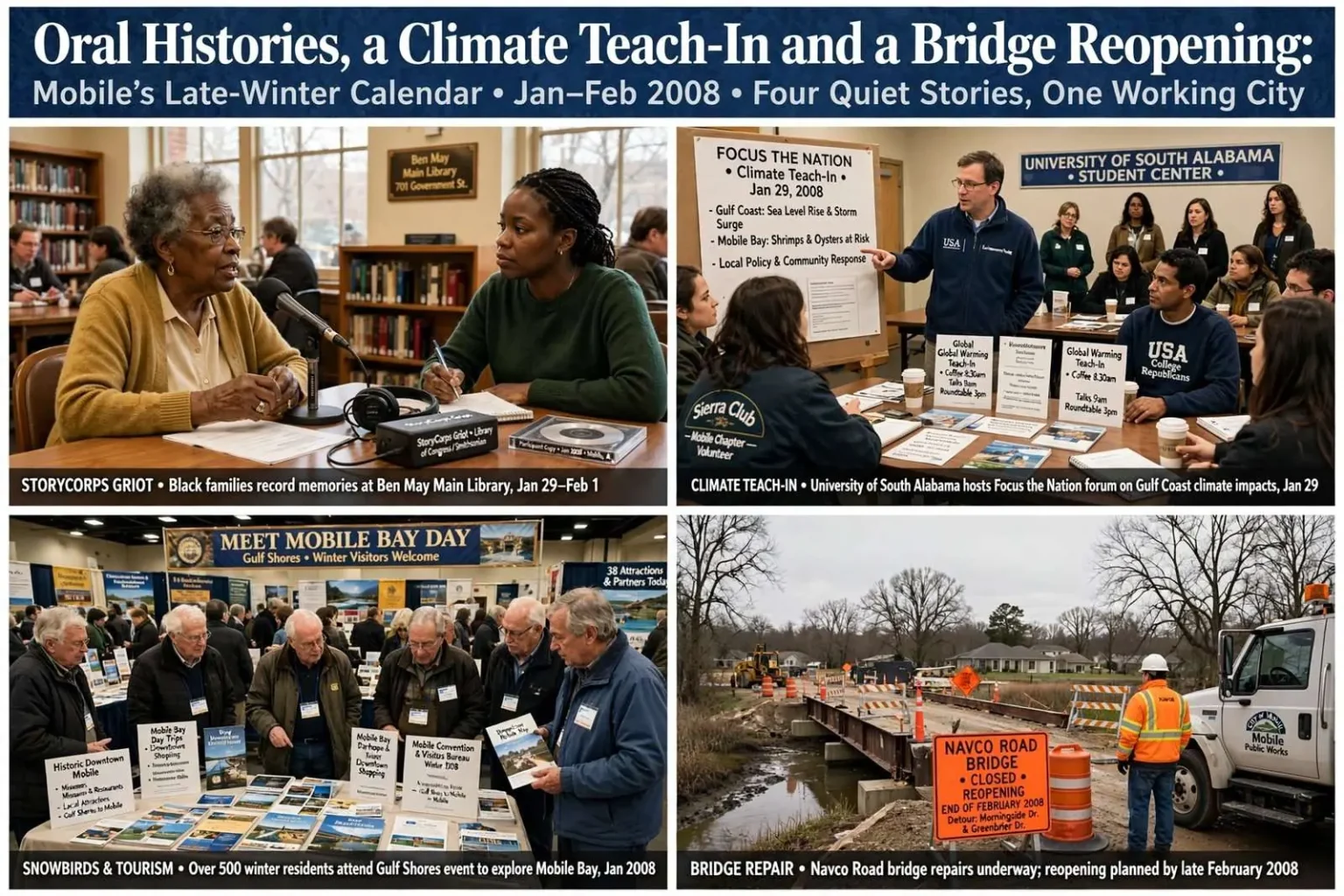
Beyond the campaign season, Mobile’s civic calendar in late January 2008 filled with the sort of events that shape a city quietly: a national effort to record Black family histories, a university teach-in on climate, a tourism push aimed at winter visitors, and a bridge repair that determined how thousands of drivers got home. None of the four dominated the headlines the way an election does, but each one touched a different layer of daily life in the Port City, from the archive shelf to the morning commute.
StoryCorps Griot comes to the libraries
StoryCorps Griot, a one-year initiative to gather and preserve the life stories of African American families across the country, scheduled recording sessions in Mobile. The project was a partnership with the Library of Congress and the Smithsonian’s National Museum of African American History and Culture, working locally in cooperation with WVAS 90.7 FM and Alabama State University. The initiative took its name from the griots of West Africa, the storytellers and oral historians charged with carrying a community’s memory from one generation to the next, and it aimed to do much the same work with modern recording equipment.
The format was simple and deliberate. Two people who knew each other sat down for a 40-minute conversation, guided by a trained facilitator who handled the technical side. The idea behind pairing friends and relatives was that the best interviews rarely come from a stranger’s questions; they come when a granddaughter asks her grandmother how she met her husband, or when two old coworkers compare notes on how a neighborhood used to look. Participants received a broadcast-quality CD of the conversation, and with their permission, copies were placed with the American Folklife Center at the Library of Congress and with the Smithsonian museum, which was then still years from opening its doors on the National Mall. Excerpts could also air on WVAS.
Sessions were set for the Ben May Main Library at 701 Government St. from Jan. 29 through Feb. 1, and at the Mobile Public Library’s Toulminville Branch, 601 Stanton Road, on Feb. 2. Appointment slots were limited, and the split between the two locations mattered. The downtown main library sat in the heart of the city’s civic district, while the Toulminville branch stood in one of Mobile’s historic Black neighborhoods, close to the families whose stories the initiative most wanted to capture. Placing sessions in both places lowered the practical barriers of transportation and familiarity that often keep community recording projects from reaching the people they are meant for.
The stakes were larger than the recording equipment suggested. Mobile’s Black community — in Toulminville, in Prichard, in the neighborhoods along Dr. Martin Luther King Jr. Avenue — held living memory of segregation, of the port and shipyard economy, of church and school life that had rarely been captured in the official record. The first generations of Black professionals in the city’s hospitals, schools and shipyards were growing older, and the neighborhoods that anchored Black commerce along Davis Avenue had changed dramatically in the decades after integration. StoryCorps Griot was an attempt to get it on tape while the people who lived it could still tell it.
The Mobile sessions also connected the city to a larger archival project. The American Folklife Center at the Library of Congress had spent decades collecting American vernacular culture, from folk music field recordings to veterans’ interviews, and the addition of hundreds of African American family conversations from communities like Mobile filled a gap that official histories had left open. For the families who sat down in the booth, the value was closer to home: a CD that could be handed to grandchildren, and a place in the national record for stories that would otherwise have stayed inside a single living room.
A teach-in at South Alabama
On Tuesday, Jan. 29, the University of South Alabama hosted a global warming teach-in, one of hundreds of events staged that day on campuses nationwide as part of the Focus the Nation project. The effort, built around a single day of coordinated climate programming at colleges and universities across the country, was designed to move climate change out of the science journals and into public discussion, campus by campus. In Alabama, where the state’s economy has long been tied to energy, manufacturing and timber, that conversation carried its own local weight.
The Sierra Student Coalition organized the local program, putting the campus’s student environmental group in charge of logistics for an event that mixed classroom science with civic debate. USA professors and outside speakers were scheduled to discuss aspects of what organizers called the climate crisis, spanning the scientific case, the policy responses under discussion in Washington, and the regional implications for a Gulf Coast city with rising water at its doorstep. For a university that trains nurses, engineers, teachers and health professionals, the teach-in framed climate change not as a single-issue cause but as a backdrop to nearly every career its students were preparing for.
The day was built around a roundtable of local voices, including a Democratic congressional candidate, the president of the campus College Republicans and a representative of the Mobile Sierra Club — an attempt, in a conservative state, to keep the conversation from collapsing into partisan lines. That structure reflected the founding premise of Focus the Nation itself: that climate policy would only move when people who disagreed politically learned to discuss the same set of facts in the same room. On a campus where many students came from families in the energy and chemical industries, the inclusion of the College Republicans was less a concession than a necessity.
Coffee was served at 8:30 a.m. in the Student Center, talks began at 9, and the roundtable convened at 3 p.m. The schedule gave the event the feel of a daylong open house rather than a single lecture, with students free to drop in between classes. The Gulf Coast context gave the science an immediacy it lacked in colder parts of the country: south Alabama faces hurricane-driven storm surge, slowly rising sea levels along Mobile Bay, and the long-term question of what warming means for the shrimp and oyster industries that still anchor the working waterfront from Bayou La Batre to Bon Secour.
Snowbirds and the tourism pitch
More than 500 winter residents attended the annual “Meet Mobile Bay Day” in Gulf Shores, the largest crowd in the event’s history, according to the Mobile Convention and Visitors Bureau. Some 38 attractions and tourism partners set up to introduce their offerings to the visitors, turning the gathering into a one-day marketplace for everything from historic sites to restaurant groups on the western side of Mobile Bay.
The snowbird economy was a real one along the Alabama coast. Retirees from the Midwest and Canada spent months in Baldwin County condominiums and RV parks each winter, and getting them to drive west across the bay for a day of shopping, restaurants and museums was a measurable gain for Mobile businesses in the slowest season of the year. Winter visitors fill a seasonal gap that no other demographic touches: they arrive after the summer beach crowds have gone home, they stay for weeks rather than weekends, and they spend like residents rather than tourists, on groceries, haircuts, church suppers and golf fees across Foley, Gulf Shores, Orange Beach and Fairhope.
The cross-bay pitch was the logical next step for a region that had learned to market itself as one destination. A winter visitor based in Baldwin County could just as easily spend a day at the museums and restaurants of downtown Mobile, and “Meet Mobile Bay Day” was designed to plant that idea directly, attraction by attraction. With dozens of partners under one roof, the event compressed a season’s worth of advertising into an afternoon of conversation with the people most likely to act on it.
Getting the Navco bridge back
City officials said they hoped to complete repairs to the Navco Road bridge and reopen it to vehicles by the end of February, weather permitting. Until then, drivers were directed to detour by way of Morningside Drive and Greenbrier Drive to reach Halls Mill Road. For a structure most commuters had crossed without a second thought for years, the closure had an outsized effect, adding miles and minutes to trips that had once taken seconds.
The Navco Road corridor serves a web of residential neighborhoods in west Mobile, the kind of area where the school run, the grocery run and the commute to work all funnel through the same two-lane streets. When a neighborhood bridge closes, the detour routes absorb traffic they were never designed for, and streets like Morningside Drive and Greenbrier Drive suddenly carry an unfamiliar volume of cars at rush hour. The scheduled reopening, dependent as always on Gulf Coast weather, represented the difference between a temporary inconvenience and a months-long rearrangement of daily routines.
The repair work also illustrates a persistent theme in Mobile’s infrastructure: the city’s low terrain, marshy pockets and creek crossings mean bridges and drainage structures are scattered through even ordinary residential districts, and each one ages on its own clock. Winter, with its drier stretches and lighter traffic than Mardi Gras season brings downtown, is the natural window for this kind of work — which is why the end-of-February target mattered to city crews and neighborhood residents alike.
It was an unglamorous item, but for the neighborhoods on either side of the closure it was the news of the month — the sort of everyday infrastructure work that rarely makes headlines and always makes commutes.
Four quiet stories, one working city
Taken together, the four items sketch a portrait of how a mid-sized Southern city actually functions in the weeks after a campaign ends. A national oral-history project treats a public library branch as a vault for community memory. A university turns a Tuesday over to a subject its region would rather debate than ignore. A convention bureau courts Canadian retirees across county lines. A Public Works crew chases a weather-permitting deadline on a two-lane bridge.
Each of them also reflects a Mobile constant: the city’s civic life runs through institutions that outlast any single news cycle. The library system, the university, the convention bureau and the city’s road crews were all still doing the same jobs a generation later, and the late-winter calendar of 2008 was simply one month’s snapshot of that continuity. For residents, the value of the week lay not in any single announcement but in the ordinary machinery turning underneath them — recording, teaching, welcoming and rebuilding, one appointment, lecture, reception and repaving at a time.