408-Foot Riverboat Casino Sunk Off Orange Beach Completes Alabama’s Big-Ship Reef Trio
The 408-foot Argosy VI, prepped in Bayou La Batre, was sunk 23 miles south of Orange Beach in 120 feet of water, completing a trio of large ship reefs alongside the LuLu and the New Venture.
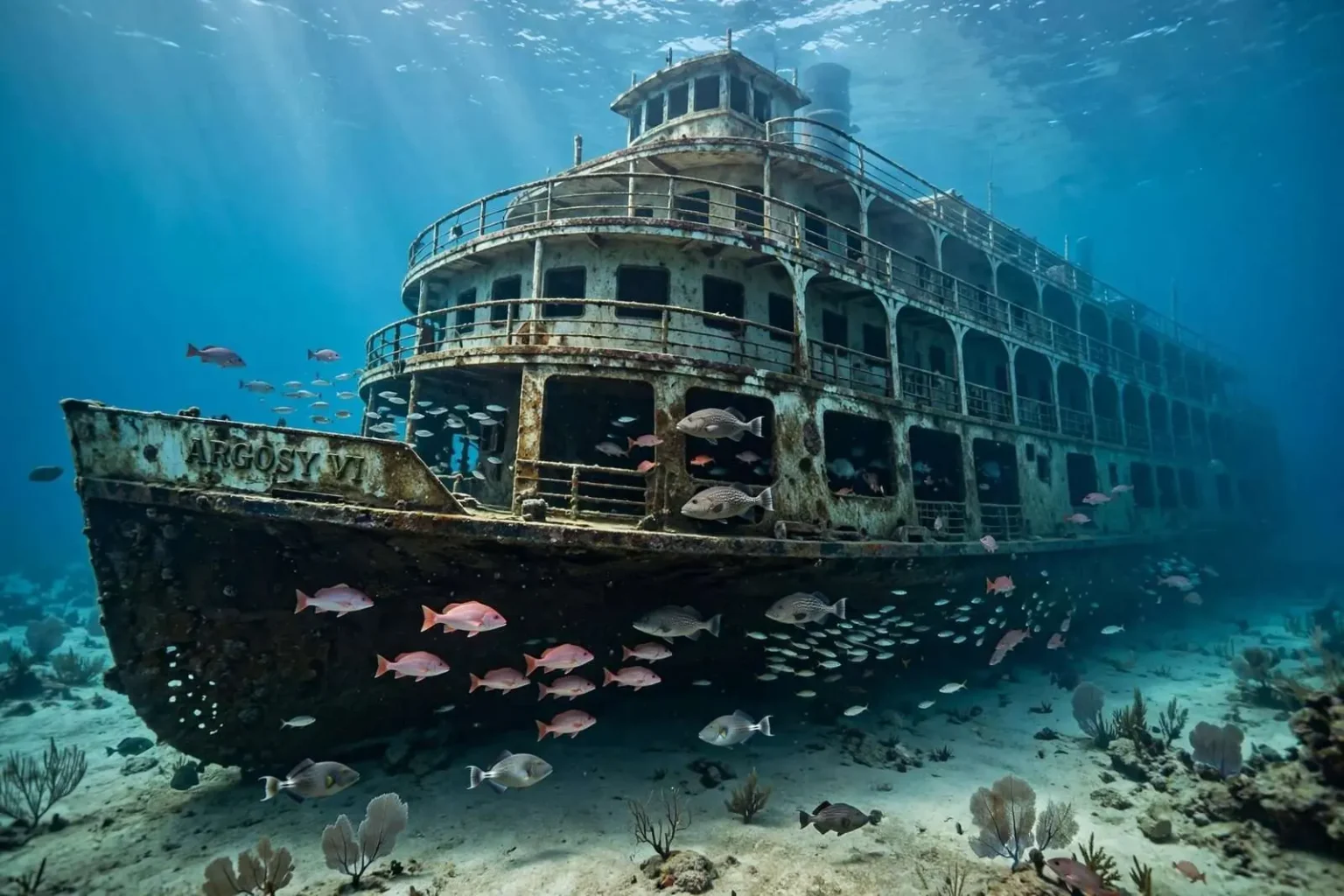
A 408-foot former Indiana riverboat casino now sits on the floor of the Gulf, 23 miles south of Orange Beach, where it will spend the next several decades doing something it was never designed to do: growing fish. The Argosy VI was intentionally sunk in 120 feet of water, coming to rest with 62 to 64 feet of water above it at coordinates N29 degrees 52.206 minutes, W087 degrees 34.984 minutes.
It is the newest and one of the largest additions to Alabama's artificial reef system, and its deployment completes a plan that state conservation officials have been assembling for more than a decade.
The Bayou La Batre Connection
Before the vessel could go anywhere, it had to be made safe to sink. That work happened in Bayou La Batre, the Mobile County seafood and shipbuilding town that has quietly served as the staging ground for a great deal of Gulf maritime work.
Crews there stripped equipment and cleaned the ship, removing grease, fuel, hydraulic fluid and any other material that could contaminate the marine environment. Large openings were cut into the hull and superstructure, both to ensure the vessel sank properly and to give divers and marine life safe passage through the interior. The Argosy had been tied up in Bayou La Batre for years. It arrived, along with another casino vessel, ahead of Hurricane Sally in 2020, and it has been an object of local speculation ever since.
"People were constantly asking me about repurposing those casino barges into reefs," said Craig Newton, district supervising biologist with the Marine Resources Division. "Now five or six years later, here we are. It was not the intention for those boats, but through some opportunities provided through GoMESA funds, we were able to work out an agreement with the owner."
Completing a Trio Started in 2013
The Argosy VI does not stand alone. It joins the LuLu, reefed in 2013, and the New Venture, deployed in 2018.
All three sit within 7.5 miles of one another, and that proximity is the entire point. "I am excited to add this huge reef to our already legendary Alabama Artificial Reef Zone," said Conservation Commissioner Chris Blankenship. "This sinking completes the dream we started back in 2013 with the reefing of the 272-foot-long LuLu. Our goal at MRD, along with the Alabama Gulf Coast Reef and Restoration Foundation, was to build three large ship size reefs in fairly close proximity and use the synergies to drive dive operators and fishing business opportunities."
The clustering means a charter boat or dive operation can visit all three sites in a single day offshore. That is not a small consideration for the Orange Beach charter fleet, which sells trips on the strength of what it can deliver in an eight- or ten-hour window.
Why a Casino Boat Makes a Better Reef Than a Cargo Ship
Alabama has been sinking Liberty ships off its coast since the 1970s. Those vessels measured about 440 feet long and roughly 50 feet wide. The Argosy VI is shorter at 408 feet but dramatically wider, with an 80-foot beam and four decks of height. "The casino vessel is 80 feet wide, and it will provide a more vertically complex type of habitat than what the Liberty ships provided," Newton said.
He noted that the Liberty ships have been reefed for more than 50 years and have absorbed a half-century of storm damage in a punishing saltwater environment. Vertical complexity is the key term. Fish do not simply want something hard on the bottom; different species occupy different heights and different kinds of void space. A four-deck structure with cut openings and overhangs offers far more distinct micro-habitats than a flat-decked freighter.
What Will Live There
Artificial Reef Coordinator Russell Rigby said transitory fish could begin using the structure within hours of deployment, though a fully developed community takes roughly a year to establish.
- Snapper: Red, gray and vermilion snapper are all expected to use the void spaces, with vermilion in particular favoring the size and vertical relief.
- Grouper: The openings and overhangs were specifically designed with grouper habitat in mind.
- Pelagics and amberjack: The vertical relief should attract species that hold higher in the water column.
- Gray triggerfish and other reef species common to the Alabama zone.
"We're looking at a structure that will last 30 to 50 years and provide the people of Alabama a great resource," Rigby said.
A Dive Site as Much as a Fishing Spot
With the top deck expected to sit at roughly 60 feet below the surface, the Argosy VI is accessible to recreational divers across a wide range of certification levels, not just technical divers. Newton said the site was chosen partly because its sandy bottom tends to produce clearer water. "Scuba divers who are making a trip offshore can see a traditional shipwreck, and within the same day, see an old riverboat casino," he said.
The Reef Zone in Context
Marine Resources Director Kevin Anson noted that Alabama's artificial reef zone spans roughly 1,100 square miles and contains more than 12,000 reef structures, most of them small pyramid-shaped units deployed routinely. Large vessels like the Argosy VI are the exception rather than the rule, and they serve to diversify what the system offers. Funding came through the Gulf of Mexico Energy Security Act following Gov. Kay Ivey's 2025 approval.
GoMESA channels a share of federal offshore energy revenue back to coastal states for conservation and restoration work, and it has become a significant funding source for Alabama's reef program. Enacted by Congress in 2006, the law directs 37.5 percent of qualified revenue from certain Gulf of Mexico oil and gas leases to Alabama, Louisiana, Mississippi and Texas and their coastal counties and parishes, subject to an annual cap.
Deputy Commissioner Charlanna Skaggs, who toured the vessel in Bayou La Batre before it was towed offshore and watched the deployment from the water, called it "one of our larger reefs at more than 400 feet."