Two strands of Republican energy ran through South Alabama that spring: an argument about who could win the White House, and a very visible show of force in the halls of the State House.
The Case for Giuliani
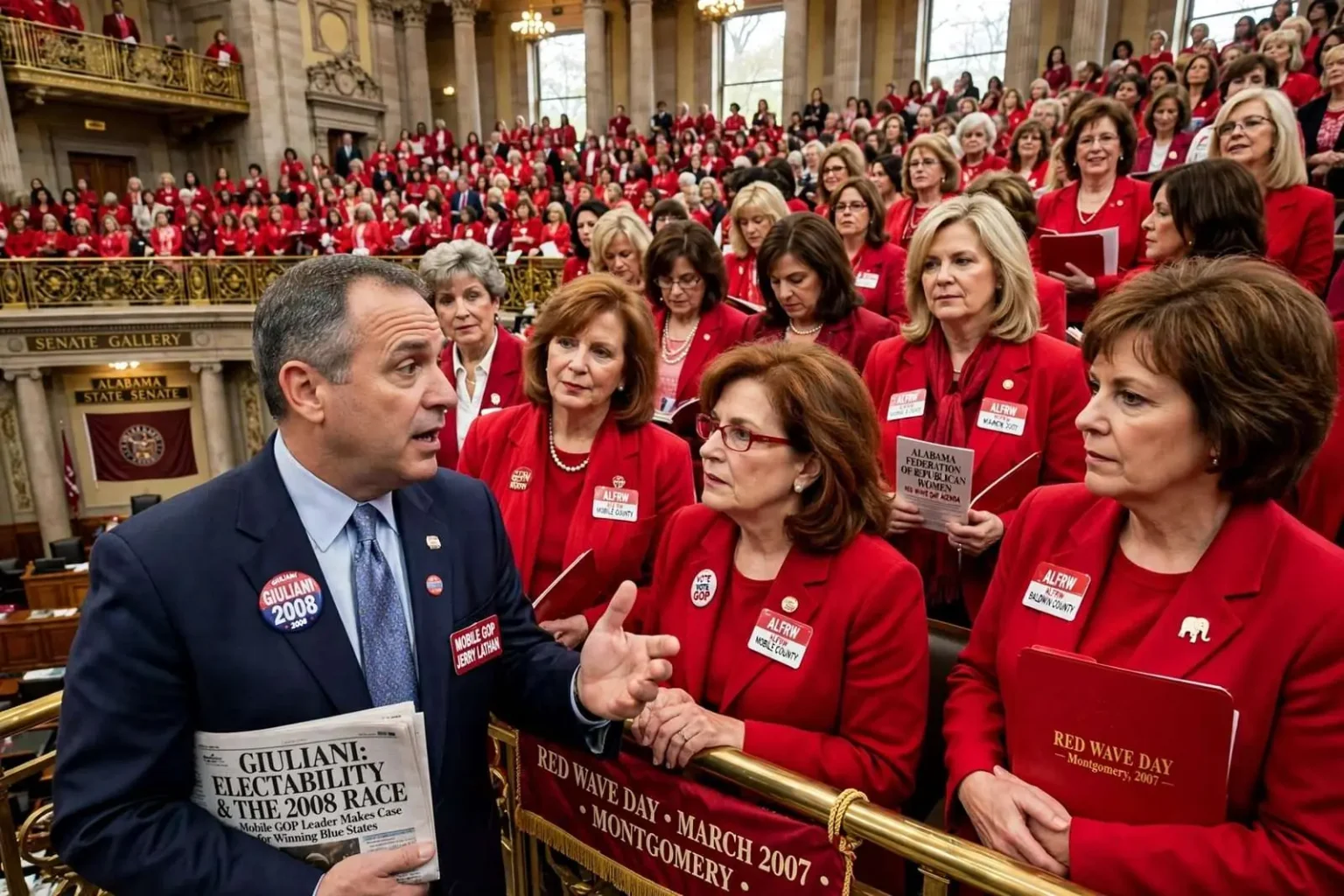
Mobile GOP leader Jerry Lathan kept up his advocacy for Rudy Giuliani, pressing the former New York mayor’s case against critics within his own party who dismissed him as an “out-of-step liberal.”
Lathan’s argument was less about ideology than about combat.
“When you look at his record against the liberal establishment in New York City, it gives me great hope for the coming battles with the same type liberal establishment he will confront in D.C.,” Lathan said, “and confront them he will.”
Above all, Lathan argued, Giuliani could win.
“I want to win,” he said. “Winning is everything, and he beats Barack Obama, Hillary Clinton or John Edwards in every red state from 2000 and 2004. We then go after and win at least three of the following, maybe a lot more: Pennsylvania, New Jersey, New York, Minnesota, Michigan, Wisconsin, Washington, New Mexico and New Hampshire. This gives him a huge electoral college advantage, which is the only poll that matters.”
Lathan’s pitch distilled the electability case that carried Giuliani to the top of national Republican polling through much of 2007. The argument rested on a simple map: a nominee who held every state President Bush had carried in 2000 and 2004 — the red-state base — and then peeled off a handful of blue states that conventional wisdom considered out of reach, would build an electoral college majority so large that the general election stopped being close. Giuliani’s two terms as mayor of New York, a city Republicans rarely carried at any level, were the proof of concept: a candidate who could win there, Lathan reasoned, could compete anywhere.
That argument had a particular resonance for south Alabama Republicans, a faction of the state party long accustomed to delivering heavy majorities in every general election and asking, with some frustration, what those margins bought nationally. To them, the lesson of losing presidential cycles was not that the party needed purer conservatives but that it needed a nominee who could make the other side’s territory competitive. Giuliani — pro-choice, socially moderate, but formidable on security and famous for governing a Democratic city — was, in Lathan’s telling, exactly that candidate, whatever the party’s purists said about him.
The electability case was the whole of the Giuliani campaign’s theory, and for a time it looked plausible — he led national Republican polling for much of 2007.
It did not survive contact with the calendar.
Giuliani’s strategy of skipping the early states and staking everything on Florida collapsed in January 2008, and he withdrew before Alabama’s Feb. 5 primary ever gave local supporters like Lathan the chance to vote for him.
The collapse was a lesson in how the nomination process had changed. By delegating everything to Florida’s late-January primary, the campaign assumed that a single big-state victory would overwhelm the accumulated momentum of rivals who had fought through Iowa, New Hampshire, South Carolina and Nevada. Instead, the early contests built alternatives into frontrunners one state at a time, and Giuliani’s national polling lead — the entire foundation of the electability argument — evaporated before a single delegate was won in a state he contested. When Florida voted, he finished well behind the man who would take the nomination, and the campaign that Alabama supporters had spent a year making the case for ended without ever appearing on their ballot.
Red Wave Day in Montgomery
The other Republican story of the season was less about candidates than about organization.
Two busloads of red-clad members of the Alabama Federation of Republican Women traveled to Montgomery for “Red Wave Day,” attending sessions of both legislative chambers.
The delegation was welcomed by Lt. Gov. Jim Folsom — a Democrat presiding over the Senate, an arrangement that says something about how Alabama politics worked at the time — along with various Republican senators.
The visitors got genuinely rowdy when newly elected state Sen. Ben Brooks, R-Theodore, asked to be recognized in order to welcome them.
Brooks had a particular claim on their affection: he was one of very few Republicans anywhere in the country to unseat a Democratic incumbent in the previous fall’s elections, a cycle that otherwise ran hard against his party nationally.
That fact framed what Red Wave Day was really about. The 2006 elections had been a national rout for the Republican Party — Congress flipped, and statehouses across the country followed — but in a handful of districts the tide ran the other way, and Brooks’s victory over an incumbent Democrat in a Mobile-area senate district was one of them. To the women in red filling the galleries, he represented the proof that the party’s ground game in Alabama could win even in a wave year running against it, and their enthusiasm when he rose to greet them was the sound of a minority party measuring its own momentum.
The federation’s members were also hosted at a breakfast at the Governor’s Mansion by First Lady Patsy Riley. Mrs. Mitt Romney delivered the keynote at the group’s luncheon, and U.S. Rep. Duncan Hunter, R-California, then a candidate for president, spoke at a dinner.
The guest list showed how early the 2008 presidential contest was already intersecting with state party politics. Ann Romney’s keynote and Hunter’s dinner speech put two presidential campaigns in front of Alabama’s most organized network of party volunteers months before any primary vote — a reminder that in a state whose February 5 primary would be, for once, genuinely contested, the candidates treated the state’s activist infrastructure as worth courting early. The Federation of Republican Women, with its county chapters and its tradition of legwork — registrations, phone banks, poll watching — was exactly the machinery those campaigns hoped to inherit.
The governor’s mansion itself supplied the day’s central symbol. Bob Riley held the office, Patsy Riley played hostess to the delegation, and yet the Legislature that the visitors watched in session remained under Democratic control — the last such arrangement Alabama would see for long.
A Party on the Cusp
Read together, the two scenes capture Alabama Republicans at a hinge moment.
The party held the governor’s office under Bob Riley and had begun making inroads in the Legislature, but Democrats still controlled both chambers and still held the lieutenant governorship.
The Republican women filling the galleries in red were a preview of the ground game that would, three years later, deliver the GOP its first legislative majorities in Alabama since Reconstruction.
The organizational muscle displayed on Red Wave Day — buses chartered, galleries filled, every county chapter mobilized for a single show of force in the capital — was precisely the capacity that converted Alabama’s long Republican tilt in federal races into control of the State House by 2010. Parties rarely flip a legislature on the strength of candidates alone; they do it when the volunteer networks that fill galleries decide to staff campaigns in every district, including the ones no one expects to win. The women in red who traveled to Montgomery that spring were rehearsing for exactly that.
What the Giuliani Episode Left Behind
At the presidential level, meanwhile, the party’s Mobile-area activists were doing what activists in a newly relevant primary state do: arguing about electability, hosting the candidates, and discovering, as Lathan eventually did, that the only poll that matters is the one that comes first.
The 2008 cycle changed Alabama’s relationship to presidential politics. For decades the state’s primary had come so late that the nomination was long since decided, leaving Alabama Republicans as spectators to the argument. February 5 changed that: suddenly the state’s delegates mattered, the candidates campaigned and advertised in-state, and local leaders like Lathan had a genuine role as surrogates and validators. The Giuliani episode — a full year of advocacy for a candidate who exited before Alabamians could vote for him — taught the state’s activists the double edge of relevance: early states get courted, and early states get abandoned when the calendar turns cruel.
It also exposed the limits of the electability argument that Lathan had articulated so completely. A candidate’s strength in national head-to-head polling proved a poor predictor of his ability to survive a state-by-state nominating contest, where intensity of support matters more than breadth, and where a strategy that skips the first four contests concedes the narrative before the first big state votes. The lesson was absorbed by activists in both parties across the country, and it made subsequent generations of electability arguments — including the ones Alabama Republicans would hear in later cycles — noticeably more skeptical of polling leads that rest on name recognition.
The Hinge in Context
The two strands of that spring — the presidential argument and the legislative mobilization — were more connected than they might have appeared at the time.
Both reflected a party that had won every statewide office worth winning and federal race on the ballot, yet still found itself in Montgomery sharing power with a Democratic legislature organized around conservative Democrats from rural districts. The Giuliani argument was about breaking through in hostile territory at the national level; the Red Wave mobilization was about the same breakthrough at the statehouse level, precinct by precinct. The same generation of south Alabama Republicans pursued both, often the same people, and the state-level project was the one that succeeded on schedule.
By 2010 the legislative majorities had arrived — the first since Reconstruction — completing the realignment the Red Wave Day visitors were helping to build. The presidency remained the harder prize: Alabama would vote Republican in every presidential election that followed, while the argument Lathan had made about winning blue states passed to other candidates and other cycles.
What remains most vivid about that spring in south Alabama politics is the juxtaposition. In Montgomery, a party that was about to inherit everything, filling the galleries in red and being welcomed, with genuine amusement, by the Democratic lieutenant governor who still presided over the chamber. And in the presidential contest, a confident case for a nominee who would be gone from the race before the state’s newly important primary ever arrived. The first story ended in triumph; the second ended in a withdrawal statement in January. Both, together, were Alabama’s Republican Party arriving at full strength.