Long Before the Primaries, Mobile’s Political Class Was Already Choosing Sides
With the 2008 field still forming, local officeholders, lawyers and pundits named their favorites. A state representative was co-chairing John McCain's Mobile County campaign; a famous oddsmaker had already called it for Hillary Clinton.
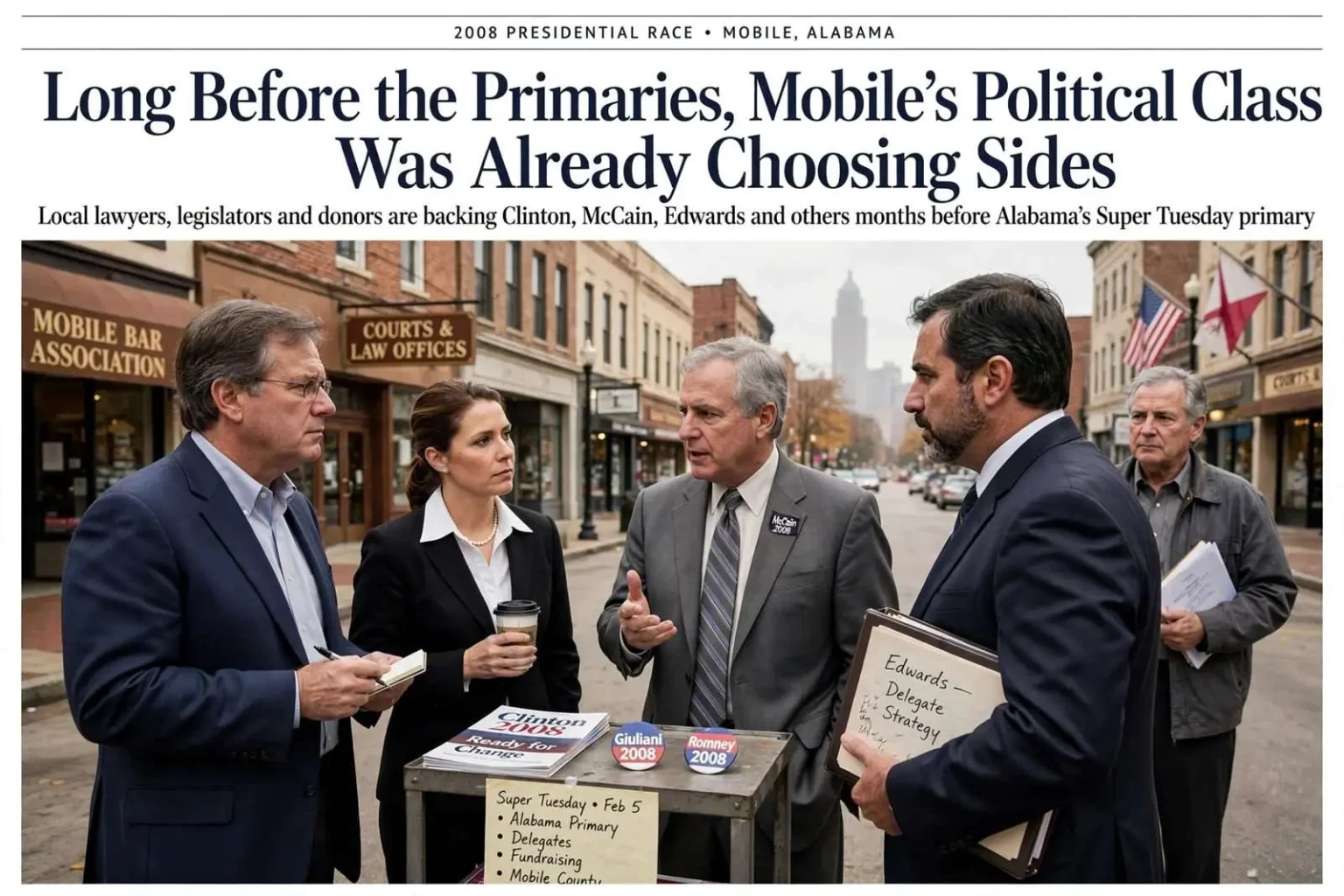
MOBILE — The first presidential primaries were still more than half a year away, but the candidates were already courting the people who raise money, recruit delegates and tell their neighbors how to vote. In Mobile, that meant a familiar cast of lawyers, legislators, judges and businesspeople — and asked whom they favored in the 2008 race, they were surprisingly willing to say.
The answers, gathered from a cross-section of local and state political figures, captured a moment when both nominations looked genuinely open. Hillary Clinton, Rudy Giuliani, John McCain, John Edwards, Mitt Romney, Bill Richardson and a not-yet-declared Fred Thompson were all live possibilities.
Alabama’s own calendar complicated everything. The state’s presidential primary was scheduled for the first week of February — Super Tuesday, when more than twenty states would vote on a single day — which meant Alabama delegates would be chosen before most of the country had spoken, and candidates who hoped to collect them needed committed local organizers months in advance. That is why the opinions of Mobile’s political class mattered beyond parlor talk: whoever organized here early would control delegate slates, fundraising calls and, in a low-information race, the quiet endorsements that tell casual voters which way to lean.
The Democrats: Clinton, Edwards and a governor from New Mexico
Former Democratic state legislator Mike Box was unequivocal. “My favorite is Clinton,” he said. “So far I’ve limited my involvement to word of mouth, but I am considering running for delegate; also, my family has made financial contributions to the campaign. Clinton’s educational and professional background, character and personality are what attract me.”
Box’s reasoning tracked the argument Clinton’s campaign was making nationally — that her years in the Senate, her policy fluency and her durability against Republican attacks made her the party’s safest general-election bet. In Alabama, where Democrats had lost ground steadily for a generation, the question of electability carried particular weight for the party’s dwindling but still organized cadre of officeholders and donors.
Mobile attorney Ed Massey went with John Edwards, the former North Carolina senator, on grounds that were frankly personal. “In spite of his tonsorial excesses, he is a friend and I have found him to be a man of integrity,” Massey said. “I truly believe his intelligence, upbringing and care for the plight of those less fortunate will make him a great President.” Edwards had built his 2008 campaign around poverty and economic fairness, and his Southern roots — born in South Carolina, raised in North Carolina — made him a natural fit for a region that believed it understood him better than the national press did.
Darrell A. Hamlin, an assistant professor of political science at Spring Hill College, offered an assessment rather than an endorsement. “I have made no formal commitments and I do not offer this opinion as one,” he said. “In my opinion, Bill Richardson is the most prepared to step into the job.” Richardson, then governor of New Mexico, had assembled perhaps the deepest resume in the field — congressman, U.N. ambassador, energy secretary — and converted almost none of it into votes.
An oddsmaker calls it early
Danny Sheridan, the Mobile-based sports oddsmaker whose national profile made him a regular stop for reporters seeking a prediction, was happy to go on the record with a long-standing one. He recalled telling the New York Post, before Bill Clinton won the 1992 Democratic nomination, that Clinton would beat George H.W. Bush — and being asked again, before the convention, whether he had changed his mind. He had not.
Roughly three years earlier, he said, the Post had asked him about the younger President Bush’s eventual successor. “I said Hillary Clinton, as long as she stayed married to Bill, would be our next president, and I’m sticking by that,” Sheridan said. “She’ll win the Democratic nomination and win the presidency in November, 2008.” He was careful to add that he supported no candidate, was somewhat friendly with McCain, and had never met Clinton or anyone else in the field.
Sheridan’s certainty illustrated a broader point about the early race: most observers, professional and amateur alike, were projecting the 2008 contest as a Clinton-Giuliani affair, the two national front-runners whose leads in the polls looked at that moment unassailable. The campaign was still half a year from the first votes, and the conventional wisdom had already hardened.
The Republicans: McCain has a Mobile organization
On the Republican side, the most concrete commitment came from state Rep. Spencer Collier of Bayou La Batre, who was co-chairing McCain’s Mobile County campaign. “Sen. McCain is strongly pro-life,” Collier said. “He is also strong on national defense, which I believe will be the most important issue to face our next president. Our next commander-in-chief will have to face Islamic terrorists and potential nuclear capabilities from North Korea and Iran. We need strength and experience in the White House.”
Collier acknowledged disagreements — he was less enthusiastic about free trade than the senator — but argued that of the top three Republicans, McCain, Giuliani and Romney, McCain was “by far the most consistent and conservative.” He also thought McCain’s independent streak was an asset with independents and Reagan Democrats.
What Collier described was the operational reality McCain’s campaign had built in Alabama: a senator with deep ties to the state’s military installations and veterans’ community, a defense-heavy message that played strongly in a region home to ports, shipbuilding and Air Force facilities, and an early organization of local chairs in the state’s major counties while rivals were still staffing up. Giuliani’s national lead rested on his post-9/11 profile; Romney’s on money and organization; but McCain, the eventual nominee of 2000’s runner-up campaign, was the one Republican with a functioning Alabama operation already in place.
State Rep. Jim Barton of District 104 was waiting on someone who had not yet entered. “I’m holding out for Fred Thompson,” he said. “I like his conservative style and he’s not controlled by any special interests.” Thompson, the actor and former Tennessee senator, was the great unannounced hope of Republicans dissatisfied with their choices; when he finally entered the race that fall, the campaign never matched the anticipation.
Barton’s hesitation captured a slice of the Alabama GOP that never warmed to any of the announced field — social conservatives who found McCain insufficiently conservative, Giuliani unacceptable outright, and Romney’s conversions on social questions unconvincing. Thompson’s late, listless candidacy briefly gave that faction a champion, then took the hope away, and many of those voters drifted to McCain by the time Alabama voted.
The holdouts
Not everyone was ready to talk. Charlie Graddick, presiding judge of the Mobile County Circuit Court and a former Alabama attorney general, kept his distance: “To answer your inquiry, no, I am not involved in any candidate’s race.” Cooper Thurber, a former president of the Mobile Bar Association, was equally brief and rather more damning: “I have not seen one I could support so far.”
Graddick’s reticence was partly professional — a presiding judge avoids public politicking as a matter of course — and partly habitual; as a former statewide candidate he understood what early commitments cost later. Thurber’s flat answer was rarer, an open declaration of dissatisfaction with an entire field in a year when both parties’ nominating contests were supposed to offer voters their widest choices in a generation.
The reticence was itself a form of information. In a county whose political networks run through law firms, banks and church pews, the people who decline to commit are often the ones whose eventual endorsement carries the most weight, because it has not been spent early or cheaply. Candidates on both sides courted exactly that category through the fall — the undeclared judge, the unimpressed bar leader, the donors who preferred to watch the first debates before wiring a check — and both front-runners’ national organizations made repeat visits to Mobile looking for precisely the commitments the local scene had not yet made.
It was, in the end, a snapshot of a race nobody could yet call. Within a year, the two candidates who would actually win their parties’ nominations — one of whom barely appeared in these conversations — had rearranged every assumption on the list. Clinton’s operation, despite Mobile’s early enthusiasm, lost a grinding caucus-and-primary war to Barack Obama, whose name appeared almost nowhere in the Mobile conversation; McCain survived Giuliani’s collapse and Romney’s spending to claim the nomination his Alabama backers had already built toward. The Mobile figures quoted here had, without knowing it, described both the campaign that was and the campaign that would be.
The lesson of the season was the one veterans of Alabama politics recite after every open-field presidential race: early enthusiasm is cheap, organization is scarce, and the county chairmen, delegates and donors who commit first shape the map long before television does. Mobile’s 2008 conversation, conducted half a year before the first ballots, was that process at work — opinions forming, lines hardening and a county’s political class quietly deciding which candidates would have anyone to answer the phone when the campaigns finally called.