Giuliani Returns to Mobile for a Free Meet-and-Greet and a $1,000-a-Head Reception
Republican presidential contender Rudy Giuliani's second Mobile visit of the year paired a free public gathering on the Causeway with a high-dollar reception and dinner hosted by the city's GOP donor class.
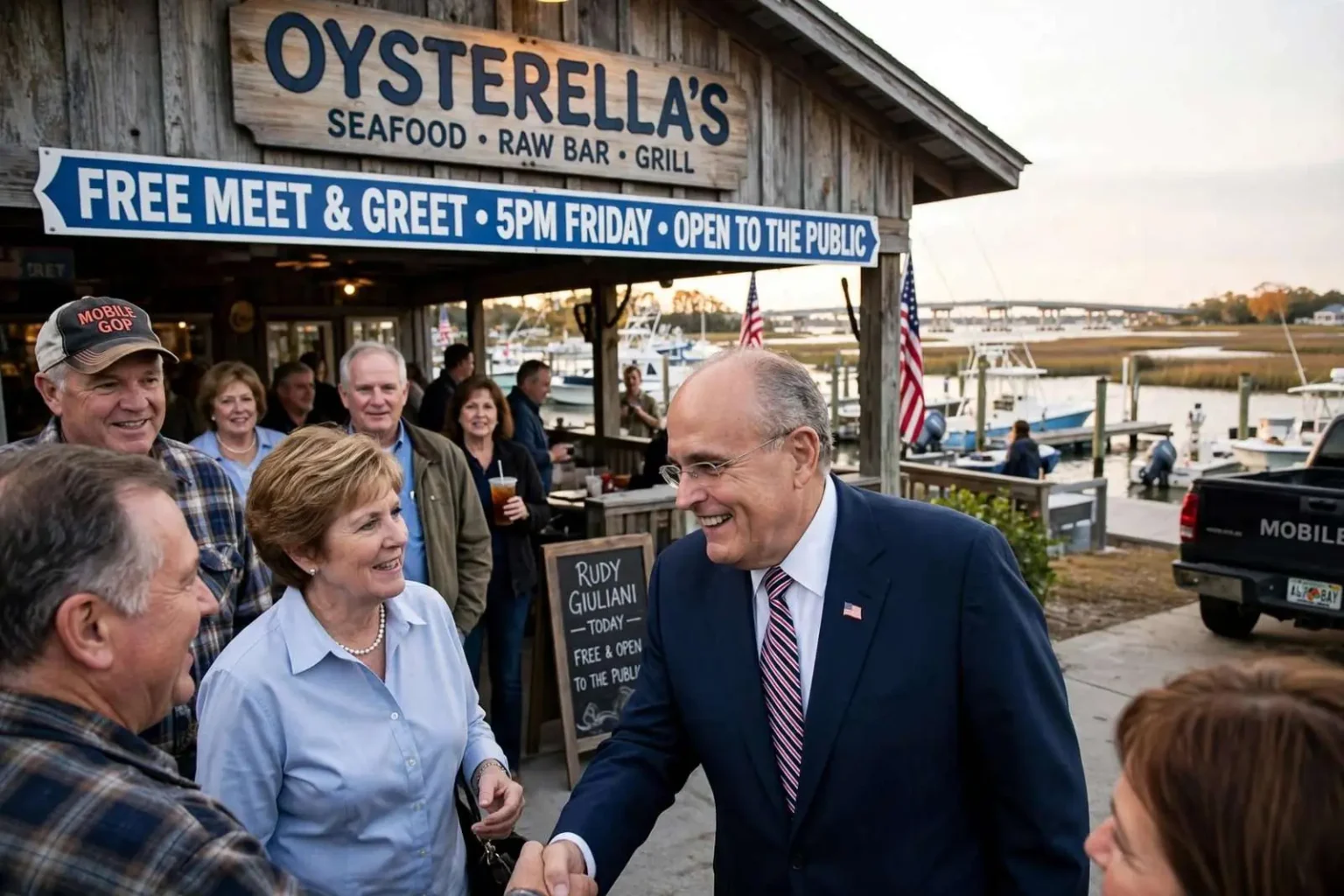
Republican presidential contender Rudy Giuliani made his second appearance in Mobile that year with a schedule that captured, in a single day, the two halves of a modern campaign visit: a free event for the public and a very expensive one for everybody else. The October swing found the former New York mayor at the height of his national standing — leading the Republican field in poll after poll — and it used Mobile the way front-running campaigns use mid-sized Southern cities: as a fundraising stop dressed with a public face.
The Causeway and Charleston Court
A “meet and greet” open to the public and free of charge was set for 5 p.m. Friday at Oysterella’s on the Causeway — the strip of restaurants along the Battleship Parkway that has served for generations as a place where Mobile politics gets conducted over seafood. The Causeway, running along the edge of Mobile Bay between the city and the Eastern Shore, is where local campaigns of both parties have long held their fish fries, rallies and hand-shaking sessions, and its seafood houses have hosted everyone from governors to county commissioners on the crawl toward an election.
Later that evening, the former New York mayor was to appear at a $1,000-per-person reception and a $2,300-per-person dinner at the Charleston Court home of Celia Wallace. The $2,300 figure was not arbitrary: it was the maximum an individual could give a federal candidate for the general election under the contribution limits then in force. A dinner priced at the legal ceiling is the standard instrument of big-dollar presidential fundraising — a few dozen checks at the maximum can produce more money in an evening than months of small-dollar solicitation.
The host committee amounted to a roll call of Mobile’s Republican donor establishment. Listed as hosts were Ann Bedsole; Les and Alleen Barnett; Robert Bolton; Jerry and Tina Carl; Tom Clement; Angus Cooper; David Cooper; Bob and Buffy Donlon; Fred Helmsing; Robert J. and Doris Isakson; Robert D. Kennemer; Anne Marie Lacy; Jerry and Terry Lathan; Bill Roberts; Dr. Leonard and Bess Rich; Rance Sanders; and Ben Stimpson.
The names on the list spanned the sectors that fund Gulf Coast politics: banking, shipping, construction, real estate, medicine and law. Several had ties to one another through boards, campaigns and business partnerships going back decades, and several — like Ann Bedsole, a former state senator, and the Coopers of the shipping house Cooper/T. Smith — were fixtures of the city’s civic leadership as well as its donor rolls. A host committee of that length signaled to Giuliani’s national operation that Mobile’s establishment had been fully engaged.
Why Mobile mattered to a New York mayor
The answer was the calendar. Alabama had moved its presidential primary to Feb. 5, 2008 — the multistate voting day that came to be called Super Tuesday — and Giuliani’s entire strategy was built on the big-state contests of that day rather than on the retail politics of Iowa and New Hampshire. That made states like Alabama, which candidates in ordinary cycles could safely ignore, worth a Friday evening and a fundraising swing.
The strategy was the most-discussed gambit of the 2008 Republican race. Giuliani’s advisers calculated that his lead in the national polls, combined with a deluge of advertising money, could carry him through the delegate-rich contests of January 29 and February 5 — Florida above all — and that early losses in Iowa, New Hampshire, and South Carolina could be absorbed. The plan required money, and money required donors, and Alabama’s newly front-loaded primary gave the state a claim on a candidate’s calendar that it had never had before.
Mobile and Baldwin counties, moreover, are where Alabama Republicans raise money. The shipping, timber, construction and legal fortunes of the Gulf Coast have underwritten statewide and national Republican campaigns for decades, and a candidate who could fill Celia Wallace’s house could count on a meaningful haul. Statewide candidates built their finance operations on the coast the way national candidates built theirs on Texas oil money or Wall Street — and presidential campaigns, once Alabama mattered, came to the same houses.
Giuliani’s local champion was Jerry Lathan, the Mobile GOP figure who spent much of that year making the electability argument to skeptical conservatives who considered the former mayor too liberal on social questions. Lathan’s case was blunt: Giuliani could win, and winning was everything. In a party whose base had doubts about a candidate who supported gay rights and had opposed some restrictions on abortion, the argument for Giuliani was always about November — the claim that the man who had led New York through Sept. 11 could hold the states no other Republican could.
How it ended
The strategy did not survive January. Giuliani’s decision to skip the early states and stake his campaign on Florida left him without momentum, money or media attention when the voting finally reached a state he had contested. He finished third in Florida on Jan. 29, 2008, and withdrew the following day, endorsing John McCain.
By the time Alabama voted on Feb. 5, Giuliani’s name was on the ballot but his campaign was over. McCain carried the state’s Republican primary. The donors who had gathered on Charleston Court that October, like Republican donors across the country, transferred their attention to the senator from Arizona.
The collapse was studied afterward as a case in presidential campaign logic. A candidate who is not on the ballot cannot win delegates, and a candidate who is not winning cannot raise money; the strategy that deferred both left Giuliani with neither. Iowa and New Hampshire, whatever their quirks, had done precisely what they were designed to do — force candidates to submit to retail scrutiny before the media narrative hardened.
The lesson of the swing
The episode remains a useful lesson in the arithmetic of presidential primaries: a candidate can lead the national polls for a year, raise money in every prosperous corner of the country, and still discover that the only votes that matter are the ones cast first. For Mobile, the Giuliani swing left a smaller legacy — a reminder that the city’s donor establishment could attract a national front-runner twice in one year when the calendar made Alabama matter, and that the same establishment could redirect its loyalties, without ceremony, the week the front-runner’s campaign ended.
The politics of the Causeway
There was symbolism in the venue as well as convenience. The Causeway’s restaurants — Oysterella’s among them — occupy the strip of Battleship Parkway where Mobile County candidates of both parties have launched campaigns and held thank-you dinners since before the interstate bypassed the bay. A candidate standing in a Causeway dining room was performing a kind of local validation that no downtown hotel ballroom could supply: the sense that Mobile politics had examined the visitor and found him worth a plate of oysters.
For Giuliani, whose New York identity was central to his candidacy, the free meet-and-greet also served a practical purpose. Southern conservatives who knew him only from television could shake the hand of the Sept. 11 mayor in person, and the campaign could photograph a crowd on the bay for use in the big-state advertising that the strategy depended on. Public events of this kind cost a campaign almost nothing and generated the local coverage that paid for itself.
Alabama moves its primary
The February 5 primary date that made Alabama worth a presidential visit was itself a product of the state’s own maneuvering. Alabama had moved its primary earlier in 2007, joining the stampede of states that compressed the nomination calendar into a single February day and set off the strategic experiments — none more audacious than Giuliani’s — that defined the 2008 cycle. Legislators who voted for the change argued that the state would finally matter; candidates would have to court Alabama’s voters and Alabama’s donors rather than passing through for airport fundraisers.
For one cycle, at least, the argument proved out. A national front-runner had come to Mobile twice in an election year, hosted by the city’s Republican establishment, chasing donors he would once have found in New York or California. The Democratic side saw the same effect, as Barack Obama and Hillary Clinton split Alabama’s Super Tuesday delegates in a contest that drew national attention to the state for the first time in a generation.
The donors, meanwhile, had done what political donors do. The checks written at the Charleston Court dinner were contributions to a candidacy, not an outcome, and when the candidacy ended the relationships simply transferred. Lathan and the rest of the host committee would remain fixtures of Alabama Republican fundraising for years afterward, and the electability argument they had made for Giuliani would be remade, cycle after cycle, for other candidates with other vulnerabilities.