University of South Alabama Mobile
Lions Club Prepares to Roast the Outgoing Mayor of Mobile
The Mobile Lions Club scheduled a March 31, 2005 roast of retiring Mayor Mike Dow, with allies and old critics alike lined up to take their turn at the microphone.
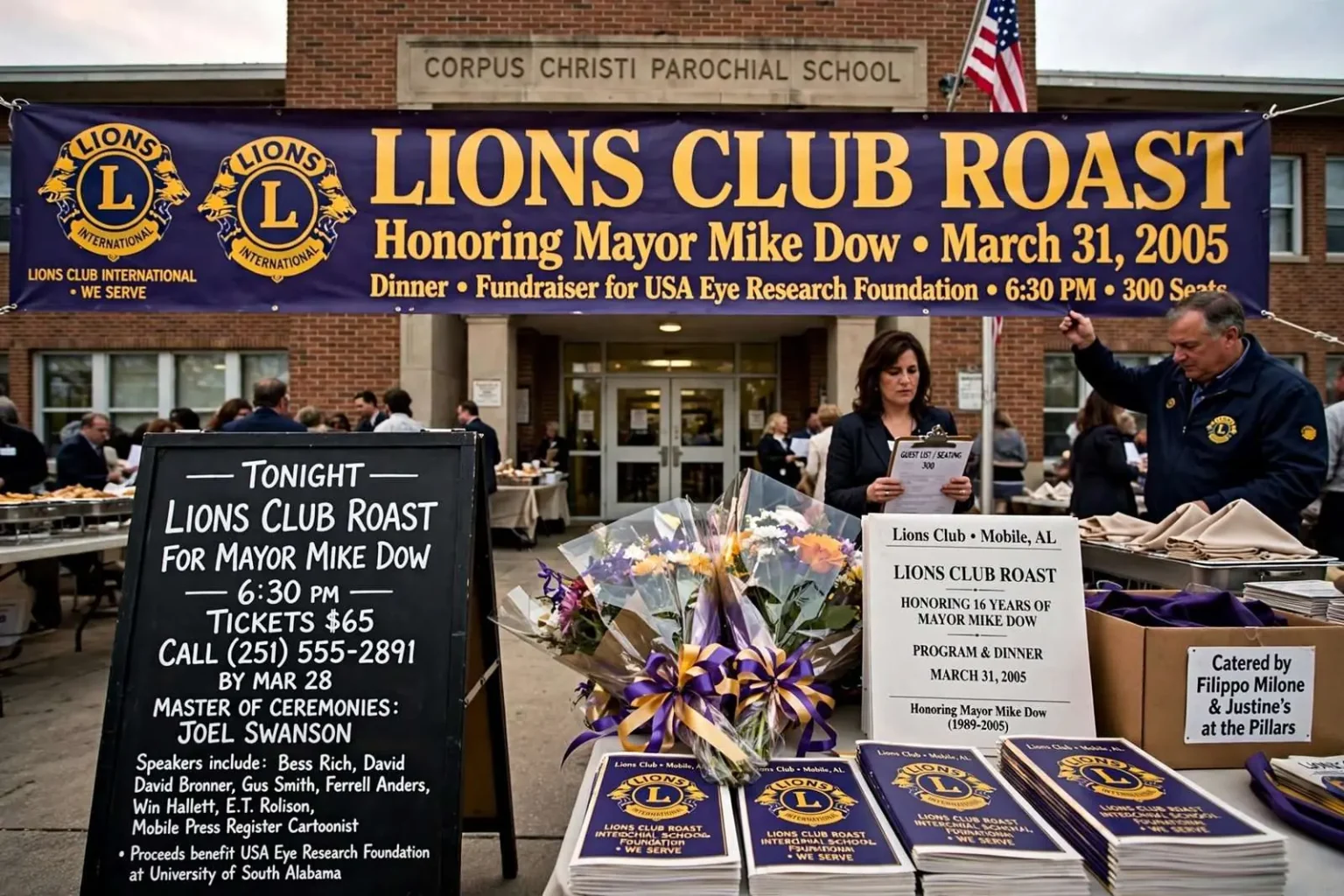
MOBILE — The Mobile Lions Club announced plans in early March 2005 to roast outgoing Mayor Mike Dow at an evening dinner on Thursday, March 31, at Corpus Christi Parochial School in west Mobile — an occasion that promised to gather, in one room, both the mayor’s closest allies and some of his most persistent critics. The event came at a moment of transition for the city. Dow, who had held City Hall since 1989 and had won four terms, had made clear he would not seek a fifth in that summer’s municipal elections.
The roast offered the city’s civic establishment a chance to mark the end of a long era in the traditional way: with affectionate abuse. Sixteen years is an eternity in municipal politics — long enough for a generation of Mobile children to grow up knowing no other mayor — and the Lions Club dinner was designed as both tribute and send-off, the kind of evening where a retiring executive gets to hear exactly what people have been saying about him for a decade and a half, delivered with a grin and a glass of wine.
An unlikely lineup at the microphone
The program brought together figures who had rarely shared a platform. Bess Rich, the former city councilwoman and by then a probable candidate for mayor who had spent years criticizing the administration’s fiscal policies, was slated to speak. So was David Bronner, the head of the state retirement systems, whose investments in downtown Mobile had made him one of Dow’s most consequential partners in the city’s economic development push.
The pairing of Rich and Bronner on the same program captured the double life the Dow administration had led in the public imagination. To the city’s financial watchdogs, Dow was a mayor whose budgets never seemed to quite add up, whose finance department battled the council year after year over shortfalls and projections. To the developers and state investment managers who bet nine figures on downtown Mobile, he was the indispensable partner whose vision had made the city’s revival possible. Both things were true at once, and on March 31 both constituencies would be in the same hall, roasting the same man.
Also scheduled to take a turn at the retiring mayor were Gus Smith, Ferrell Anders, Win Hallett, E.T. Rolison and a Mobile newspaper editorial cartoonist, among others. Joel Swanson was to preside as master of ceremonies. The roster read like a cross-section of the city’s civic machinery — businessmen, civic boosters, and the cartoonist whose pen had skewered every mayor of the era — with each speaker allotted the ceremonial right to puncture, briefly and publicly, a man who had spent sixteen years being quoted in the paper instead of making fun of it.
Dinner, wine and a cause
The dinner was to be catered by Filippo Milone, a Lion and veteran local restaurateur, along with Matt Shipp of Justine’s at the Pillars — then one of the more prominent dining rooms in the city. Wine was included. The hall seated 300 people.
The logistics carried the details that made the event more than a rubber-chicken ritual: Date: Thursday, March 31, 2005. Program begins: 6:30 p.m. Location: Corpus Christi Parochial School, west Mobile. Tickets: $65 per person, available through March 28. Capacity: 300 seats. The ticket price put the evening in the range of a serious civic fundraiser rather than a casual dinner, and organizers expected the seats to fill with the city’s business and political establishment — a crowd for whom the chance to watch the mayor be publicly ribbed by his own critics was worth the price on its own.
Proceeds from the evening were earmarked for the Lions’ USA Eye Research Foundation, the service organization’s long-standing charitable focus on sight and vision research, carried out in partnership with the University of South Alabama. The choice of beneficiary was natural for the Lions, whose century-old international mission has always centered on sight — from eyeglass recycling drives to blindness prevention programs worldwide — and whose local clubs had long channeled fundraising into the university’s eye research efforts on behalf of patients across the Gulf Coast.
The tradition behind the ribbing
The political roast has long occupied a particular place in the civic life of Gulf Coast cities — a ritual in which rivals suspend hostilities for one evening, deliver their sharpest lines with a smile, and raise money for a cause in the process. That Rich, who was preparing to campaign on the argument that the city’s finances had been mismanaged, would appear on the same program as Bronner, whose Retirement Systems of Alabama money helped reshape the downtown skyline, captured the peculiar intimacy of Mobile politics: the field was small enough that everyone knew everyone, and adversaries were expected to be able to laugh in the same room.
That intimacy cuts both ways. In a city of Mobile’s size, the same handful of families, firms and institutions appear at every ribbon-cutting and every council hearing, and political disputes are settled within relationships rather than between strangers. A roast formalizes that reality — the critic is not simply tolerated at the podium but invited, because in a few months she may need the same room’s votes, and the partners are not merely guests but patrons of the very institution throwing the party.
Bronner’s presence at a downtown-Mobile fundraiser was also a reminder of how unusual the city’s development story was by national standards. The Retirement Systems of Alabama, a pension fund for public employees, had spent years building an entire skyline’s worth of projects in downtown Mobile — the RSA tower rising over Royal Street, the restored Battle House hotel, and the office complexes that anchored the city’s revival — investments made in direct partnership with the Dow administration’s downtown agenda. No mayor in Mobile’s modern history had so completely fused City Hall’s fortunes with a single investor’s balance sheet.
Sixteen years at City Hall
For Dow, the evening was one of the first in a sequence of valedictory occasions that would mark his final months in office. He had come to City Hall in 1989 after a career in the technology sector, unseating then-Mayor Arthur Outlaw, and he left behind a record that would be argued over for years — a revitalized waterfront and downtown on one side of the ledger, a strained municipal budget on the other.
The waterfront record was the one Dow’s supporters pointed to first. Under his administration the city extended its footprint to the Mobile River, building on the convention center era that began under his predecessor and pushing the redevelopment that made the downtown skyline a regional draw. The city that hosted the 2005 roast looked, physically, little like the one Dow had inherited in 1989 — taller in the middle, brighter along the waterfront, and considerably more active after dark, as restaurants and entertainment venues followed the investment downtown.
The budget record was the counterweight. The city’s finances had been a running battle for much of Dow’s tenure, with shortfalls, contested projections and friction with the city council giving fiscal critics like Rich a decade’s worth of material. Dow’s defenders argued that the investments were the cost of a city building its future; his critics counted the deficits. The 2005 mayoral race would give the argument its referendum, with the mayor’s departure leaving the field open and the city’s finances a central issue for every candidate who entered it.
Those wishing to attend were directed to call the Lions Club organizer for tickets and further information ahead of the March 28 cutoff. For the price of a dinner, Mobile’s civic class would get to watch the mayor take what he had been dishing out — and, knowing the form, return every jab with one of his own — before an audience that included the people who would spend the next four years arguing over everything he left behind.
The crowd the roast was built for
Organizers said the 300-seat hall at Corpus Christi was expected to draw a mix the city’s political observers would study as closely as the speeches: downtown developers and port interests seated near neighborhood activists, council members who had fought the mayor over budgets sharing tables with the department heads who drafted them. In a city where the establishment calendar fills up months in advance, the roast had become one of the fixed points of the spring — an event where attendance was itself a statement about who stood where in Mobile’s civic hierarchy.
The Lions Club itself supplied the connective tissue. The club’s members — drawn from the city’s business, professional and civic leadership — had spent decades building the fundraising machinery that made an evening like this possible, and their eye-research mission gave the political theater a philanthropic purpose that smoothed over partisan edges. Roast dinners of this kind succeeded, club leaders had long maintained, precisely because the money went to something uncontroversially good: no one has to defend their politics for supporting sight research.
The format also served the speakers. Roast material, by custom, trades in known grievances — the finance battles, the ribbon cuttings, the mayor’s well-documented enthusiasm for announcements about the city’s future — and converts them into comedy before they can become campaign attacks. For Rich, the evening offered a chance to show a roomful of establishment voters that the administration’s sharpest critic could be funny rather than merely harsh, a credential that mattered in a city where likability carried real weight. For Bronner, it was a return engagement with a city he had invested in heavily, playing the role of the outside money man who had fallen for downtown Mobile and put the pension fund’s dollars where his affection was.
The retiring mayor, for his part, would get the customary last word. Roast tradition gives the honoree a closing rebuttal, and observers expected Dow to use his to answer sixteen years of criticism in a single speech — with the same confidence, backers noted, that had carried him through four campaigns and a generation of arguments about the city’s direction. Whatever he said on March 31 would be remembered less as comedy than as the opening statement of his legacy, delivered to the room where most of his legacy’s custodians were sitting.