University of South Alabama Mobile
Copeland Aims for a Sixth Term on the Mobile City Council, but a Firefighter May Challenge Him
Mobile City Council President Reggie Copeland said in December 2004 he would seek a record sixth term in District 5, even as city firefighter Bryan T. Lee weighed his first run for public office.
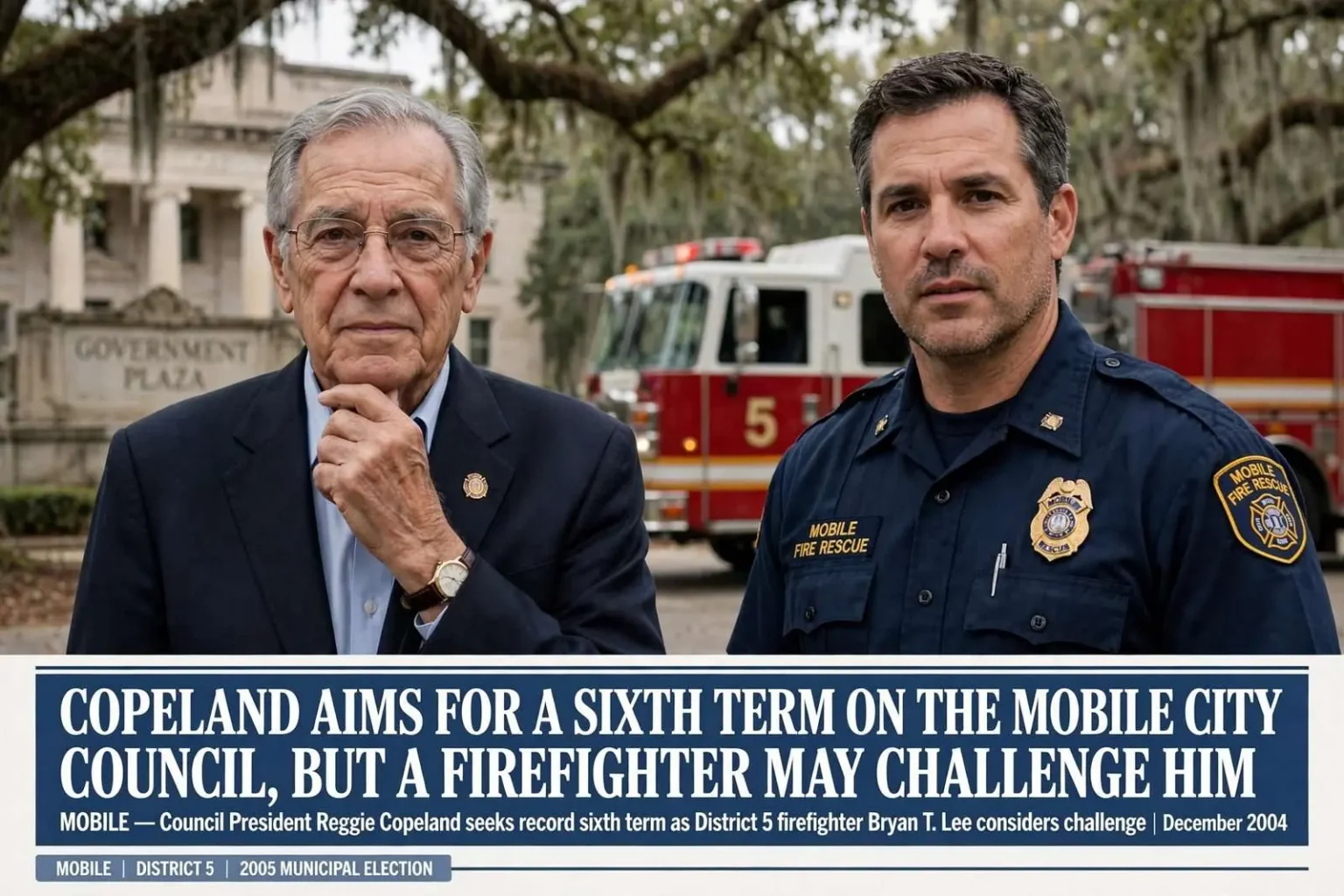
MOBILE — Mobile City Council President Reggie Copeland said in December 2004 that he intended to seek a record sixth term in the municipal elections scheduled for the following August — and that he would do so, for the first time in 12 years, with the real possibility of an opponent.
Copeland had held the District 5 seat since the creation of Mobile’s mayor-council form of government in 1985, when voters replaced the old three-member commission with a mayor and seven district council representatives. He had won five consecutive terms under that system, serving longer in the seat than anyone else in the city’s modern government, and at least two prospective challengers had been mentioned in connection with the seat as the 2005 campaign approached.
Asked directly, the council president left no room for doubt. He said he would “definitely, definitely” run again.
Back on his feet
The question was not idle. Copeland, 75, had recently undergone heart surgery. The procedure was successful, and he missed only two council meetings during his recovery — a fact he mentioned without much prompting.
“I’m blessed and following doctor’s orders,” he said, describing a regimen that included daily walks through his Llanfair neighborhood. In a city where council members’ health was a recurring subject of political speculation, his quick return to the council chamber was itself a campaign message: the incumbent was working, and intended to keep working.
What his plans might not include was another turn as council president. Assuming re-election, and depending on how the mayor’s race resolved, Copeland said he might choose not to seek the presidency again.
“It depends on what happens in the mayor’s race,” he said. “I may or may not try for it. It takes up a lot of your time.”
That caveat carried weight. With Mayor Mike Dow widely expected to step aside, the council’s leadership structure in the next administration was an open question. Dow had led the city since 1989, and the race to succeed him was already shaping up to be the most consequential municipal contest in a generation — one that would decide not just the mayor’s office but the balance of power the council president would face at Government Plaza.
A firefighter considers a run
City firefighter Bryan T. Lee, 47, confirmed that he was weighing a bid for the District 5 seat — and, notably, that Copeland’s decision would not govern his own.
“I’ve been thinking about it for several years,” Lee said. “I’ve toyed with the idea. For the past six months, several people have come and asked me to consider it. It looks like a good time.”
Lee had never sought public office. He said he needed to move deliberately, in part because being a city employee imposed particular burdens on a candidate.
“Once you declare your candidacy, you must request a leave of absence,” he explained. “Once your campaign has raised $1,000, that dictates that you’re a candidate and you have to file papers for a leave of absence.”
The rules meant that a firefighter’s trial balloon carried real professional risk. Raising even a modest sum for exploratory purposes would trigger the leave requirement, setting his career aside before the race had truly begun. Prospective candidates who held city jobs had to be certain before they crossed that threshold, while incumbents and private-sector challengers faced no such wall.
He said he would discuss the matter with his family first and might have a firm answer as soon as March.
“It is something that I’m leaning towards doing,” he said. “I’m seriously looking at it.”
Lee was careful about one thing above all. Should Copeland run for a sixth term, he said, no one should read a Lee candidacy as an attempt to exploit the incumbent’s health.
“I would regret it if anyone thought it looked like I was kicking Reggie Copeland when he was down,” Lee said. “If I decide to run, it will be because the timing is right for me, and not because of his health status.”
The sensitivity was understandable. Copeland’s surgery and rapid recovery had been widely known across the city, and any challenger would be under pressure to prove the race was about ideas and the district’s future rather than the incumbent’s age or condition. Lee, whose professional life was spent in emergency response, framed the decision instead in the language of service and timing — the vocabulary of a man considering whether the next decade of his life should be spent at City Hall rather than in the fire service.
A district that moved west
The geography of District 5 had changed considerably. It had once been the geographic center of Mobile — the district that all the others surrounded and bordered. As the city’s population migrated westward, redistricting pulled District 5 along with it, giving it a more north-south orientation and shifting it out toward Airport Boulevard.
The shift tracked the city’s postwar growth pattern: from the downtown core, through Spring Hill and the midtown neighborhoods, and out along the Airport Boulevard corridor into the subdivisions of west Mobile. Each round of redistricting moved the district’s boundaries to follow the population, and the district that once anchored the middle of the map had become one defined by its western neighborhoods.
Lee lives in Ridgefield off Airport Boulevard in west Mobile, an area formerly in District 6 and now drawn into District 5. He grew up in Berkshire Hills and attended Azalea Road Middle School and Davidson High School — stomping grounds that also fall within the redrawn district. He holds a degree in emergency medical services management from the University of South Alabama.
He and his wife, Dr. Lynn Dyess, have six children, including 10-year-old quadruplets. A household of that size in west Mobile placed Lee squarely in the demographic the district’s council member represented: families whose daily concerns ran to schools, roads, drainage, public safety and the quality of neighborhood services, the bread-and-butter agenda of any City Hall district seat.
One challenger bows out
A second name mentioned in connection with the seat was Republican Party official Ralph Buffkin, whose spirited campaign for the District 2 seat on the Mobile County Commission had fallen short earlier that year.
Buffkin ruled himself out so long as Copeland was in the race. “As long as Reggie’s running, I wouldn’t run,” Buffkin said. “Reggie supported me and I’ve supported him. And I understand that he’s running.”
Buffkin’s withdrawal illustrated the practical dynamics of the incumbent’s position. Municipal races in Mobile are nominally nonpartisan, but candidates carried reputations and alliances across the county’s political networks, and Copeland’s two decades of relationships meant that would-be challengers — even experienced ones fresh off a countywide campaign — calculated the odds and stood down.
The incumbent
Copeland is president of the Copeland Agency, a full-service advertising and public relations firm, and previously spent more than 11 years at Saad’s Health Care.
He attended Murphy High School, Spring Hill College and the University of Alabama’s Mobile Center, and is a veteran of the Korean War. He and his wife of 53 years, the former Betty Ann Pittroff, have five children and 12 grandchildren. He is a charter member of St. Pius X Catholic Church.
The biography mapped neatly onto the city he served. A Murphy graduate raised in midtown traditions, a businessman whose agency work had connected him to the commercial life of Mobile for decades, a veteran of a war fought by a generation whose numbers in public life were steadily thinning, and a parishioner of one of the city’s established Catholic churches, Copeland embodied the civic texture of the district he had represented since 1985.
His council career had spanned the city’s most consequential recent history: the economic diversification that brought German steel and aeronautics suppliers to Mobile County, the rebuilding of the downtown riverfront, the fight over school governance, and the hurricane seasons that tested every municipal government on the Gulf Coast. As council president, he had presided over the chamber that controlled zoning, budgets and the contracts that shaped that growth, and his longevity had made his institutional memory itself a civic asset.
Two decades into Mobile’s mayor-council era, Copeland remained one of the few constants at Government Plaza — and, as of the end of 2004, he intended to stay that way.
Whether the August elections would return him for a sixth term, and whether the man he would answer to in the mayor’s office would be Dow’s successor, remained the open questions of the coming year. The stakes ran in parallel: a firefighter weighing a candidacy that could give the district its first new representative in two decades, a council presidency that might or might not be his for the asking, and a mayor’s race that would redraw the city’s political arithmetic in a single contest. Mobile’s political class would spend the winter reading the signals from Government Plaza — and, in the meantime, the council president’s daily walks through Llanfair continued, one recovery step at a time.