Does Mobile Still Have an Establishment? A Debate About Power in a City That Lost Its Headquarters
As a new Republican county commission promised tense days for Mobile's old guard, longtime observers asked a harder question at the close of 2004: does the city still have an establishment at all?
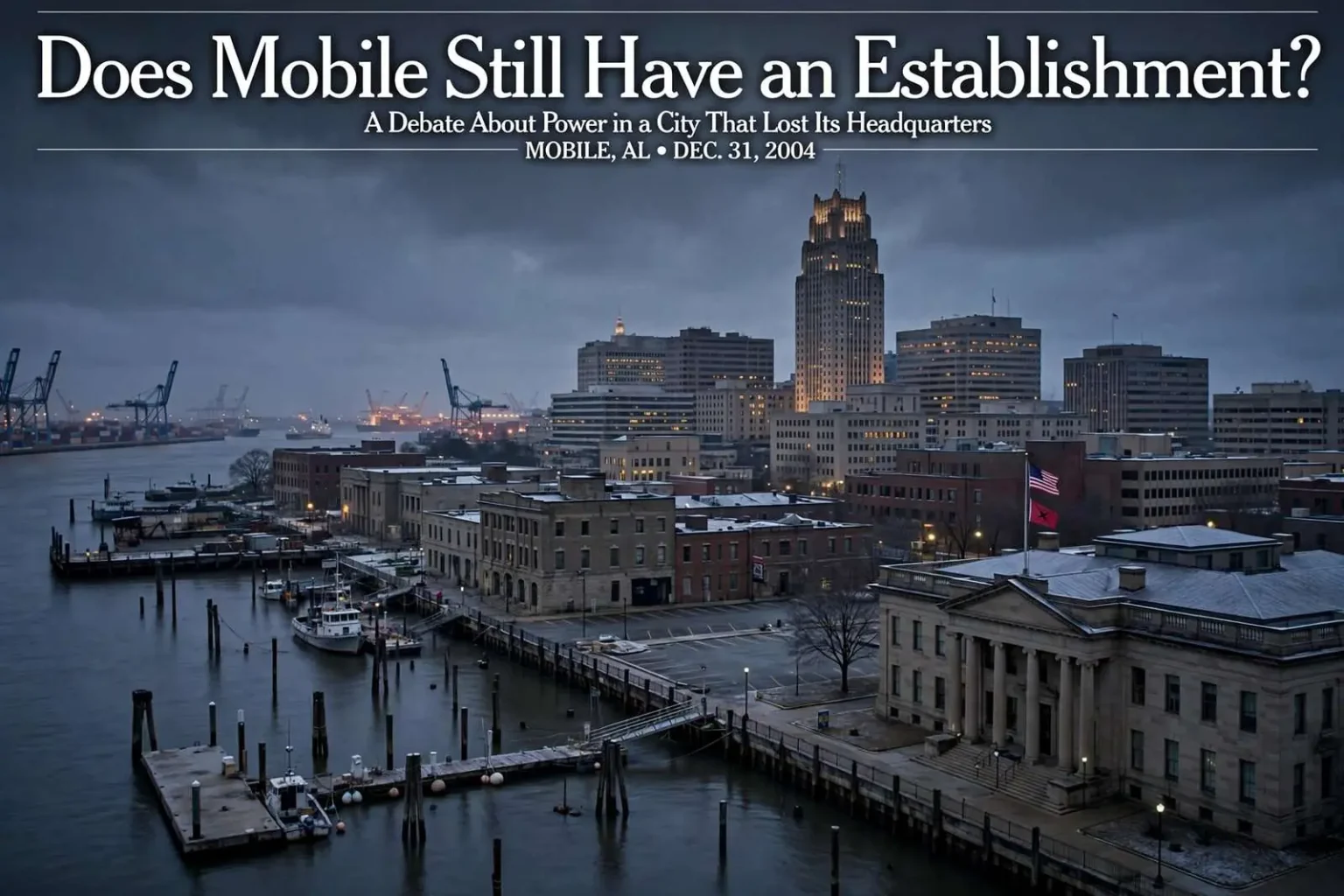
When newly elected Mobile County Commissioner Stephen Nodine warned in late 2004 of “tense days” ahead for the “old guard,” he assumed the existence of something to push against. As the year closed, that assumption itself became the subject of a searching argument among longtime observers of Mobile politics.
The question was simple and uncomfortable: does Mobile still have an establishment?
What the Fight Looks Like in Practice
Whatever the answer in theory, the friction was real enough in practice.
Nodine and a number of the disaffected regarded the Mobile Area Chamber of Commerce as ineffective or worse — and, more pointedly, as beholden to the city and county governments from which a significant share of its budget flowed. There was serious talk in that camp of defunding it.
The votes were not there on the City Council, but the possibility of finding an ally on the commission was being weighed. There was also talk of shaking up the County Commission itself, including the future of the commission’s longtime attorney, sometimes called the fourth commissioner.
The prevailing guess among those watching was that he would be retained but in a diminished role, with another lawyer brought on alongside him.
The Argument Against an Establishment
The skeptical case rested on a single historical fact: Mobile lost its corporate headquarters.
In the 1950s, the city had captains of industry and banking who could genuinely call the shots — Ed Roberts at Waterman and Southern Industries, Finley McRae at Merchants National Bank, Austill Pharr at First National Bank, the Delchamps family. Those men have passed on, and the institutions they led have been merged, acquired or relocated.
What is left, one veteran observer argued, are outposts staffed by scouts rather than headquarters commanded by principals. The test he offered was memorable.
A friend in the insurance business once remarked that Mobile could get a lot more done if there were more people to whom others could not afford to say no. Without such people, there is no establishment — only men and women of influence and sway, significant factors rather than determinative ones.
By this measure, the so-called Dow “kitchen cabinet” did not qualify. Its members had influence and could help candidates, but they were not indispensable, and other factions of comparable weight existed.
Fold in the Chamber and the group gains power on paper — and becomes even more likely to splinter. An establishment that cannot establish itself, one participant observed, is a sorry excuse for an establishment.
The Comparison to Other Southern Cities
The contrast with Birmingham was instructive. Birmingham had become a corporate headquarters city, where the leaders of the top banks and corporations could sit down together and cause change — as they could in Charlotte and Atlanta.
New Orleans once could, and no longer can, for precisely the reason Mobile no longer can. Even Birmingham’s position, one observer cautioned, might not hold forever.
Banks get acquired. Airports lose ground to Atlanta and Charlotte.
What happened to Mobile could happen there. None of this was a claim that Mobile lacked leaders.
The city, by this account, was blessed with capable and savvy people. The problem was that they did not command the influence the corporate community once possessed.
Where Mike Dow Fits
Mayor Mike Dow’s arrival in 1989 complicated the picture. Much of the business leadership had supported the incumbent he defeated, Arthur Outlaw.
Once in office, Dow brought those same people into his camp — and the irony, as one observer put it, was that the two sides had more in common than either would admit. There was no ideological obstacle to the merger.
The composition of the group some call an establishment therefore did not change much under Dow. The same people, supporting a different mayor, holding the same views.
That is not to say Dow did not change the city. He plainly altered the standing of African Americans in Mobile’s government and, in doing so, gave the city a measure of harmony — expanding on a theme that the Outlaw administration had also sounded.
The Young Turks and the Vacuum
The conversation turned back to the late 1970s, when a group known as the “Young Turks” — Gary Greenough, Dan Wiley, Ken Malone, Tom Purvis and others — challenged the reigning power structure. Those were years of contentious county Personnel Board meetings, of employees who backed the wrong candidate finding themselves exiled to dimly lit basement offices.
In a city the size of Mobile, the stakes felt high. Had the corporate heavyweights still been in the saddle then?
Probably not, came the answer — and that may be the point. The Young Turks succeeded, quite possibly, because the vacuum was already there.
Is There a Godfather?
Asked whether Mobile had a political “godfather,” a single figure whose blessing a citywide candidate would covet above all others, the answer was flat: no.
There were influential people, donors and fundraisers, respected voices who could move votes. But nobody operating on a scale that dwarfed the rest.
The one possible exception was Dow himself, who as a sitting mayor with a formidable fundraising record could have played that role had he chosen to. And that exception, at the end of 2004, was about to expire.
If the reports were true and Dow did not seek re-election, his carriage would turn back into a pumpkin soon enough — and the calls he made from it would go unreturned. Only re-election recharges that kind of power.
Greenough, Wiley, Malone and Purvis could have told him so.