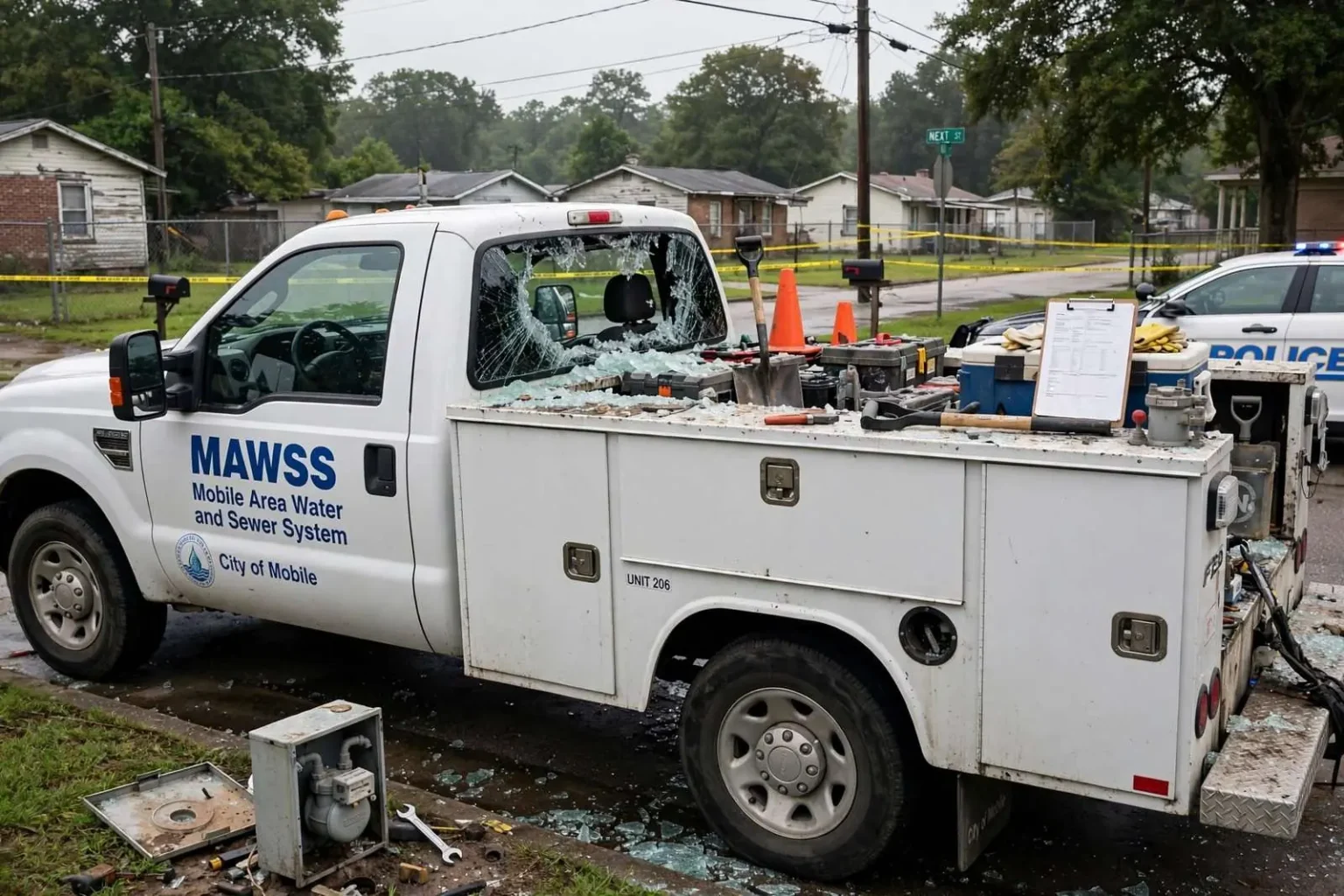
MOBILE — Two Mobile Area Water and Sewer System workers escaped injury Friday morning when someone fired on their truck as they turned on water service in north Mobile, near the Prichard line. The shot shattered the vehicle’s rear window. No one was hit.
According to the utility’s incident report, the crew had just turned on the water at 1401A Next Street at about 8:20 a.m. when a shot was fired at the truck by occupants of a silver mid-1980s Chevrolet Monte Carlo. Josh Leachman was preparing to get back into the cab. Derrick Reynolds was already seated on the passenger side.
“Derrick told me to get in the truck, somebody was shooting at us,” Leachman recalled. “I looked up and saw a silver Monte Carlo, 80’s model shooting at us.”
The car did not simply drive away. “Then they circled around again while we were trying to leave,” Reynolds said. “We saw the car coming back and we took off,” Leachman added.
The crew left the area and reported the incident to police. Officers were dispatched, but no suspects were found at the scene. Mobile Police Department spokesman John Young said Friday that no arrests had been made and that the investigation was continuing.
The neighborhood where the shooting occurred sits along the ragged boundary between Mobile and Prichard, a stretch of north Mobile County streets where the two cities’ jurisdictions meet and overlap. Crews from the utility work those blocks routinely — MAWSS’s service map takes in neighborhoods well outside the Mobile city limits — and the work itself, turning meters on and off at individual addresses, puts workers at doorsteps across the area every day of the week.
‘It looked like it was intended for our truck’
MAWSS Director Malcolm Steeves called the shooting very disturbing, and said his first hope — that it was random — had not survived a closer look at the facts.
“At first I thought, was hoping it was just a random thing, but on closer study, it looked like it was intended for our truck,” Steeves said.
The truck was one of six MAWSS crews assigned to turn water service on and off. That assignment carries a particular exposure. “That’s the same truck that turns off meters for ‘no pays’ or delinquent payments,” Steeves said. “I don’t know for sure what happened out there. The person who was the driver is on vacation so I haven’t spoken with him yet. The summer worker was concerned, concerned but okay.”
Steeves speculated that the shooter could have been a customer angry about a disconnection — “upset about it being turned off the previous week, the previous day or whatever. That’s what that truck does, turns water off and on, all day every day.”
The distinction mattered to the director because it changes what the incident says about the utility’s work. A random shot fired at a marked truck would be frightening but essentially unpreventable. A deliberate one aimed at a disconnection crew would mean the routine enforcement of the utility’s payment policies had become dangerous work — a conclusion that would force MAWSS to think differently about how, and where, it sends its meter crews.
A first in 14 years
The director said nothing like it had happened in his 14 years at the utility. The financial damage to MAWSS property, he noted, was negligible, and was far outweighed by what he called the psychological concern for the safety of his employees. The utility offered counseling to the two men.
“If that’s the way they were responding to us cutting off service for failure to pay, then it’s real disturbing,” Steeves said. “If it was just a random incident, that’s also disturbing, but maybe not quite so much.”
He noted, almost in passing, that school had just let out for the summer. “We’ve had some reports of fire hydrants turned on and sometimes those things happen the first few weeks that school’s out,” he said, “but who knows?”
The hydrant problem is a familiar summer nuisance for water systems across the Gulf Coast: when school closes, idle teenagers open hydrants to cool off, dumping thousands of gallons into the street, dropping pressure in the surrounding lines and occasionally damaging the hydrants themselves. Steeves was careful not to link the two phenomena — teenagers who open hydrants are not shooters — but the timing left him, and the investigators, with more than one theory to weigh.
Steeves said the MAWSS board would take up the incident at its next meeting, on Monday. “We’ll have a chance to evaluate what we want to do, if we decide to do anything,” he said. “I hope it was just an isolated incident and we can go on with regular business.”
Options before the board, had the threat persisted, ranged from the practical to the procedural: pairing crews more consistently, adjusting the routes and timing of disconnection work, better documenting repeat problem addresses, and coordinating more closely with police in the neighborhoods where payment disputes have flared before. Steeves’ stated preference, for now, was to treat the shooting as an aberration — but the board meeting on Monday gave the utility a formal occasion to revisit that judgment if police developments warranted it.
The hazards of the meter route
The episode drew attention to a category of public employee who is rarely thought of as being at risk. Utility field crews work alone or in pairs, in marked trucks, on foot, in yards and along rights of way — and in the case of disconnection crews, they arrive as the visible face of a decision made in an office somewhere else.
The dynamics of the job are unforgiving. A meter technician announces, by the color and lettering of the truck, exactly what has happened to the household being visited: service is being cut off for nonpayment, often in a month when the household is already stretched. The customer’s grievance is real, but it is with the bill and the policy — and the person standing at the meter did not set either. Across the country, water and power utilities have long trained disconnection crews to recognize hostile situations, to withdraw rather than argue, and to leave enforcement to police when threats are made.
MAWSS, created by the city of Mobile to run its water and sewer systems, serves a service area that extends well beyond the city limits, including neighborhoods along the Prichard boundary where the shooting occurred. The utility’s crews turn service on and off thousands of times a year. On this Friday morning, one of those routine calls ended with a shattered window and two men driving away as fast as they could.
For the two workers, the morning’s ordinary checklist had nearly run its course when the shot came. The water at 1401A Next Street had been turned on; Leachman was crossing to the driver’s door; Reynolds was in his seat. The report they filed afterward — the color and vintage of the car, the direction it came from, the fact that it circled back for a second pass — gave Mobile police investigators the specifics they would need, and gave MAWSS an account of an incident unlike any in its director’s memory.
The investigation, as of Friday, had produced no arrests and no announced suspects. Police asked anyone with information about the silver mid-1980s Monte Carlo or its occupants to come forward. Until someone was identified, both theories — the aggrieved customer and the random act — remained open, and both, as Steeves observed, were disturbing in their own way.
What the utility could control in the meantime was how it sent its people back into the field. The counseling offer to Leachman and Reynolds was the immediate response; the board’s Monday session was the institutional one. Between them lay the question every water system faces after an incident like this: whether to change the way routine work is done because of one terrible morning, or to hold to the routine and trust that it was, as Steeves hoped, an isolated event.
The arithmetic of the utility’s exposure is worth spelling out. Six crews, rotating across a service territory that reaches from west Mobile through the city’s northern neighborhoods to the Prichard line, generate thousands of individual meter visits a year — each one a brief, unscripted encounter at a stranger’s property. Most pass without incident and always have. The rarity of Friday’s shooting, measured against the volume of work behind it, is precisely why Steeves could say it had never happened on his watch in 14 years, and precisely why its aftermath will be measured less by the window that was replaced than by whether the crews who ride those routes every day believe the routine is still safe.