A Fundraising Letter, a Field House Debt and a Commissioner’s $200,000 Promise
A supporter's letter told the men who co-signed a loan for the Alma Bryant field house that Commissioner Mike Dean would steer $200,000 in county money toward the debt if re-elected. Both men denied any deal.
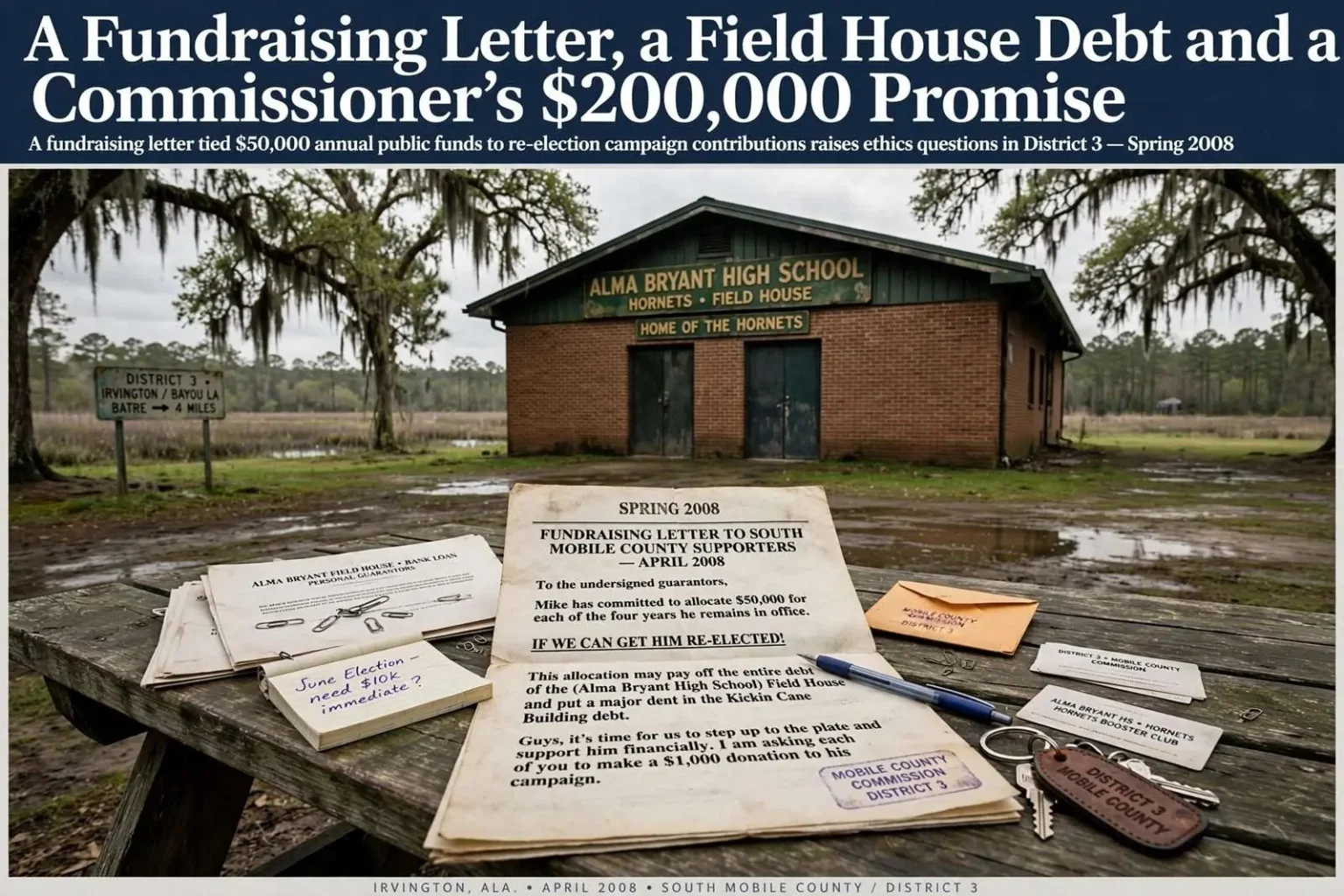
A fundraising letter circulated to a group of south Mobile County businessmen placed Mobile County Commissioner Mike Dean at the center of an uncomfortable question in the spring of 2008: whether public money promised to retire a private debt had been tied, even implicitly, to campaign contributions. The letter was written by Dean supporter Allen Horn and addressed to the roughly 10 men who had personally guaranteed a bank loan used to build an athletic field house at Alma Bryant High School in Irvington. In it, Horn told the guarantors that the commissioner had made a commitment contingent on the outcome of the June election. “Mike has committed to allocate $50,000 for each of the four years he remains in office … if we can get him re-elected!” the letter read. It went on to say the money “(may) pay off the entire debt of the (Alma Bryant High School) Field House and put a major dent in the Kickin Cane Building debt,” before making the ask plain: “Guys, it’s time for us to step up to the plate and support him financially. I am asking each of you to make a $1,000 donation to his campaign.”
The controversy unfolded in District 3, which covers south and west Mobile County, including the communities of Coden, Bayou La Batre, Grand Bay, and Irvington. The Alma Bryant High School field house had been constructed with financing backed by personal guarantees from local business owners, a common practice in Alabama’s smaller communities where school facilities often rely on community support beyond what tax revenues can provide. The Kickin Cane Building, a separate community facility, carried its own debt obligations. Both projects reflected the tight-knit nature of south Mobile County, where civic infrastructure and personal relationships frequently intersect.
Both Men Denied a Quid Pro Quo
Dean, a Republican seeking re-election in District 3, rejected any suggestion that county dollars had been conditioned on contributions from the co-signers. “He sent the letter four or five months ago. I knew Allen was going to write the letter last year,” Dean said. “I try to help Coden and Bayou La Batre regardless of whether they vote for me. I try to help the school. I thought this would be a good gesture to do.” Horn was equally unrepentant. “If it’s a crime to support somebody who supports our community, then I plead guilty,” he said. “I’m not hiding. I’m proud that Mike Dean supports our community which has so many needs. The letter I wrote was not at Mike’s request.” Pressed on the letter’s wording, Horn allowed that he had gone too far. “Mike did not promise us anything. That was a mistake on my part.”
The letter’s language — particularly the explicit linkage between the commissioner’s allocation of public funds and the recipients’ campaign donations — drew scrutiny from political observers and ethics advocates. Alabama law prohibits public officials from conditioning official acts on campaign contributions, and the phrasing “if we can get him re-elected” suggested a transactional understanding that crossed ethical lines even if no explicit agreement existed. The guarantors, who had put their personal finances at risk to support the school, found themselves in a position where refusing to donate could be seen as jeopardizing the very debt relief they had been led to expect.
District 3 and the Politics of South Mobile County
District 3 encompasses some of Mobile County’s most distinctive communities, stretching from the industrial waterfront of Theodore down to the fishing villages of Bayou La Batre and the rural expanses of Grand Bay and Coden. The district’s economy has long been tied to shrimping, shipbuilding, and the paper mill in nearby Brewton, creating a working-class electorate that values tangible results over political rhetoric. Dean, first elected in 2004, had built his reputation on constituent service — showing up at community events, securing road paving for neglected neighborhoods, and advocating for the Alabama State Port Authority projects that sustained local jobs. His relationship with Horn, a businessman with interests in the area’s marine construction sector, exemplified the personal networks that drive politics in this part of the county.
The field house at Alma Bryant High School, completed in the early 2000s, represented more than an athletic facility. In a region where high school football serves as a primary cultural touchstone, the building was a source of community pride. The guarantors — local business owners, farmers, and professionals — had stepped forward when the Mobile County Public School System’s capital budget could not accommodate the project. Their personal guarantees meant that if the school system defaulted, the bank could come after their homes and businesses. This arrangement was not unusual in Alabama, where Amendment 778 to the state constitution allows local boards of education to accept private donations for capital projects, but it placed the guarantors in a uniquely vulnerable position when the fundraising letter arrived.
Campaign Finance and Ethical Boundaries
The $1,000 donation request was significant but not extraordinary by Alabama campaign finance standards. Individual contribution limits for county commission races were capped at $5,000 per election cycle at the time, making a $1,000 ask a serious but not maximal commitment. What distinguished this solicitation was its explicit framing: the letter presented the commissioner’s future official action — the allocation of district funds — as contingent on electoral success, which the donors were being asked to finance. This structure mirrors the “pay-to-play” dynamics that have long plagued Alabama politics, from the Siegelman-Scrushy case at the state level to countless local controversies over zoning, contracts, and appointments.
Dean’s defense — that he supported the community regardless of political allegiance — reflects a common justification in Alabama’s patronage-heavy political culture. County commissioners in Alabama wield significant discretion over “district funds,” allocations from the county general fund that each commissioner directs to projects in their district. These funds, typically ranging from $100,000 to $500,000 annually depending on the county budget, are a primary tool for commissioners to demonstrate responsiveness to constituents. Critics argue the system invites favoritism; defenders say it ensures local accountability. The Dean-Horn letter brought this tension into sharp relief, exposing how easily the line between public service and political reciprocity can blur in a system built on personal relationships.
Community Reaction and Political Fallout
The letter’s existence became public knowledge through local political channels, prompting debate at county commission meetings and in the pages of the Mobile Press-Register. Some constituents viewed the episode as business as usual in a region where personal loyalty and political support have always been intertwined. Others saw it as a breach of the public trust, arguing that the commissioner’s obligation to allocate public funds impartially was compromised by the implicit quid pro quo. The Alabama Ethics Commission, which oversees compliance with the state’s ethics laws, does not typically investigate county-level campaign finance matters unless a formal complaint is filed, and no such complaint appears to have been pursued in this case.
Dean ultimately won re-election in June 2008, defeating his primary opponent and facing no Democratic challenger in the general election. Whether the field house debt was retired through county allocations remains a matter of public record; commission meeting minutes from 2008-2009 show periodic discussions of District 3 discretionary funding for Alma Bryant High School improvements, though a direct line from the letter’s promise to specific budget votes is difficult to establish. The guarantors, for their part, continued their civic involvement in south Mobile County, some remaining active in local politics while others returned to private life.
Broader Implications for Alabama Local Government
The episode illustrates a structural feature of Alabama county government: the concentration of spending authority in individual commissioners rather than the full commission acting as a body. Unlike many states where county boards approve expenditures collectively, Alabama’s commissioners exercise near-autonomous control over their district allocations. This system, rooted in the state’s 1901 constitution and the historical power of the “courthouse gangs” that dominated local politics, creates opportunities for the kind of transactional politics the Dean-Horn letter exemplifies. Reform efforts over the decades — including the 1980s ethics legislation and the 2010 passage of a statewide ethics law — have addressed campaign finance disclosure and lobbyist regulation but have left the district-fund system largely intact.
For south Mobile County residents, the controversy faded into the background of a political culture where such episodes are neither unprecedented nor disqualifying. Dean served until 2012, when he chose not to seek re-election. The field house at Alma Bryant High School continues to host basketball games, graduations, and community events, its debt long since resolved through a combination of school system payments, booster club fundraising, and, according to county records, discretionary allocations from the District 3 commissioner’s office. The Kickin Cane Building, a community center in Bayou La Batre, also saw its obligations met. The letter, meanwhile, remains a case study in how the intersection of public obligation, private debt, and political ambition plays out in Alabama’s smallest political units.