
Ann Bedsole Rules Out a Mayoral Bid and Joins the Campaign to Keep Mike Dow at City Hall
Former state Sen. Ann Bedsole dismissed talk of a mayoral run in December 2004, saying she supported Mike Dow and joining prominent Mobilians urging the mayor to take a second look at re-election.
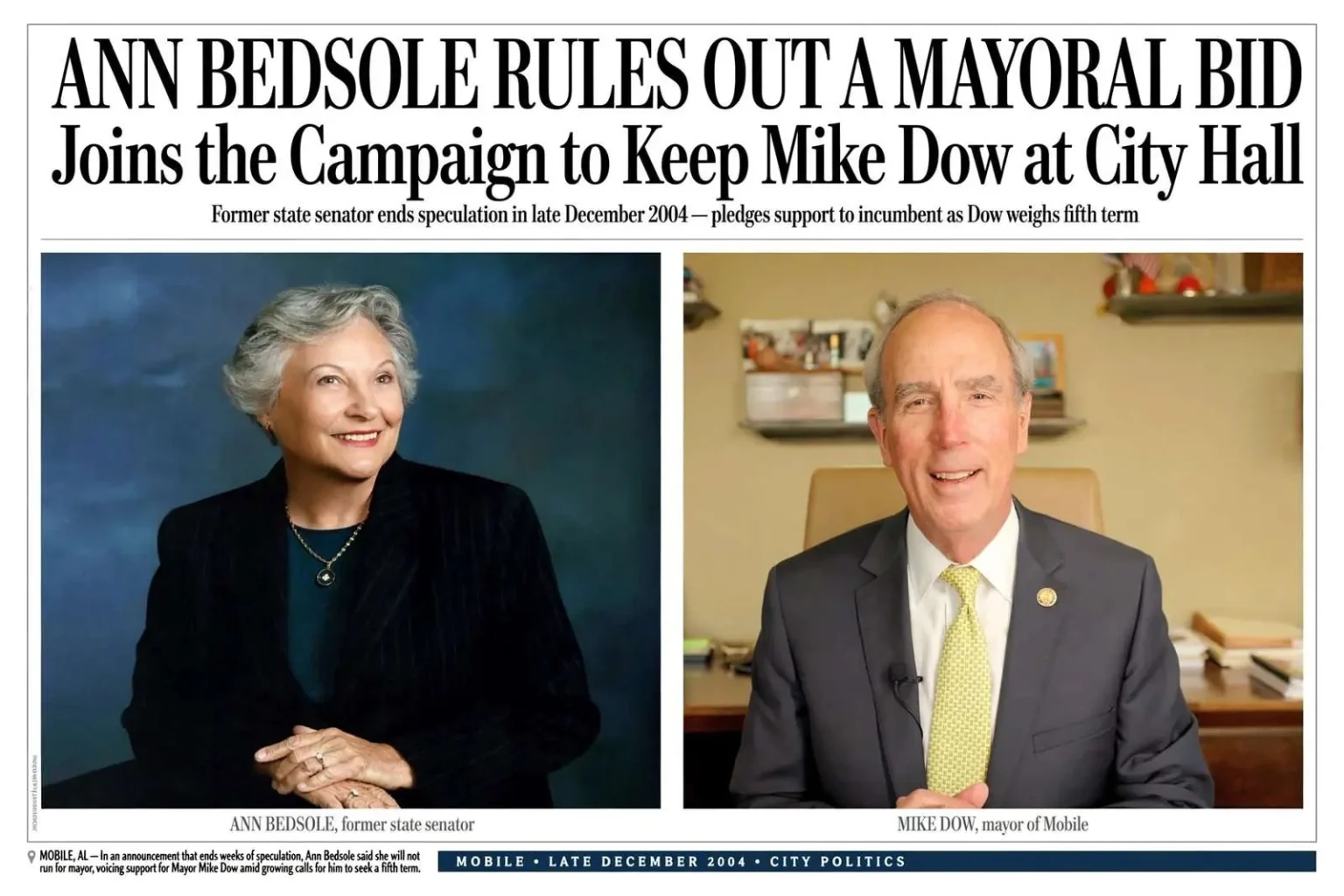
Former state Sen. Ann Bedsole put an end to the speculation in late December 2004: she had no interest in running for mayor of Mobile so long as any hope remained that the incumbent, Mike Dow, might seek a fifth term.
Bedsole, a community leader who represented Mobile in both houses of the Alabama Legislature and sought the Republican nomination for governor in 1994, said she had heard the talk about her own supposed ambitions and pronounced it “not true.” “As far as I know our mayor is running and I support our mayor,” she said. “I haven’t heard anything official that he’s not running.”
The Race Taking Shape Without Him
That formulation was becoming familiar in Mobile.
Dow himself had refused to make a definitive statement, holding to the line that he was running until he said he wasn’t. But sources close to him had confirmed his intention to leave public office the following fall in favor of a more lucrative opportunity in the private sector.
In the meantime, two candidates were laying groundwork. City Councilman John Peavy and Mobile County Commissioner Sam Jones were both preparing mayoral campaigns for the municipal elections scheduled for the coming August.
Both had said they would not oppose Dow if he ran. The relationships were tangled.
Jones and Dow had worked closely for years on projects of joint city-county interest. Dow had played a role in Peavy’s hard-fought special-election victory over Rick Collins three months earlier, filling the unexpired council term of Stephen Nodine, who had gone on to win a seat on the County Commission in November.
Bedsole noted a telling silence. Peavy had spoken openly about running for mayor, and the incumbent had not contradicted him.
“Peavy has talked openly about running, but the mayor didn’t turn around and say, ‘I’m not,’” she said. “As for me, I wouldn’t even think about anything as long as we’ve got a good mayor.”
The Fear Behind the Draft-Dow Effort
The campaign to persuade Dow to stay was rooted in more than admiration.
Among the anxieties driving it, Bedsole and others acknowledged, was the prospect that a Peavy-Jones contest could be reduced to a racial referendum. Peavy is white; Jones is Black.
Both had support across racial lines, but the fear was that the campaign would harden into something neither man intended and that the city would be the worse for it afterward. According to Bedsole, many of those pressing Dow to reconsider were people who had originally opposed him — supporters of Arthur Outlaw, the incumbent Dow unseated in 1989, who came around after he took office.
“He has a lot of friends, people who have supported him, and most of these people are trying to get him to take a second look,” she said. “Most of these people want him to stay. It’s a tough thing. You don’t want to force someone to do something they don’t think is right for them. Sometimes when I’ve talked to the mayor I’ve had the feeling that he would like to live a different life.” One source who had been close to Dow since before his 1989 election, and who asked not to be identified, cautioned against writing the mayor off. “There are powerful people who are working on changing his mind and they just might succeed,” the source said.
Among those reportedly involved were former U.S. Rep. Jack Edwards and businessman Matt Metcalfe.
The Money Problem
Underlying everything was a plain economic fact.
Dow, 57, earned $89,000 a year as mayor of Mobile. His supporters readily conceded that his skills as a sales and marketing executive could command far more in the private sector.
“He spreads himself thin staying in office,” one supporter said. “To serve in public life today, you have to have an independent income, and he had it at first with all the QMS stock that he sold. But it runs out eventually.” Bedsole said she and other backers found it awkward to ask a man who had already given the city 16 years to keep sacrificing. “You hate to say you need to continue to make this sacrifice for the city,” she said.
“Yet you don’t want him to go. It’s the position those who think a lot of him find themselves in.”
‘Moses Never Saw the Promised Land’
Bedsole believed the mayor’s mind was not fully made up, and she framed his dilemma in almost scriptural terms.
“I suppose it’s true: Moses never saw the Promised Land,” she said. “You lead them to the Promised Land and someone else takes them across.” It could not be easy, she said, to walk away before his vision for the city was realized.
“If I’m Mike Dow, that’s what I would consider: Do I want to leave the city up to chance? Risk everything, all that hard work over 16 years, to leave four years too soon?” she said.
“I think that’s what’s holding up his decision. He’s got to weigh that against what’s a difficult life for his family. He works 24-7.”
Bedsole represented District 101 in the Alabama House of Representatives before succeeding H.L. “Sonny” Callahan in the state Senate from District 34.
She is president of White Smith Company, which holds land and timber interests concentrated in her native Clarke County, and is a principal in the Sybil H. Smith Charitable Trust.
What Happened Next
Dow did not seek a fifth term in 2005. Jones and Peavy advanced to a runoff, and in September 2005 Jones defeated Peavy by a margin of about 56 percent to 44 percent, becoming the first Black mayor of Mobile. Jones served two terms before losing to Sandy Stimpson in 2013.