University of South Alabama Mobile
How Mike Dow Gambled on the Mayor’s Office in 1989 – and Changed Mobile’s Course
Nearly two decades later, former Mayor Mike Dow and the friends and rivals who shaped his first campaign recalled the audacious 1989 decision to bypass a council seat and run straight for mayor.
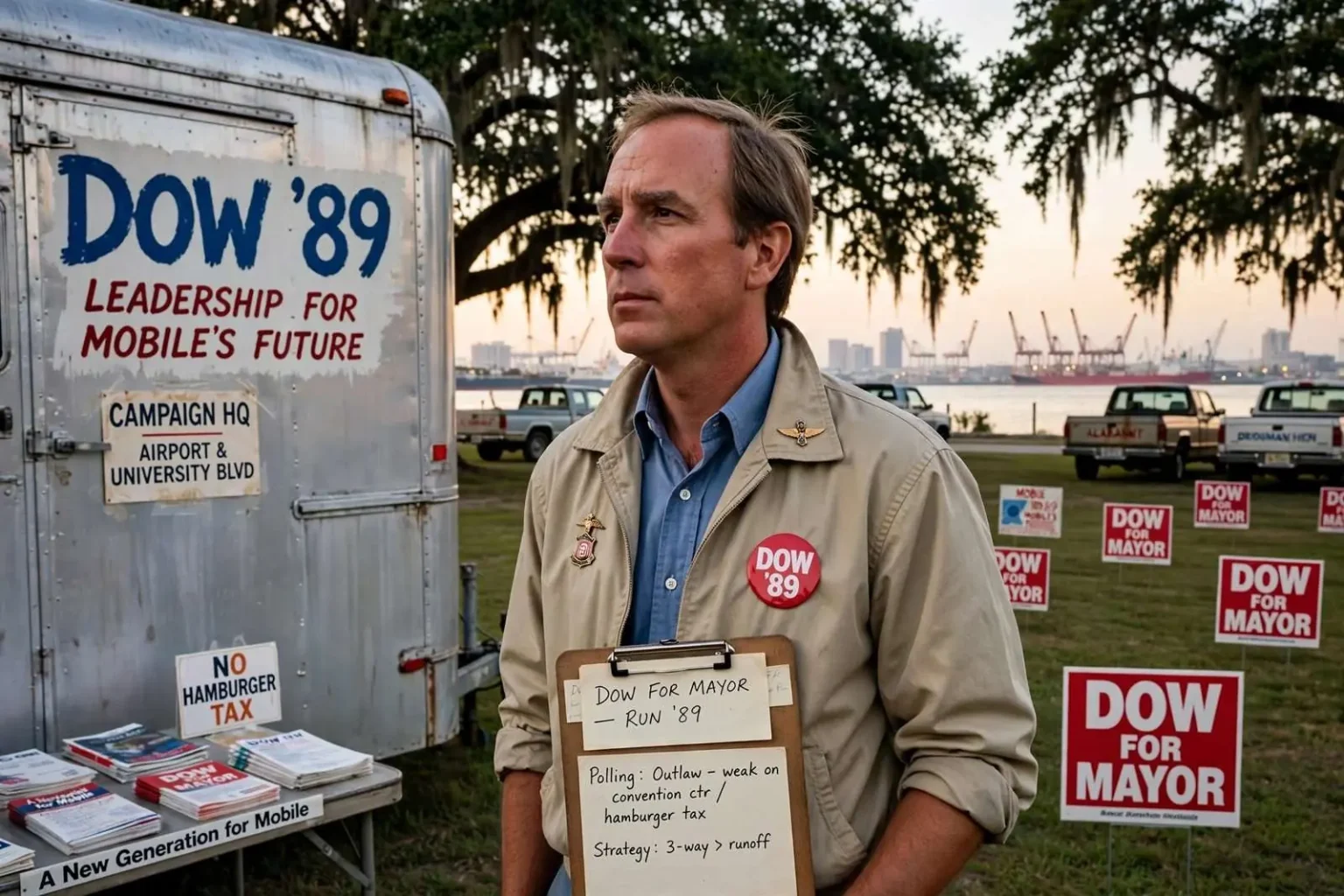
Nearly two decades after the fact, former Mobile Mayor Mike Dow and the friends and rivals who shaped his first campaign looked back candidly on the audacious decision that launched his political career: a novice’s leap past a City Council seat straight into a race for mayor.
Dow, a successful QMS Inc. executive, had planned a cautious entry into politics in 1989 — a run for the District 6 council seat representing the Cottage Hill area, with an eye toward the mayor’s office somewhere down the road. Then, on a quiet Sunday evening that summer, a friend and adviser stopped by his campaign trailer at Airport and University boulevards and made a case Dow could not shake.
‘You’re not going to win in District 6’
The adviser, Mark Berson, argued that Dow could not beat incumbent Councilwoman Jane Q. Baxter in her Republican-leaning district, but that he could unseat Mayor Arthur Outlaw, a towering figure whose wealth and standing seemed to armor him politically. District 6 was a closed door, the argument went; the mayor’s office was wide open.
The advice inverted every conventional rule of Alabama political ladders, which held that a first-time candidate earned his way upward — school board or council first, county or citywide office second, and only then, if the record held, a run at the top. Skipping directly from private citizen to mayor was the kind of leap that, when it failed, ended careers before they started. The fact that Berson made the argument not to a politician but to a businessman who could afford to take a long shot was part of what made the conversation possible at all.
What the public did not know was that Outlaw was more vulnerable than he appeared. Polling six months out, according to campaign aides, showed the mayor weakened by public anger over a proposed downtown convention center and the lodging and “hamburger” taxes meant to pay for it. The same polling suggested that a well-financed newcomer such as Dow could end the Outlaw era.
The convention center fight had become the defining issue of Outlaw’s term. The mayor had championed a waterfront convention facility as the anchor of downtown Mobile’s renewal, and the taxes to finance it — a levy on hotel rooms and, most memorably, a penny on prepared food that critics tagged the “hamburger tax” — landed on residents who had not been sold on the project. To Outlaw and his allies the center was an investment Mobile needed; to a restorative segment of the electorate it had become shorthand for a city government that taxed first and explained later. That gap between the mayor’s record and the public’s mood was the opening the poll numbers revealed.
A candidate’s story made for the trail
Dow’s biography lent itself to a campaign. Abandoned by an alcoholic father at 9 and separated from an institutionalized mother, he and his brothers grew up as wards of the state, shuttling between foster homes. He joined the Army at 17, trained as a paratrooper and served 27 months in Vietnam as a helicopter door gunner.
He came to Mobile at 21, married, raised a family and worked his way through the University of South Alabama on the G.I. Bill, earning an economics degree and an MBA while helping his brother-in-law Jim Busby build QMS from a small startup into a company listed on the New York Stock Exchange.
The story carried every note a Mobile campaign could want. The foster-care childhood and the Army service gave a political newcomer a biographical answer to the inevitable charge that he was an inexperienced interloper; the QMS years — a homegrown technology company that had grown into one of the city’s quiet business success stories — gave him standing with the business community that might otherwise have defaulted to the incumbent. At a time when Mobile’s civic leadership was worried about keeping young talent in the city, a thirty-something executive promising a “new generation” of leadership made a coherent argument that had nothing to do with party or personality.
Ad man Bill Yeager saw the potential immediately. Hired ostensibly for a council race, Yeager blanketed the city with billboards proclaiming “Mike Dow — Leadership for Mobile’s future,” an unorthodox move that preserved the option of a mayoral run. The billboards introduced a name the city had never seen on a ballot, bought visibility before the race had even been chosen, and let the campaign test the waters without committing to either contest. Rivals who understood what was happening could do little about it: the message itself was innocuous, and billboard contracts had already been signed.
Anger, calculation and a switch
Dow said the local Republican executive committee’s decision to endorse Baxter without ever speaking to him pushed him toward the bigger race. The slight — a routine county-party endorsement of an incumbent, delivered as if the challenger did not exist — did more to settle the question than all of Berson’s polling analysis.
Baxter’s camp offered a blunter reading: her team believed Dow’s advisers concluded he could survive a loss for mayor but not a drubbing in District 6. “We put up 1,000 yard signs on a Sunday night,” recalled her campaign manager. “A few days later, he switched to the mayor’s race.”
Baxter recalled a call in which Dow suggested she not seek re-election given the money he planned to spend, and mused about eventually running for Congress. She said she found the naivete almost comic at the time, though her opinion of Dow softened over the years as the two came to work together.
By the qualifying deadline, Dow had dropped the council bid and filed for mayor. The switch left the District 6 race to its original contenders and rewrote the citywide contest overnight: what had promised to be a referendum on Outlaw’s record with no obvious challenger became a genuine two-man race between a sitting mayor and a young executive nobody had cast a ballot for before.
The gamble pays off
The strategy rested on a calculation: former City Commissioner Lambert Mims, then facing federal charges, would draw enough votes to force Outlaw into a runoff, giving the fresh-faced challenger three additional weeks to mature into a genuine contender. It worked.
Mobile’s election rules required a majority to win outright, and a third significant candidate in the field made a first-round majority nearly impossible for the incumbent. Mims, a fixture of the old city commission government that Mobile had replaced with the mayor-council form in the mid-1980s, retained a stubborn personal following even as the federal case against him progressed. Dow’s team planned accordingly: their candidate would introduce himself in the first round, hold his base, and let the arithmetic of a three-way race do the rest. If Outlaw fell short of 50 percent, the general election became a runoff — and a runoff, against a wounded incumbent with three weeks to fill, was a different contest entirely.
On Aug. 22, Dow led with 18,962 votes to Outlaw’s 17,892, with Mims trailing far behind. The numbers stunned the city’s political establishment: the incumbent who had seemed armored had not even carried the first round. The runoff three weeks later was a formality. The outsider was in, and Mobile had a new mayor — one who would go on to serve four terms.
What the gamble produced
The Outlaw era ended on a note its architects could hardly have scripted. The mayor who had staked his term on the downtown convention center lost his office over the taxes that financed it, and the center itself would rise on the waterfront in the years that followed — carrying Outlaw’s name. The hamburger tax outlived the mayor who proposed it. And the challenger who had entered politics expecting a council district learned, within a single campaign, that timing and arithmetic could matter more than any ladder.
Dow’s four terms in office would remake Mobile’s self-image — the Mardi Gras park at the waterfront, the revitalization of downtown, the city’s long pursuit of the aircraft work at Brookley all traced to the administration that began with a Sunday-evening argument in a campaign trailer. But the 1989 race itself remained, for the people who ran it, the defining proof of the city’s capacity for surprise: a novice who could not win a council seat won the mayor’s office in his first campaign, against an incumbent who had done everything except count the anger correctly.
Baxter, whose 1,000 Sunday-night yard signs had helped push Dow up the ladder he hadn’t planned to climb, would serve alongside the man who had once called her about retiring — a small, fitting coda to a campaign that Mobile’s political class spent two decades retelling, and that its winner spent four terms justifying.