
In Fairhope, the ‘Fruit and Nut’ Section Is About the Streets, Not the People
Mayor Tim Kant's offhand reference to Fairhope's 'fruit and nut' section raised eyebrows among outsiders. Longtime residents knew exactly what he meant: Fig, Orange, Pecan and Satsuma streets.
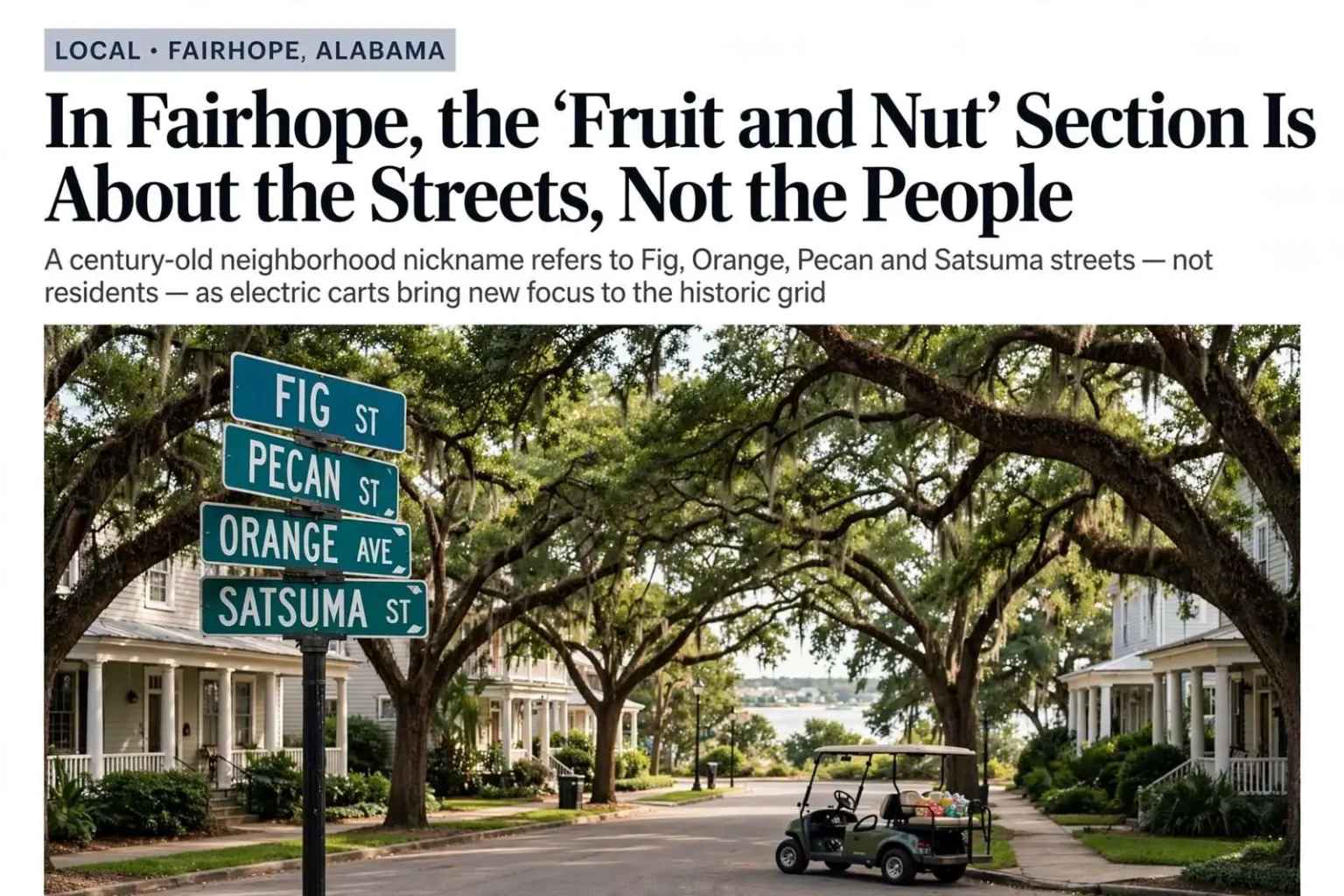
A small linguistic misunderstanding rippled outward from Fairhope, and it is worth setting straight, because it says something about how a place gets read from the outside. Mayor Tim Kant, quoted on the growing popularity of small electric carts as a means of short-haul transportation, observed that they might prove especially popular in the “fruit and nut section” of town. The phrase raised eyebrows among some alert-to-prejudice readers elsewhere, who took it as a slur aimed at the people who live there.
It was nothing of the kind. Anyone who has spent time in Fairhope knows the phrase the way they know the route to the pier, and the confusion says more about the distance between an outsider’s ear and a community’s shorthand than it does about anything the mayor said. For residents of the Eastern Shore, “fruit and nut” is not a comment on people. It is a comment on street signs.
Fig, Orange, Pecan and Satsuma
As Fairhopers and most nearby residents of any duration are well aware, the “fruit and nut” section refers not to the residents but to the street names. The older neighborhood near downtown is laid out along thoroughfares named Fig, Orange, Pecan, Satsuma, Pomelo and their kin — a naming convention that gave the area its nickname long before anyone thought to be offended by it. The grid sits just inland from the bluff that overlooks Mobile Bay, a few blocks’ walk from the shops and restaurants that draw weekend visitors down from the Eastern Shore and across the bay from Mobile.
“We’ve always called it that,” Kant said. Then, with the resignation of a mayor who has been quoted before, he added: “Maybe I should say the older section of town when being quoted for publication.”
The correction was good-humored, but it carried a genuine point. Local place names accumulate meaning from the people who use them daily, and the fruit-and-nut shorthand has been part of Fairhope speech for generations. Real estate listings, delivery routes and dinner-table directions in Fairhope all lean on the orchard-named streets, and no one who grew up in the town needed the phrase explained.
Why the streets are named that way
The names are a legacy of Fairhope’s origins. The town was founded in 1894 by a group of Iowa reformers who established a single-tax colony on the eastern shore of Mobile Bay, inspired by the economic theories of Henry George. George’s argument — that the value of land belonged to the community as a whole and should be taxed accordingly — drew idealists from across the country, and the settlers who came to the Mobile Bay bluff believed they had a fair hope, as the story goes, of building their experiment into a working demonstration.
They laid out a town of generous lots and wide streets on a bluff overlooking the water, and they named those streets for the fruit and nut trees that flourished in the Gulf Coast climate — satsumas above all, the cold-hardy citrus that became a commercial crop across Baldwin County and lent its name to a Mobile County town as well. Fig trees, pecan groves and citrus orchards were part of the working landscape the colonists hoped to cultivate, and the street names recorded the crops they expected to grow there.
The orchard economy never became the foundation the founders imagined, but the names held. The result is a neighborhood grid that reads like an inventory of Gulf Coast trees, and a local shorthand that has survived more than a century of newcomers. Walk the blocks between the bay and the downtown today and the founders’ optimism is still posted at every corner, one fruit and one nut at a time.
The single-tax experiment itself left its mark well beyond the street names. Fairhope grew from a handful of colonists into one of Baldwin County’s defining communities, with a public library, a pier and a bluff-top park that remain gathering places for the whole Eastern Shore. The town’s founding as a colony of reformers explains much about what visitors still find distinctive: the parks kept open to everyone, the long-standing reputation for tolerating independent thinkers, and the habit of viewing the town as a shared project rather than a private holding.
The carts that started the conversation
The subject that started it all — low-speed electric vehicles — was not incidental. Fairhope’s older section is precisely the kind of place where they make sense: flat, compact, walkable, laid out on a grid, with a downtown a few minutes from most front porches and a bluff-top park at the end of the street. A cart that tops out at modest speeds is well matched to those distances, and residents already use golf carts and similar vehicles for short runs to the store, the pier and the elementary school.
Communities across the Gulf Coast were beginning to grapple with where such carts could legally operate, and Fairhope, with its short distances and steady stream of visitors, was a natural candidate. Municipalities have to sort out which streets low-speed vehicles may share with regular traffic, how operators are to be licensed and insured, and what the rules mean for a downtown that fills with pedestrians on pleasant weekends. Those are practical questions, and the mayor’s remark was aimed squarely at them — a note about neighborhood suitability in a town that thinks constantly about how people move around its streets.
Nothing in the discussion had anything to do with the character of the residents on Fig, Orange, Pecan, Satsuma or Pomelo. The neighborhood is one of the oldest and most beloved parts of Fairhope, close enough to the downtown that its porches and live oaks form part of the picture postcard image the town trades on. Anyone suggesting otherwise misunderstood the reference entirely.
A town that has to explain itself
The misunderstanding was, in the end, harmless. But it is a familiar experience in a town like Fairhope, which has spent the last several decades being discovered — by retirees, by tourists, by magazine writers ranking small Southern towns — and which now must occasionally explain itself to an audience that did not grow up knowing which streets are named for citrus. Every community of any age carries shorthand like this, and every community of any size eventually watches a piece of that shorthand travel somewhere it gets misread.
Fairhope’s version of the experience is milder than most. The phrase in question describes a neighborhood the town cherishes, in a vocabulary the town has used for a century, in a conversation about electric carts that was purely practical. Once explained, it stops being mysterious: the fruit and nut section is simply the part of town where the map reads like a grove.
The people who live on Fig and Pecan know. They have known for a hundred years. And if the arrival of small electric carts makes those quiet, tree-lined blocks easier to reach from downtown, the founders who named the streets after the crops they hoped to grow might have found the arrangement fitting — the orchard streets, once again, at the center of the town’s life on Mobile Bay.
The satsuma connection runs deep
Of all the trees named on the street signs, the satsuma carries the most weight in Gulf Coast history. The small, easy-peeling mandarin arrived in the region in the late nineteenth century and found the sandy soils and mild winters of Baldwin County much to its liking, at least by citrus standards. Satsumas tolerate cold better than most orange varieties, which made them the one citrus commercial growers along the northern Gulf Coast could reliably attempt, and for a stretch of the early twentieth century the county marketed itself as a citrus belt.
Hard freezes eventually pushed commercial production far south of the bay, but the fruit never left the local identity. Home gardeners across Baldwin and Mobile counties still grow satsumas in their yards, the harvest season is a fixture of fall farm stands along the Eastern Shore, and the town of Satsuma in north Mobile County keeps the fruit’s name on the map in Alabama. A street in Fairhope carrying the same name fits the pattern: the founders reached for the trees that defined the local landscape, and the satsuma defined it as thoroughly as any.
That living history is part of why the nickname never wore out. A neighborhood named for trees that still bear fruit in nearby yards each November is not an abstraction, and residents’ attachment to the terminology reflects genuine fondness for what the words describe. The idea that the phrase could be aimed at people rather than trees simply would not occur to anyone standing on Fig Street.
What the episode says about local language
Local shorthand everywhere works this way, and it almost always mystifies outsiders on first contact. Every old city has neighborhoods whose nicknames come from landmarks that have changed, industries that have moved on or jokes that only longtime residents remember. The shorthand survives because it does useful work — it locates people precisely, it signals local roots, and it compresses history into a phrase.
Fairhope’s fruit-and-nut section does all three. It identifies a specific set of blocks near downtown, it marks the speaker as someone who knows the town, and it preserves, in two words, the story of a group of reformers from Iowa who named their streets for an orchard they never quite got to build. Misread once from a distance, it was easily corrected, and the correction carried a small lesson worth keeping: before taking offense at a phrase, it helps to ask what the words mean to the people who have used them longest.
The mayor’s electric carts, meanwhile, remain the real story. Whether the older section’s grid becomes a proving ground for low-speed vehicles will be settled by the town’s own traffic decisions, not by a misread quote. And if it happens, the carts will glide along streets named by people who believed a town on a Mobile Bay bluff could be built fairly — past Fig, past Pecan, past Satsuma — in a neighborhood that has answered to the same cheerful nickname for more than a hundred years.