A Fairhope Lawyer’s Campaign to Give Dixey Bar Its Proper Name
In March 2005, Fairhope attorney David Bagwell asked federal geographers to make Dixey Bar official, tracing its name to a clipper ship lost in a hurricane at the mouth of Mobile Bay in 1860.
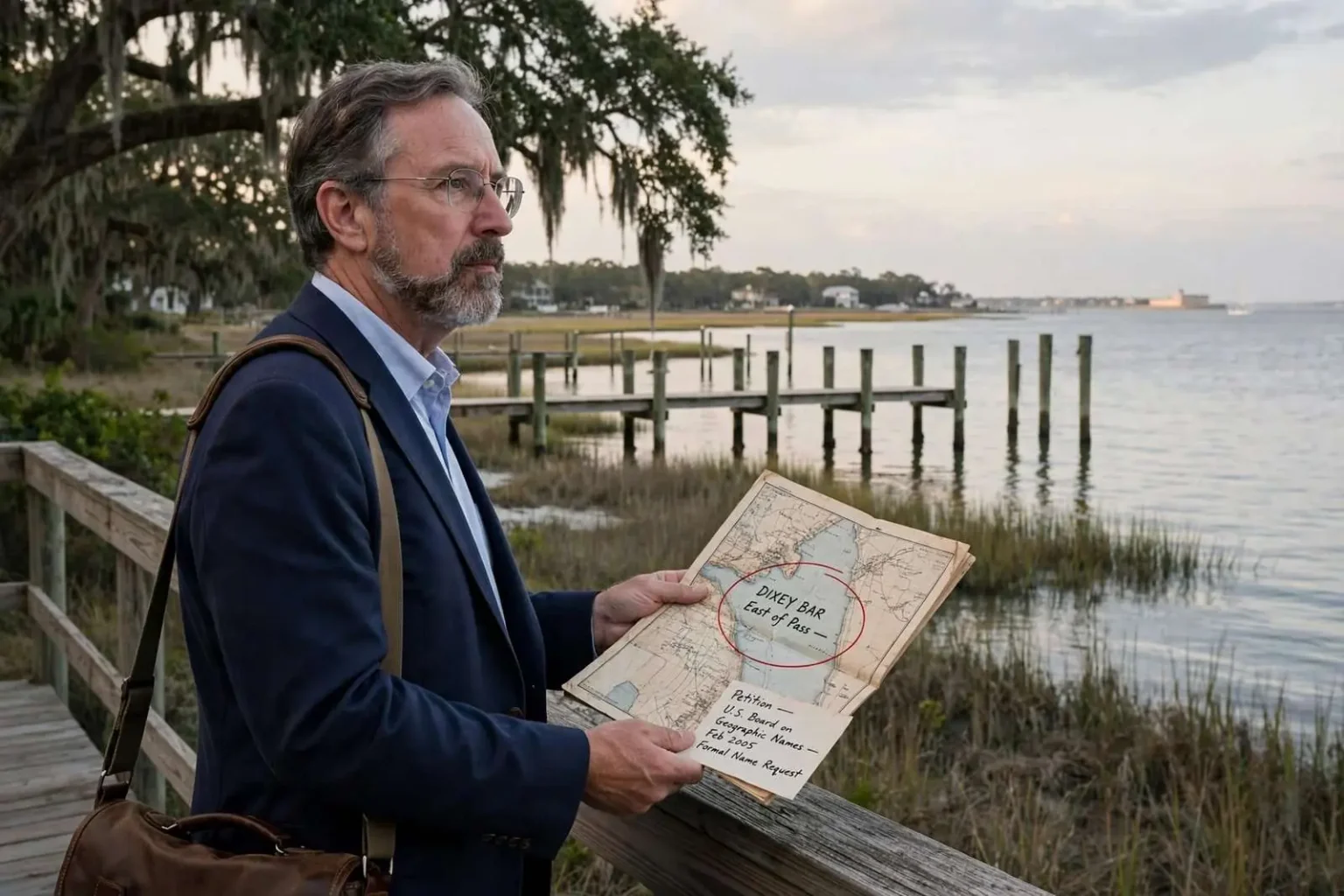
FAIRHOPE — For more than a century, mariners running out of Mobile Bay into the Gulf of Mexico have known the sandbar off the eastern side of the pass as Dixey Bar. Charts, however, did not.
In the spring of 2005, a Fairhope attorney and amateur historian set out to fix that.
David A. Bagwell wrote in February 2005 to Roger L. Payne, executive secretary of the U.S. Board on Geographic Names at the U.S. Geological Survey, asking that the shoal be formally christened with the name everyone already used.
“Even though the bar is and has been for maybe a century called ‘Dixey Bar’ by people in boats and ships going anywhere near it,” Bagwell wrote, “for some reason — likely because nobody has ever taken the trouble to write a letter like this — the bar has never been officially named.”
He expected no opposition, he said. The likelier reaction was simple surprise that Dixey Bar was not already Dixey Bar in the eyes of God, government and mariners alike.
Not ‘Dixie’ — Dixey
The spelling is the point. The bar takes its name not from the anthem of the Confederacy but from a ship: the clipper Robert H. Dixey, which was destroyed on the shoal in a hurricane on Sept. 14-15, 1860, with the loss of nineteen lives.
The distinction matters more on the Gulf Coast than it might elsewhere. A name that sounds like a secessionist tribute would carry one meaning; a name that commemorates a ship and the men who died on her carries another entirely. Bagwell’s campaign was, at bottom, an argument that the second meaning had been sitting in plain sight for 145 years — spoken constantly at sea, and never written onto a chart.
The ship and her owners
The vessel was built in East Boston in 1854-55 — 165 feet on the waterline, some 40 to 60 feet shorter and therefore slower than the great clippers of the day, double-topsail rigged, framed with sawn live oak and planked with yellow pine.
Those construction details place her precisely in the clipper era. East Boston’s yards were then turning out the fastest merchant ships in the world, and a 165-foot medium clipper — built for cargo capacity and economy rather than record passages — was the workhorse version of the type: fast enough to compete, sturdy enough to make money. Live-oak framing gave American ships a hull strength that European builders envied, and yellow-pine planking was the standard sheathing of the Yankee merchant fleet.
Her ownership was a characteristic mix of Northern and Gulf Coast money: Robert H. Dixey of New York City; his lifelong friend Thomas J. Fettyplace of Marblehead, Massachusetts and Mobile; the shipbuilder Paul Curtis; Nicholas Harleston Broun of Boston and Mobile; Daniel and George Deshon of Boston and Mobile; and Edward Bergoren DeMeaux of New Orleans.
The investor list tells its own story about the cotton economy of the 1850s. Ships like this one were financed jointly by Northern builders and merchants and by Gulf Coast commercial men who needed hulls to move cotton, passengers and general cargo between the gulf ports, the East Coast and Europe. Mobile’s antebellum prosperity ran on exactly such arrangements, and a ship sailing out of Mobile Bay was the visible instrument of them.
Between 1855 and 1860 she sailed the world, ranging as far as St. Petersburg at the far eastern end of the Baltic.
A medium clipper’s employment in those years meant long hauls on the world’s trade routes — Atlantic crossings, gulf passages, and northern European ports like the Russian capital’s Baltic anchorage. Five years of that work was a solid career for a merchant vessel; most ended their days quietly in some port, scrapped when the economics ran out.
The full account appears in An Antebellum Life at Sea, a 1997 book by L. Tracy Girdler published by Black Belt Press in Montgomery.
The book is one of the small number of works that reconstruct a single American merchant vessel’s working life from owners’ papers, port records and contemporary accounts — the kind of scholarship that amateur historians along the Gulf Coast have often advanced further than the professionals.
The last voyage
Bagwell’s letter recounted the wreck in detail.
The ship carried a Mobile bar pilot, Capt. Samuel Smyly, from New York on that final passage. He brought her over the bar and into Mobile Bay just ahead of a hurricane on the night of Friday the 14th, drawing 17 feet 5 inches.
Halfway up the bay the wind shifted to north-northwest. At 10 p.m. the pilot put out both anchors, with 45 and 50 fathoms of chain. They held until 10 a.m. Saturday, when the eye passed and the north winds came on harder.
The smaller chain parted and the ship stranded. The crew went to work cutting away masts and sails as she took on water. Then the big chain parted, and they knew there was no hope.
All twenty-four men made for the forecastle and lashed themselves to the ship. She bounced down the channel, drifting eastward outside the bay, until she struck the east bar and broke to pieces.
The account reads like the seamanship manuals of the day because it was written by men who lived by them: anchoring ahead of a hurricane, doubling the ground tackle with two chains, cutting away rigging when the hull began to pound, and lashing the crew to the forecastle as a last resort when the deck was no longer survivable. Every step was the standard procedure of a 1860 merchant crew, and every step failed in sequence as the storm outlasted the tackle.
The pilot, the mate and four men reached land and were rescued by a boat from a nearby vessel.
Capt. Richard H. Dixey, 51, stayed aboard with eighteen Black seamen — apparently free men. His last words to the pilot were: “Goodbye, I hope we shall meet in heaven.”
All who stayed with the ship were lost.
The captain’s choice to remain, and the crew’s with him, was the era’s grim arithmetic: the forecastle lashings were for men who could not reach a boat, and the master stayed because abandoning a ship — and eighteen of his crew — was not something a antebellum master could do while any chance remained.
The seamen were buried in unmarked graves on Dauphin Island, on the west side of the bay’s mouth.
Dauphin Island in 1860 was a quiet barrier island with a small population, a military past at Fort Gaines, and ground enough for graves that no family would ever visit. Unmarked burials of merchant seamen were common on the gulf barrier islands, and most remain anonymous today.
Capt. Dixey was buried in the then-new Magnolia Cemetery in Mobile, where, Bagwell noted, only a broken stone remains.
Magnolia Cemetery had been established only a few decades before as one of Mobile’s principal burial grounds, and its silent stones hold many of the city’s antebellum commercial families — including, in this case, the New York master whose ship gave the bar its name.
An island that came and went
The story did not quite end with the wreck.
A later hurricane threw up an island in the vicinity — “Dixey Island” — which survived on the charts until another storm washed it away, leaving only the bar itself: submerged, well known, and officially nameless.
Barrier islands are built and erased by exactly such storms, and the pass out of Mobile Bay has been reshaped repeatedly by them. A sand island that appears after one hurricane and vanishes after another is a normal event on this coast; the remarkable part is that the name — borrowed from a wrecked clipper — attached itself to the shifting shoal and stayed there for more than a century, passed from chart hand to chart hand among working mariners while never entering the official record at all.
Shrimpers, charter captains and pilots learn the bar young, because running out of the pass means crossing it: the shoal reaches south from the Fort Morgan side, and the channel’s eastward drift carries silt and stranded vessels onto exactly the ground where the Robert H. Dixey came apart.
The argument for the name
Bagwell’s argument was finally one about memory.
The bar runs south from Fort Morgan on the eastern side of the pass into the Gulf, a feature every shrimper, charter captain and ship pilot on the coast can name from the wheelhouse.
That the name commemorates a captain who stayed with his ship and the men who died beside him seemed to him reason enough to get it right.
“The Robert H. Dixey and Capt. Dixey deserve to be remembered,” he wrote, “and correctly spelt.”
That is how geographic names actually survive: not by decree, but by the daily use of people whose livelihoods depend on knowing a feature by its name. Bagwell’s letter asked the government to catch up to the wheelhouse — to write down, with the right spelling, what the coast had never stopped saying.