Foley Closes the Last Gap in a Four-Mile Sidewalk Network Along Alabama 59
Construction has begun on the final 1.25-mile stretch of Foley's Alabama 59 sidewalk system, a project largely funded by a federal grant that will complete continuous pedestrian access through the heart of the city.
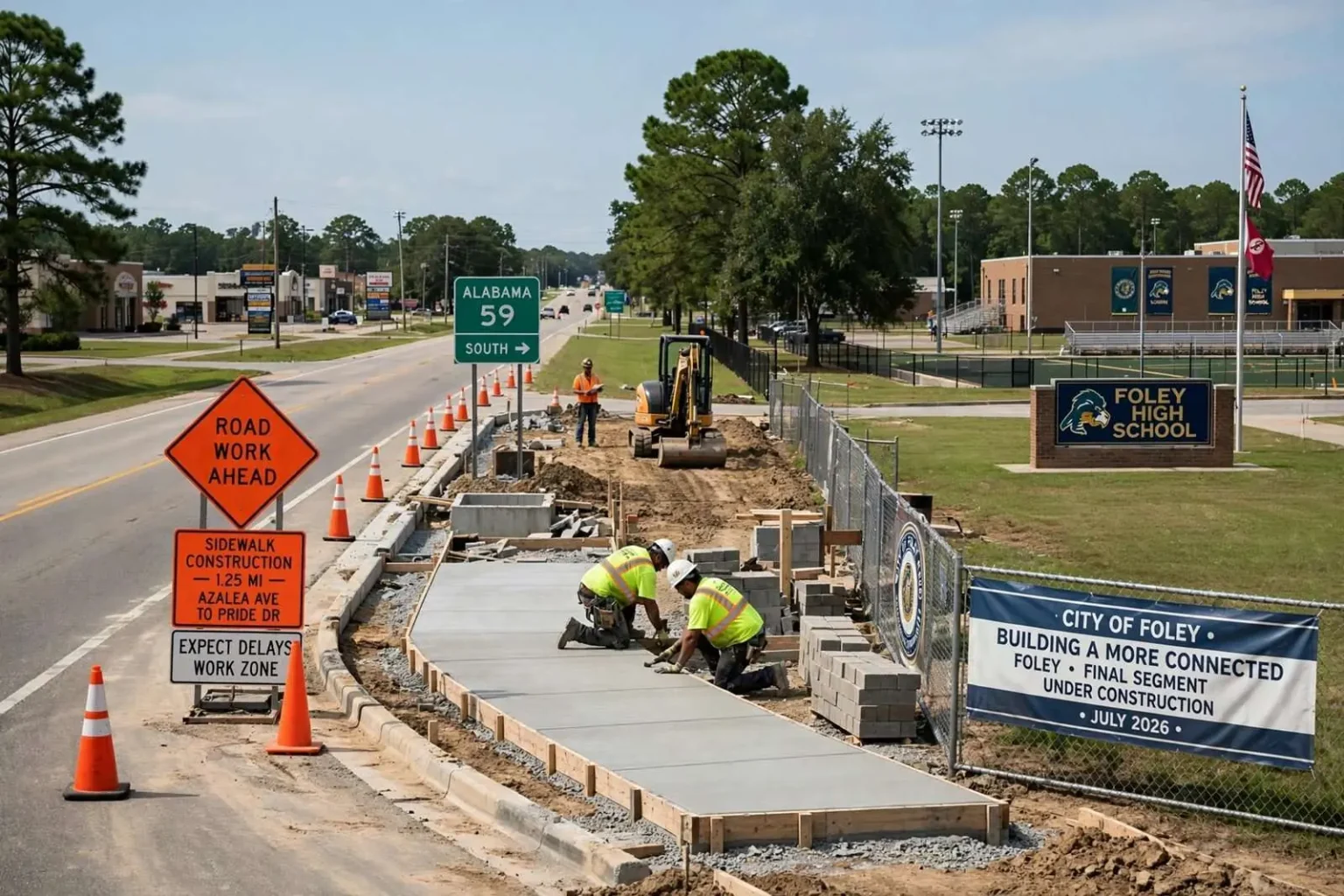
For years, walking the length of Alabama 59 through Foley meant accepting that at some point the sidewalk would simply end and the shoulder would have to do. That is about to change. Construction has begun on the final segment of a nearly four-mile sidewalk network along the highway, closing the last gap in a system that has been assembled piece by piece over more than a decade of planning and grant applications.
The Final Segment
The new stretch fills a 1.25-mile gap between Azalea Avenue and Pride Drive, near Foley High School. Work on the segment was announced on July 6, 2026. When it is finished, the completed corridor will run continuously from Miflin Road, also known as Baldwin County Road 20, south of the Tanger Outlets, north all the way to Peachtree Avenue.
The location matters. A sidewalk gap adjacent to a high school is not an abstraction. It is the reason a teenager without a car walks in the road, and it is the reason a parent decides the walk is not safe and drives instead, adding another vehicle to the same congested corridor.
How It Is Being Paid For
The project is partially funded through the federal Transportation Alternatives Program, administered in Alabama by the state Department of Transportation. The federal grant covers 80 percent of construction costs, with the City of Foley responsible for the remaining local match.
That ratio is the whole reason a project of this size is achievable for a city of Foley’s population. TAP dollars are competitive and are specifically set aside for pedestrian and bicycle infrastructure, safe routes to school, and similar work that rarely survives a general road budget on its own merits. Cities that build the internal capacity to write successful applications get sidewalks. Cities that do not, generally, do not.
Congress created the Transportation Alternatives Program in the 2012 federal surface transportation law known as MAP-21, folding in earlier programs such as Safe Routes to School, and later highway bills, including the 2021 Infrastructure Investment and Jobs Act, have continued it as a set-aside within the Surface Transportation Block Grant Program. Projects are typically funded on the same 80 percent federal, 20 percent local basis as Foley’s.
Mayor Ralph Hellmich pointed directly at that dynamic. “This project is the result of years of planning and persistence,” he said. “Our staff has worked hard to pursue grant opportunities that allow us to maximize local tax dollars while continuing to invest in infrastructure that improves everyday life for our residents. Completing this sidewalk network is another step toward creating a more connected Foley.”
A Sustained Local Commitment
The grant money sits on top of a substantial local investment. Since 2022, Foley has put between $3 million and $4 million in municipal funding into sidewalks, entirely separate from grant awards. The city council has also committed approximately $1 million annually in recent years toward sidewalk construction and expansion projects across the city.
That is an unusual level of sustained commitment for a line item that generates no revenue and rarely makes headlines. Sidewalks do not attract industry the way an interchange does. What they do is quieter and more durable: they reduce pedestrian injuries and fatalities, they let children walk to school, they let older residents reach a pharmacy without driving, and they make it possible for a household to function with one car instead of two.
What Else Is Being Built
The Alabama 59 corridor is the most visible piece of a broader pedestrian program. Recent and planned work includes:
- North Cedar Street, where completed sidewalks now provide pedestrian access from Peachtree Avenue to U.S. 98 and onward to West Fern Avenue.
- The Mills community, where the city plans to extend sidewalks to connect west Foley neighborhoods into the growing citywide network.
The Alabama 59 route itself connects neighborhoods, schools, businesses, and shopping destinations throughout Foley. It is among the busiest transportation routes in the city, which is precisely what makes walking along it dangerous where the sidewalk stops.
The Bigger Picture
Baldwin County’s rapid growth has produced a familiar pattern across South Alabama: commercial development strung along a state highway, residential subdivisions behind it, and no safe way to get from one to the other on foot. Retrofitting sidewalks into that pattern after the fact is expensive and slow, requiring right-of-way, drainage work, and coordination with the state highway department.
Foley’s approach, pairing steady local appropriations with competitive federal grants and simply refusing to stop applying, is one of the few reliable ways a mid-sized city closes that gap. The last 1.25 miles on Alabama 59 is the proof.