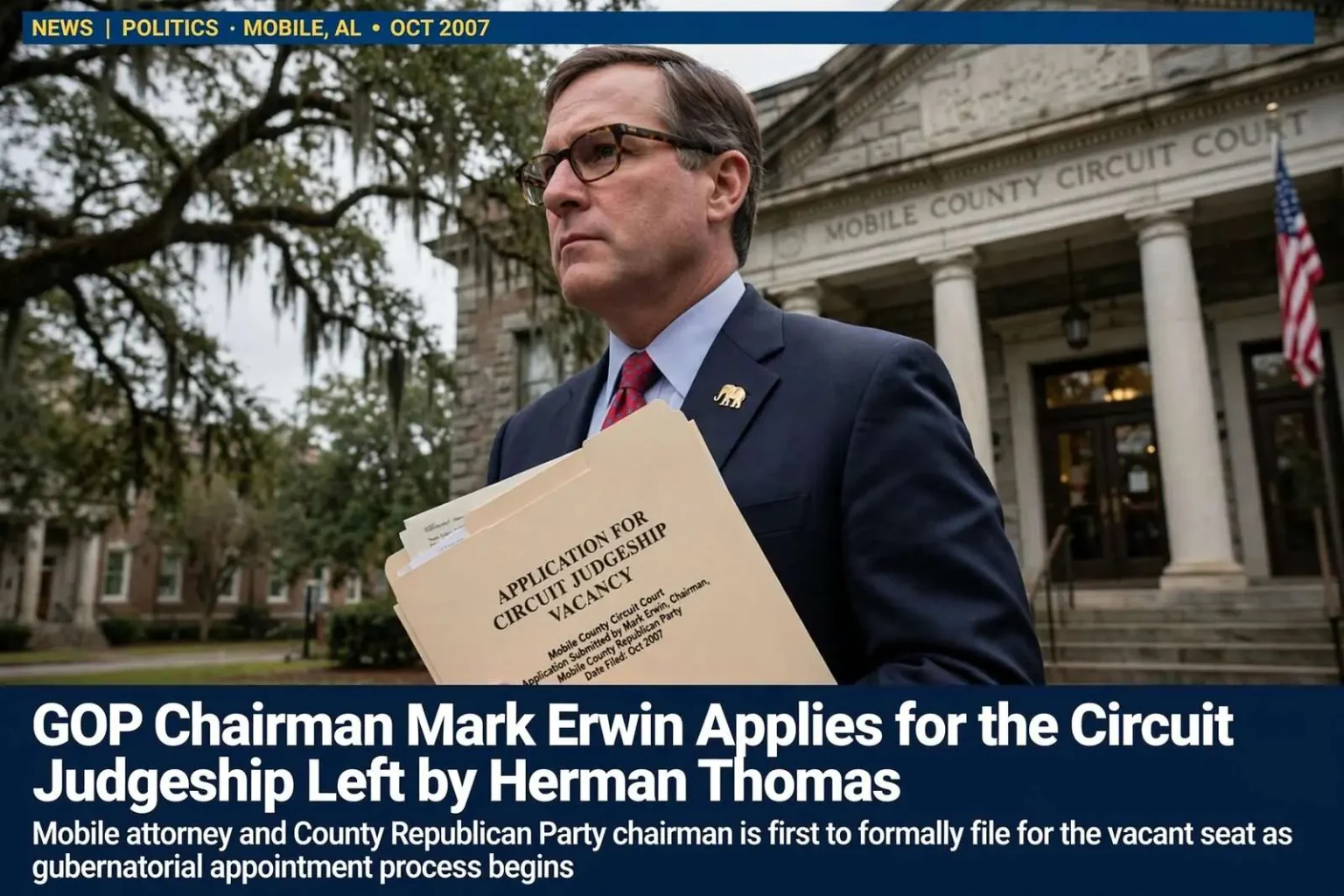
GOP Chairman Mark Erwin Applies for the Circuit Judgeship Left by Herman Thomas
Mobile attorney and Republican Party chairman Mark Erwin formally applied for the circuit court vacancy created by Judge Herman Thomas's resignation, as more names surfaced for the appointment.
The First Name Into the Open
Mobile attorney Mark Erwin, chairman of the Mobile County Republican Party, formally applied to fill the vacancy on the Mobile County Circuit Court bench created by the resignation of former Judge Herman Thomas. Erwin, who also served as an assistant attorney to the Mobile County Commission, had been among the names in circulation almost from the moment Thomas stepped down. His was the first application to become public.
The early move signaled how quickly the contest for the seat would take shape. In Mobile County, where a circuit judgeship is one of the most consequential and visible positions in local government, the window between a resignation and a gubernatorial appointment is a period of intense maneuvering — and by filing first, Erwin established himself as the candidate to beat within his own party’s circles.
A Widening Field
Others surfaced in the days that followed. Among the names newly mentioned as possible candidates for the opening were Michael Youngpeter, Scott Wright and E.J. Saad — additions to an already long list that included district judges, prosecutors, municipal judges and private practitioners across the Mobile bar.
The breadth of the field reflected the seat’s appeal. Circuit judges hear felony cases, major civil suits and the kind of high-stakes litigation that shapes a county’s legal and business community, and an appointment offers the rare chance to run as an incumbent without ever having faced the voters for the office. For lawyers in the middle of their careers, few opportunities combine prestige, public service and political upside the way a circuit vacancy does.
The selection process ran through a judicial committee chaired by Presiding Circuit Judge Charlie Graddick, which was charged with screening applicants and forwarding three finalists to Gov. Bob Riley. The governor would make the appointment.
Graddick, himself a former Alabama attorney general and a veteran of statewide politics, lent the screening process weight within the bar, and his committee’s job was as much about winnowing as recommending: turning a list of ambitious applicants into a short list the governor could act on without political embarrassment.
Politics and the Bench
That an active party chairman would seek a judgeship was neither unusual nor disqualifying in Alabama, where circuit judges are elected in partisan contests and where the path to the bench frequently runs through party work. Judicial candidates here run with a D or an R beside their names, raise money like any other candidate, and take positions before electorates that have grown steadily more partisan.
Alabama is one of the states that elects its trial and appellate judges on partisan ballots, a system that has repeatedly drawn national attention and periodic reform proposals but has endured through decade after decade of Alabama politics. The practical consequence in Mobile County is that a judicial vacancy is never just a legal event — it is immediately a partisan one, with both parties scanning their benches for credible candidates the moment a seat opens.
The appointment carried an additional political dimension. Thomas, a Democrat, had won the seat in 2006. A Republican governor filling the vacancy would give the appointee the considerable advantage of incumbency heading into the 2008 election — in a county where Republicans had been steadily gaining ground in judicial races.
Incumbency in judicial races is formidable: an appointed judge spends the interim building a record on the bench, appearing in courtrooms before the very lawyers who may one day serve on a campaign committee, and entering 2008 as the sitting judge rather than the challenger. Both parties understood that whoever received Riley’s appointment would begin the next election with a structural advantage that no amount of campaign spending could easily offset.
The Vacancy Behind the Vacancy
Thomas resigned as the Alabama Judicial Inquiry Commission prepared to consider complaints about his conduct in office, ending a tenure that had drawn scrutiny even as the judge maintained his innocence of any wrongdoing. The resignation created the vacancy but not the closure — the questions that surrounded the seat’s previous occupant hung over the selection process that followed.
What the Committee Looked For
Judicial screening committees in Alabama typically weigh a candidate’s trial experience, reputation among the bar, temperament and administrative ability — the qualities a circuit judge needs to manage a docket of hundreds of felony and civil cases a year. In Mobile County, where the circuit court is among the busiest in the state, the managerial dimension is no small consideration: a judge who cannot move cases creates backlogs that ripple through the jail and the entire local justice system.
The committee’s obligation to forward three finalists preserved the governor’s discretion while narrowing the field through a process led by the judiciary itself. For applicants, the sequence meant two auditions — one before Graddick’s committee, one before the governor’s office — and the candidates who advanced understood that both legal credentials and political viability would be in the file.
The Road to 2008
Whoever received the appointment would have to face the voters in 2008 to serve out the remainder of the six-year term Thomas won in 2006, meaning the winner of the appointment would serve only briefly before having to defend the seat at the ballot box. The compressed timeline concentrated everyone’s attention: applicants wanted the appointment not merely for the office but for the head start it provided on the next campaign.
For Mobile County voters, the episode was a familiar chapter in Alabama’s system of electing judges. A seat won by one party was surrendered amid scandal, filled by appointment from a governor of the other party, and set for resolution by the electorate — with the bar’s most ambitious members competing at every stage. Erwin’s application put the machinery in motion; the committee, the governor and eventually the voters would determine where it stopped.
Between the application and the election lay the ordinary business of the circuit court, which kept running while its future occupant was decided — a reminder that in Alabama’s system, judicial politics and judicial work are never fully separate, and the county’s courtrooms absorb the consequences of both.
Inside the Circuit Court’s Reach
The Mobile County Circuit Court is the county’s court of general jurisdiction, meaning nearly every serious matter in the county’s legal life passes through it: murders and other felonies, multi-million-dollar civil disputes, divorces with complex estates, challenges to zoning and taxation, and the litigation that tests the contracts binding the port city’s businesses together. A circuit judge’s rulings can reach further than any ordinance the county commission passes, which is one reason the bench attracts attention well beyond the legal community.
The docket’s sheer size also shapes who can do the job. Mobile County’s circuit judges manage caseloads measured in the thousands, from arraignment through trial and sentencing, supported by staffs that look small against the volume. Lawyers who appear before the court know that a judge’s case-management style — how firmly hearings are held, how quickly rulings come, how trials are scheduled — affects the daily working lives of hundreds of attorneys, litigants, jurors and witnesses.
That practical reality informed the screening committee’s work. Beyond the political dimensions of the appointment, the three names forwarded to the governor had to be people capable of stepping into that docket almost immediately, since an appointed judge takes the seat in medias res, inheriting trials and rulings midstream from the judge who left.
The County’s Changing Political Map
The partisan arithmetic underlying the appointment had been shifting for years. Once a Democratic stronghold, Mobile County had seen judicial and legislative offices fall steadily into Republican hands through the 1990s and 2000s, a realignment visible in the county’s voting returns and in the composition of its courthouse. A seat won by a Democrat in 2006 sitting vacant before a Republican governor was the realignment in miniature — one election old, and already the subject of a contest both parties expected to win.
Erwin’s dual roles — party chairman on one hand, attorney for the county commission on the other — drew the kind of scrutiny that follows any politically active lawyer into a judicial contest. Supporters argued the combination was standard preparation for the bench in Alabama; critics would have the chance to make the same résumé an argument against him in 2008. Either way, the first public application set the terms of debate for the field that followed.
The applicants newly in the mix reflected the range of experience the committee would consider: Youngpeter, Wright and Saad joined a candidate pool spanning the district bench, the prosecutor’s office and the municipal courts, each bringing a different vantage point on the county’s justice system. The committee’s task was to sort that range into three finalists while the political calendar — the appointment now, the election soon — pressed on everyone involved.