Discovering Alabama Marked 20 Years on Public Television With a Fairhope Open House
Discovering Alabama, the public television series devoted to the state's natural wonders, celebrated its 20th year in 2005 with an open house reception at Faulkner State College in Fairhope.
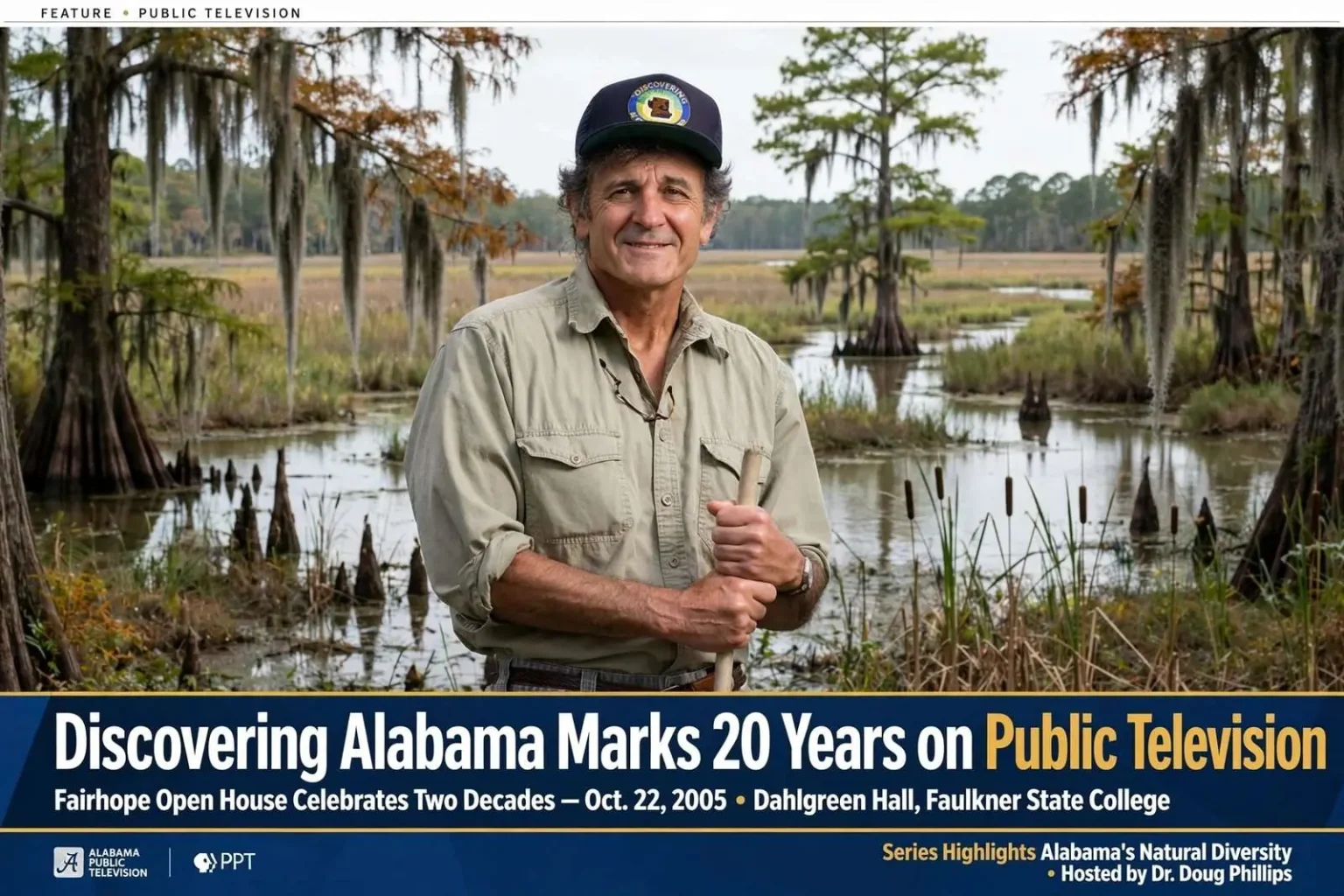
Discovering Alabama, the public television series that has carried the state’s natural diversity into homes and classrooms for two decades, marked its 20th year on the air in 2005, and it chose Baldwin County as the place to celebrate. The program scheduled an open house reception for its fans and supporters on Saturday, Oct. 22, 2005, from 3 to 5 p.m. at Dahlgreen Hall on the Fairhope campus of Faulkner State College. Those wanting more information about the event were directed to contact the series’ host, Dr. Doug Phillips, at (205) 348-3553.
A series built on Alabama’s own landscape
Discovering Alabama’s premise was simple and, in its way, radical for public television in the mid-1980s: that Alabama’s own rivers, forests, caves, canyons, bays and barrier islands were subject enough for a documentary series. While national productions flew camera crews to distant continents, the series argued that a viewer could spend a lifetime exploring the state line to line and never exhaust the material. The program took Alabama’s remarkable natural wonders to viewers across the state, and in doing so it made a case that few in the television business had made before: that Alabama was not a flyover state but one of the most biologically rich corners of North America.
The claim held up under scrutiny. The state is among the most biologically diverse in the nation, with an extraordinary range of aquatic species — Alabama’s rivers and streams hold more species of freshwater fish, mussels, snails and turtles than nearly anywhere else in the country — along with longleaf pine systems that once covered millions of acres, mountain terrain in the north and coastal marsh and dune systems in the south. The Mobile-Tensaw Delta alone, at the head of Mobile Bay, ranks among the largest river deltas in the country and shelters a density of species that scientists are still cataloging.
The program set out to bring those wonders to viewers across the state, and it became a staple of classroom instruction as well as living-room viewing. Teachers across Alabama built lesson plans around episodes, and the series’ companion materials made it as much a teaching instrument as a broadcast. Phillips, the naturalist who hosted the series and became its public face, was the constant across those 20 years, walking viewers through swamps and up ridgelines with a patient, teacherly manner that made the program as much a civics lesson in stewardship as a nature documentary. His dual role — educator and advocate — gave the series a voice that no national production could have supplied.
Why Fairhope made sense
Holding the anniversary reception on the Eastern Shore was a fitting choice. Baldwin County sits at the meeting point of several of the systems the series had spent two decades documenting: the Mobile-Tensaw Delta to the north, one of the largest river deltas in the country; Mobile Bay itself, with its oyster reefs and heron rookeries; and the Gulf beaches and dune systems to the south, where sea turtles nest and the state’s barrier islands guard the mainland. For a program about Alabama’s natural inheritance, there are few better classrooms within a short drive.
Fairhope, with its long tradition as a haven for writers, artists and naturalists, and its bayfront setting overlooking the Eastern Shore, has long drawn exactly the sort of audience such a series cultivates. The town was founded in 1894 as a single-tax colony by Midwestern idealists who believed land should serve the community, and the strain of public-mindedness never entirely left it. A celebration of a publicly supported documentary series fit the place.
The venue, then and now
Faulkner State College, which hosted the reception at Dahlgreen Hall, was for decades Baldwin County’s community college, with its main campus in Bay Minette and additional locations in Fairhope and Gulf Shores. For generations of Baldwin County students, “going to Faulkner” meant the first two years of college close to home, and the institution’s campuses grew as the county’s population boomed in the second half of the 20th century.
Readers looking for the institution today will not find that name on a sign: in 2017, Faulkner State merged with two other two-year institutions to form Coastal Alabama Community College, which now serves students across the region under a single banner. The Fairhope campus remains in operation, continuing the site’s long service as a place where the county comes to learn.
Twenty years, and the argument for public television
The anniversary arrived at a moment when public broadcasting’s funding was a recurring subject of debate in Washington and in state capitals. Critics questioned why commercial-free television still needed public money; defenders pointed to programming that no advertiser-supported network would fund. Programs like Discovering Alabama offered a concrete answer to the question of what public television is for. The series was not a ratings vehicle. Its value was measured instead in the teachers who used its episodes as curriculum, the students who saw a Delta cypress swamp or a Cahaba lily for the first time on a classroom screen, and the viewers who came away with a clearer sense of what the state holds and what it stands to lose.
That classroom role carried particular weight in Alabama, where a statewide public television network had spent half a century carrying educational programming into rural classrooms that no local station could reach. Discovering Alabama’s episodes, distributed through that network, meant a student in the Black Belt and a student in suburban Birmingham watched the same cypress swamp, the same pitcher plant bog, the same ridge country. In a state whose schools vary widely in local resources, a shared visual curriculum was no small thing.
The series also arrived with credentials. Phillips, who hosted and produced the program through the University of Alabama’s television operation, was a working naturalist whose field knowledge kept the productions from drifting into scenery; the programs consistently connected landscape to policy, from timber practices to water quality to the protection of the delta. The result was a body of work that could be cited in a legislative hearing as easily as screened in a fourth-grade classroom.
An open house reception on a Saturday afternoon in Fairhope was, in that sense, less a party than a small act of institution-building, an occasion for the people who had supported the program to be thanked in person and to be reminded that the work continued. Receptions of this kind also served the practical purpose every long-running production knows: renewing the circle of viewers, educators and underwriters on which a noncommercial series depends.
The legacy
Discovering Alabama went on well past its 20th year, accumulating episodes that now function as a visual archive of the state’s landscapes, some of which have changed considerably since they were first filmed. Forests cut and regrown, coastlines redrawn by hurricanes, rivers altered by drought and development — the series recorded all of it in a format that future researchers will be able to compare against the present. Few state institutions can offer anything comparable.
For South Alabama in particular, the series documented the Delta, the bay and the coast at a time when development pressure, hurricane damage and questions about water use were reshaping all three. The Eastern Shore corridors filled in, subdivisions spread across former pine land, and the pressure on the delta’s edges grew with every passing year. Episodes filmed in the program’s early years preserve views of places that no longer look the way they did, which gives the archive a value that only increases with time.
The program’s influence is also visible in a quieter way: in the generations of Alabamians who grew up watching it and came to think of the state’s natural systems as an inheritance to be defended rather than a backdrop to be taken for granted. Conservation groups across the state have borrowed the series’ framing — that the landscape is an economic and civic asset as much as a scenic one — in arguments over everything from delta protection to coastal restoration.
The program’s production home in Tuscaloosa also made it a statewide project in the fullest sense: the crews that filmed a Baldwin County swamp one month might spend the next on Lookout Mountain or in the Black Belt prairies, and the series treated each region as essential to the whole. That rolling survey of the state gave the 20th-anniversary celebration on the Eastern Shore a double meaning, marking both the program’s endurance and the breadth of ground it had covered.
Two decades in, the celebration in Fairhope offered a straightforward proposition to anyone who turned up: that Alabama is worth knowing, and that knowing it is the first step toward keeping it. The open house ran from 3 to 5 in the afternoon, long enough for old viewers to meet the host, ask their questions and remind themselves what the series had been about all along. Twenty years is a long run for any television program, and longer still for one made on public money about a subject as unglamorous as home. The gathering at Dahlgreen Hall was the audience’s way of saying the run had been worth it.