Coastal Alabama Lands $87 Million in Deepwater Horizon Money for Wetlands, Islands and Water Quality
Alabama will receive $87 million in RESTORE Act funding for coastal projects, including 100 acres of new wetland in upper Mobile Bay and replenishment of Dauphin Island's West End and Grand Batture Island.
Sixteen years after the Deepwater Horizon rig blew out and sent more than 130 million gallons of oil into the Gulf, the settlement money is still arriving on the Alabama coast, and the newest installment is a substantial one.
Alabama has been allocated $87 million in RESTORE Act funding for a set of coastal restoration projects concentrated in Mobile and Baldwin counties. The award is the state’s share of a larger $403 million package approved unanimously by the RESTORE Council and distributed across all five Gulf Coast states.
Where the Money Is Going
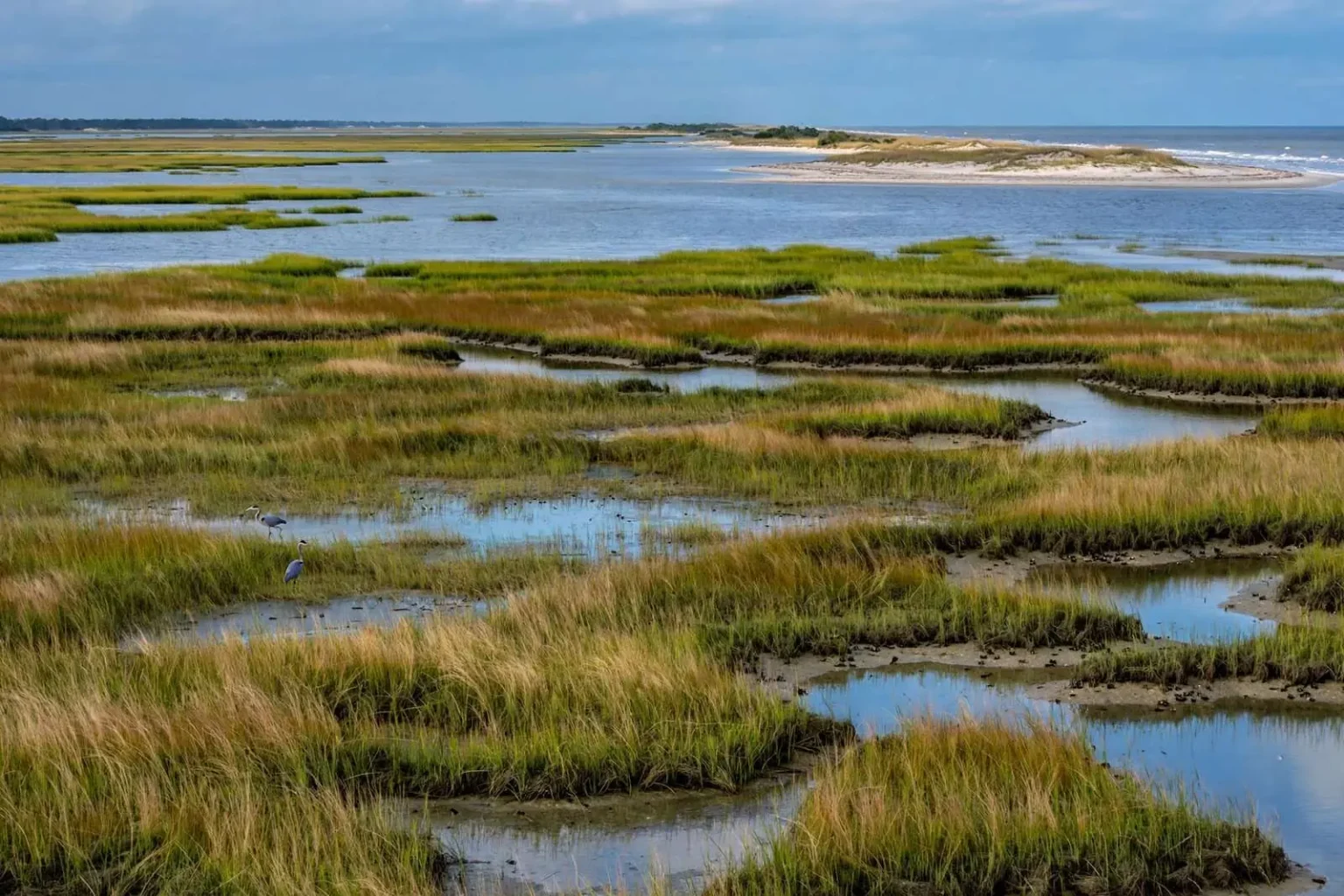
100 acres of new wetland in upper Mobile Bay. Wetlands function as the estuary’s filtration system, trapping sediment and absorbing nutrients before they reach open water. They also serve as nursery habitat for the shrimp, crab and finfish that support the coast’s commercial and recreational fisheries, and they blunt storm surge before it reaches developed shoreline.
The upper bay is where Mobile Bay’s two great rivers — the Mobile and the Tensaw — spread into the delta’s maze of marshes, and it is where the estuary does much of its biological work. Freshwater arriving there carries the sediment, nutrients and pollutants of a watershed that stretches far inland; the wetlands at its edge are the system’s filter, and the acres being added expand the part of the bay that most needs it.
Replenishment of Dauphin Island’s West End. The island’s western tip is among the most dynamic and vulnerable stretches of shoreline in Alabama, repeatedly reshaped by storms and chronic erosion.
Dauphin Island guards the mouth of Mobile Bay, and its western end — the spit facing the open Gulf — has rebuilt and collapsed with every hurricane season since the barrier island was charted. Replenishing it does more than save beachfront: a intact west end keeps storm waves from working directly into the bay and against the communities that sit behind the island’s shelter.
Replenishment of Grand Batture Island. This low barrier island west of Dauphin Island functions as a first line of defense for the mainland behind it and provides critical bird habitat.
Grand Batture is the kind of island that survives only as long as it is replenished — a low, sandy shield that absorbs wave energy for the mainland and nests the colonial seabirds that colonize such spars. Its loss would be felt twice: in the exposure of the shoreline behind it and in the bird habitat the Alabama coast would lose outright.
Continuation of a water quality program that has funded infrastructure improvements in waterfront municipalities across the two-county coastal region.
That program is the RESTORE portfolio’s most locally visible piece: money that reaches the towns themselves, upgrading the sewers, drainage and treatment systems whose failures show up as overflows and advisories after every heavy rain. Continuing it extends the repair work already begun in coastal municipalities.
What the Money Is
The funding traces to the $20.8 billion environmental damage settlement that emerged from the 2010 disaster, the largest environmental settlement in United States history. The RESTORE Act channels a portion of those penalties into Gulf Coast recovery.
Critically, the program was designed with flexibility built in. Rather than restricting spending to projects that address only the direct effects of the spill, administrators established broad parameters, ranging from habitat restoration and conservation to expanded recreational access, and left themselves room to fund whatever the coast actually needs.
That decision has proven consequential, because many of the problems facing Alabama’s waterways today have nothing to do with a drilling rig.
The flexibility is why a settlement born of an offshore blowout can legitimately fund a wetland acre that filters agricultural runoff, or a sewer upgrade in a bayfront town. RESTORE’s drafters wrote a recovery program for a coast, not a compensation program for a spill, and sixteen years on, that drafting choice is what lets the newest $87 million reach problems the oil never touched.
The Damage That Was Done
Scientists have estimated that as many as 167,600 sea turtles, 105,400 seabirds and 8.3 billion oysters died as a result of the spill. Deep-water coral beds were smothered. Dolphins in the northern Gulf experienced the largest die-off in recorded history. The well gushed for 87 days before it was capped, and tar balls persisted on the sands of Gulf Shores long after the visible slicks had been removed.
The numbers are the spill’s true inventory, and each category tells a different story. The turtles and birds died at the surface, in the oil itself; the oysters died in the estuaries, where closing harvests and altered water flow compounded the losses; the deep corals died invisibly, at the wellhead’s depth, discovered only by submersible surveys. The dolphin die-off unfolded over years, and its scale — the largest ever recorded in the northern Gulf — remains one of the disaster’s most sobering legacies.
No settlement restores any of that. What money can do is address what comes next.
That sentence is the honest boundary of every RESTORE project. The turtle counts and the dolphin deaths are settled facts that no wetland can reverse; what the money can shape is the health of the coast those losses left behind — the systems that must sustain the next generation of turtles, birds, oysters and dolphins, and the people who depend on them.
The Slower Problems
The threats to coastal Alabama’s water today are less dramatic than an offshore blowout and, in aggregate, arguably more persistent. They come from development, industrial discharge and agricultural runoff, and they surface in ways that rarely make national news.
The remnants of Tropical Storm Arthur, which scraped along the Gulf in mid-June, dumped enough rain to trigger roughly two dozen sewage overflows across Mobile and Baldwin counties.
Each overflow sent untreated or partially treated sewage into the streets, creeks and bay waters — the routine consequence of systems built for a smaller, drier coast being asked to absorb heavier storms and growing populations. Two dozen overflows from a single storm’s remnants is a count that repeats, in some form, most summers.
The Alabama Department of Public Health’s current Fish Consumption Advisory Guidelines warn against eating several species taken from state rivers and creeks because of elevated mercury and other contaminants.
The advisories mark the slow poisons — mercury that accumulates in predatory fish over years, contaminants that persist in sediment — the threats that never produce a slick or a news image but change what a family can safely eat from its own rivers. They are also the clearest evidence that Alabama’s water problems extend far beyond the salt line.
An Alabama Department of Environmental Management swim advisory issued in early June reported the highest levels of enterococcus, a fecal indicator bacterium, recorded in more than twenty years of testing at sites in Fairhope and Gulf Shores.
Fairhope sits on the bay’s eastern shore; Gulf Shores faces the open Gulf. Finding record fecal-indicator readings at both — in a bay town and a beach resort — in the same early-summer report, described the coast’s water problem in a single stroke: it is not one system failing, but many, from inland tributaries to the tourist beaches themselves.
Those are the conditions the RESTORE money is now being pointed at.
The Case Officials Are Making
In announcing the award, Gov. Kay Ivey framed the projects in economic terms. “These $87 million in restoration projects will strengthen our coastal communities, improve our waterways and preserve the natural beauty and resources that support Alabama jobs, tourism and outdoor recreation,” she said.
That framing reflects a broader shift. Conservation on the Alabama coast has increasingly become a subject on which business interests and environmental advocates find common ground, in part because the commercial value of the coast, its fisheries, its beaches, its tourism economy, depends entirely on the health of the systems underneath it.
The convergence is practical, not sentimental. A charter fleet needs healthy reefs and clean water; a beach town needs water that passes its swim advisories; a seafood processor needs the wetlands that grow the shrimp. When the systems fail, the losses land as economic losses — closed oyster beds, advisories that scare off visitors, fisheries that shrink — and so the state’s case for restoration is now made in jobs and visitors as readily as in habitat.
The Limits of the Money
Settlement funds are finite. The Deepwater Horizon money will eventually run out, and the pressures on Mobile Bay’s watershed, which extends far inland across a large share of the state, will not.
The wetlands, islands and water infrastructure funded by this $87 million will help. Whether coastal Alabama’s waterways are healthy a generation from now will depend on decisions made well upstream of the coast, in places that have never seen a tar ball.
That closing distinction is the award’s real meaning. The RESTORE Council can buy wetlands, rebuild islands and fund municipal systems — the visible assets of a healthy coast. It cannot, with any permanence, control the fertilizer applied in the Tennessee Valley, the discharges permitted in inland counties, or the growth patterns that send more pavement and more sewage toward Mobile Bay. The $87 million buys the coast time and resilience. The generation after that belongs to everyone upstream.