‘You’re in Deep Trouble’: A Mobile Broker’s Rough First Year Under a New Firm’s Rules
A retired Mobile stockbroker recalled the punishing first year at a new firm, where unfamiliar exchange rules, an unhappy back office and a parsimonious owner made for slow going and a famous Christmas card fight.
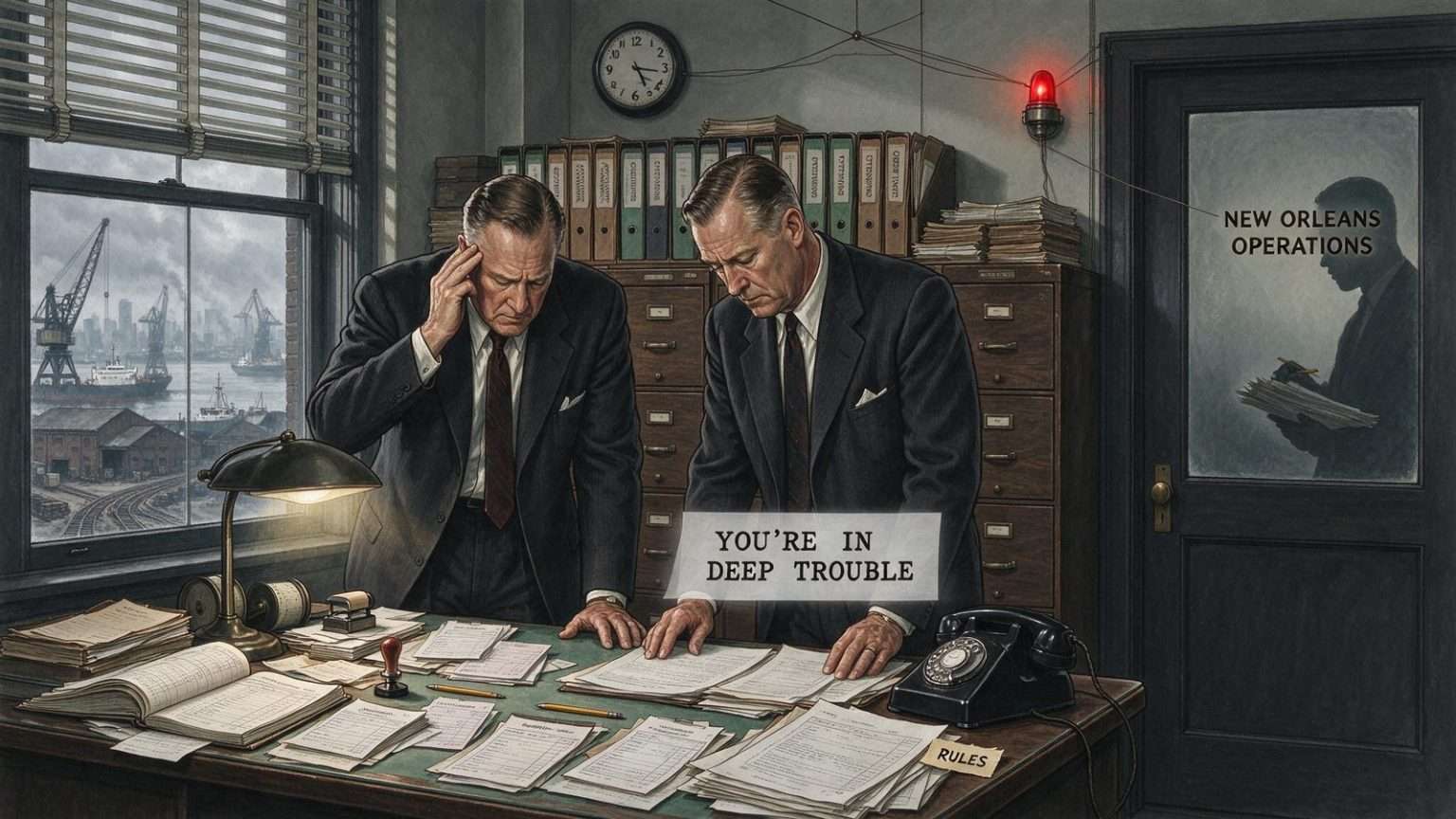
MOBILE — Having walked out of one brokerage house and carried most of their clients across town to another, the Mobile brokers whose story is told in this serialized recollection expected the hard part to be over. It was not. The resignation, the walkout, and the delicate art of asking customers to follow a broker to a new firm had all gone as well as such things go. What the men had not reckoned with was that the greatest test of their move would come not from their old employer but from their new one — in the form of rules.
Business developed slowly at the new firm. Transferring accounts turned out to be a grinding, paper-by-paper process. Customers had to be re-registered, documents re-signed, balances moved, and every step required forms that had to match exactly what the home office required. A broker’s book, it turned out, was not a stack of relationships that could be picked up and set down in a new office; it was a file cabinet of paper that had to be rebuilt one page at a time, and the rebuilding consumed weeks that produced no commissions.
And although the bear market had technically ended two months before the men made their move, its demise was not apparent for many months afterward — as is nearly always the case. Markets do not post signs announcing that the bad times are over. Prices stopped falling long before investors stopped believing they would fall, and customers who had been burned for two years did not rush back to a broker simply because he had changed employers. The phones stayed quiet, and quiet phones gave the men plenty of time to think about how little they knew about the firm they had joined.
People were not exactly falling over themselves to buy stocks from anyone. The mood of the investing public after a long decline is one of suspicion, and the brokerage business in Mobile — a port city of shipping fortunes, timber money and modest family accounts — was a relationship business conducted by telephone and personal visit. When relationships are intact, orders flow; when the market has frightened everyone, a broker’s week is measured in the customers he calls who decline to buy.
Rules they had never heard of
The deeper shock was cultural. The new employers operated under far tighter rules than the men had known at their old shop. Every new account had to pass a rigid credit survey. Any time a customer was late paying for a purchase, an extension had to be formally obtained, with a good reason given. Every order had to be marked solicited or unsolicited. And there was a long list of other nagging requirements, a good many of which the men discovered only at the moment they broke them.
The credit survey, in particular, struck them as an imposition. At the old firm, a customer was a customer, and the man who paid slowly was tolerated as long as his account eventually cleared. The new firm wanted to know, before the first order was accepted, what the customer did for a living, what he owned, what he owed, and what experience he had with securities. The survey felt like an insult to men who were used to judging character by handshake — but it was the price of admission, and the men soon learned that the home office enforced it without exception.
Extensions were another revelation. A late-paying customer at the old shop produced a shrug; a late-paying customer at the new shop produced paperwork. The broker had to request more time formally, state why the customer could not pay on schedule, and wait for approval before the matter was considered settled. Each extension request was a written admission that an account had slipped, and the men discovered that the home office read those admissions carefully, tallying the brokers whose customers most often needed more time.
The solicited-or-unsolicited marking was the rule with the sharpest teeth. Writing “unsolicited” beside an order attested that the customer, not the broker, had initiated the trade. The distinction mattered enormously: a stream of unsolicited orders in a dormant account suggested churning, and a broker who marked orders casually was creating a written record that could be used against him. The men, used to filling out tickets from habit rather than certification, now had to ask themselves with every order who had really proposed the trade.
The awkward truth, as the author acknowledged, was that most of these were stock exchange rules that should have been enforced at the old firm too, and simply never were. The exchange’s requirements for credit verification, payment discipline and order documentation bound every member firm; the difference was that the old house treated them as suggestions while the new house treated them as law. The men had not been operating outside the rules so much as inside a firm that never checked.
Their new employers had no idea the men were ignorant of them. To the compliance-minded managers of the new firm, every veteran broker was presumed to know the exchange’s book by heart, and every violation was read as negligence rather than innocence. So each violation was met with a mix of unhappiness and frank disbelief when the Mobile office explained that it had not known the rule existed.
Those conversations followed a pattern the men came to dread. A memo would arrive from the home office noting a rule that had been broken, the branch manager would call the broker in, and the explanation — “I didn’t know” — would be received not as an excuse but as a deeper offense. In a firm that took its obligations seriously, ignorance was the one defense that made things worse, because it suggested the broker had never bothered to learn the standards everyone else was assumed to live by.
The title of this installment — “You’re in deep trouble” — is the phrase that eventually summed up the experience, the words that hung over the branch as the violations accumulated and the men realized their reputation was being built, in their first months at the new firm, on a file of rule-breaking they had not known they were creating. A broker’s value to a firm rests on trust, and the men were learning that trust was audited in writing.
The voice on the wire
The back-office work for the Mobile branch was performed in New Orleans, by a staff already unhappy at having a new burden dropped on them with no additional pay or help. The southern district’s operations office handled the margin work, the transfers, the confirmations and the certificates for a string of branch cities, and the Mobile accounts — old, irregular, and full of the informal habits of the previous firm — arrived as a fresh pile of complications on desks that were already full.
The Mobile men’s unfamiliarity with the firm’s procedures did nothing to improve relations. Every transfer that came through with a missing signature, every account opened without a completed survey, every extension requested in the wrong form generated wire traffic between Mobile and New Orleans, and the operators on the other end of the wire learned to associate the new branch with extra work. The men, for their part, felt the New Orleans staff was unhelpful and slow. Neither impression was entirely fair, and neither improved the daily flow of business.
The kingpin of that New Orleans operation was a gentleman the author calls Merlin H. A larynx operation had robbed him of ordinary speech, and communication with him was difficult — conducted in whispers, gestures and written notes, with the result that every exchange with Merlin H. was deliberate and slow, and no one wasted his time casually.
He regarded himself — with some justification, the author allows — as the guardian of the firm’s paperwork and the arbiter of what the branches could and could not do. A margin request, a late confirmation, an extension with a missing signature: all of it crossed Merlin H.’s desk, and all of it came back marked in accordance with his judgment of the rules. The Mobile men discovered quickly that the most important relationship a branch broker had was not with his clients alone but with the back office that made his paper work — and that Merlin H., running that paper from New Orleans with a whisper and a pencil, held more power over their daily lives than anyone on the firm’s org chart suggested.
The first year at the new firm taught the men a lesson that generations of brokers before and after them have learned: the sales side of the brokerage business, for all its skill and nerve, is only half the trade. The other half is procedure — the surveys, the extensions, the markings, the certificates, the wires between branch and back office — and a broker who ignores procedure is building his career on paper that will someday be read back to him.
There was, in retrospect, a purpose to the discipline that the men could not see while they were chafing under it. The rules that felt like harassment were the machinery of a firm that intended to survive. Credit surveys kept bad risks out of margin accounts; formal extensions kept receivables honest and visible; solicited-or-unsolicited markings kept the firm able to prove, order by order, that its brokers were serving customers rather than generating commissions at their expense. The old firm’s looseness had been a private convenience, but it was also a liability the exchange’s examiners would eventually have found.
The bear market’s slow, invisible end shaped the year as much as the rules did. A market that has stopped falling but not yet started rising is the hardest environment in which to build a book: no crash to trade around, no rally to ride, only days of drift in which the broker’s inventory of goodwill is spent a call at a time. The men’s clients, having followed them across town, watched and waited, and the men spent the quiet months doing what brokers in quiet markets do — writing letters, making visits, and learning the paperwork that would keep them out of trouble.
The friction with New Orleans faded, as such frictions do, once the Mobile branch learned the firm’s forms and the New Orleans staff learned the Mobile accounts. Merlin H. remained what he had always been — the immovable center of the operation, guarding the flow of paper with a whisper and an iron sense of the rules — but the men came to see that guardianship as the thing that separated their new firm from their old one. The office that checked was the office that lasted.
The serialized recollection of which this chapter forms a part preserves a portrait of the brokerage business as it was practiced in the South in the middle of the last century: branch cities like Mobile linked by telegraph wire to regional back offices, men who carried their books from firm to firm on the strength of personal loyalty, and the slow, post-market-crash professionalization of an industry learning to write its rules down and enforce them. The Mobile brokers’ rough first year sits at that turning point — the moment when the handshake gave way to the survey form, and “I didn’t know” stopped being an answer.
For the men themselves, the year ended better than it began. The accounts were transferred, the surveys completed, the extensions documented, the tickets marked. The home office’s file on the Mobile branch grew shorter, and the branch’s production grew longer, as the market’s recovery — invisible for months, then suddenly plain — brought customers back to the phones. The men had left one firm to escape its looseness and had arrived at another whose tightness nearly broke them; the compromise they reached, between the way they had always worked and the way the business now required them to work, was the real price of the move — and, in the end, the education it paid for.