Grand Jury Indicts Mobile Businessman Matt Walker on Four Counts of Trafficking in Stolen Property
The four-count indictment accuses Walker of receiving or disposing of stolen antiques, household furnishings and appliances belonging to four Mobile-area residents.
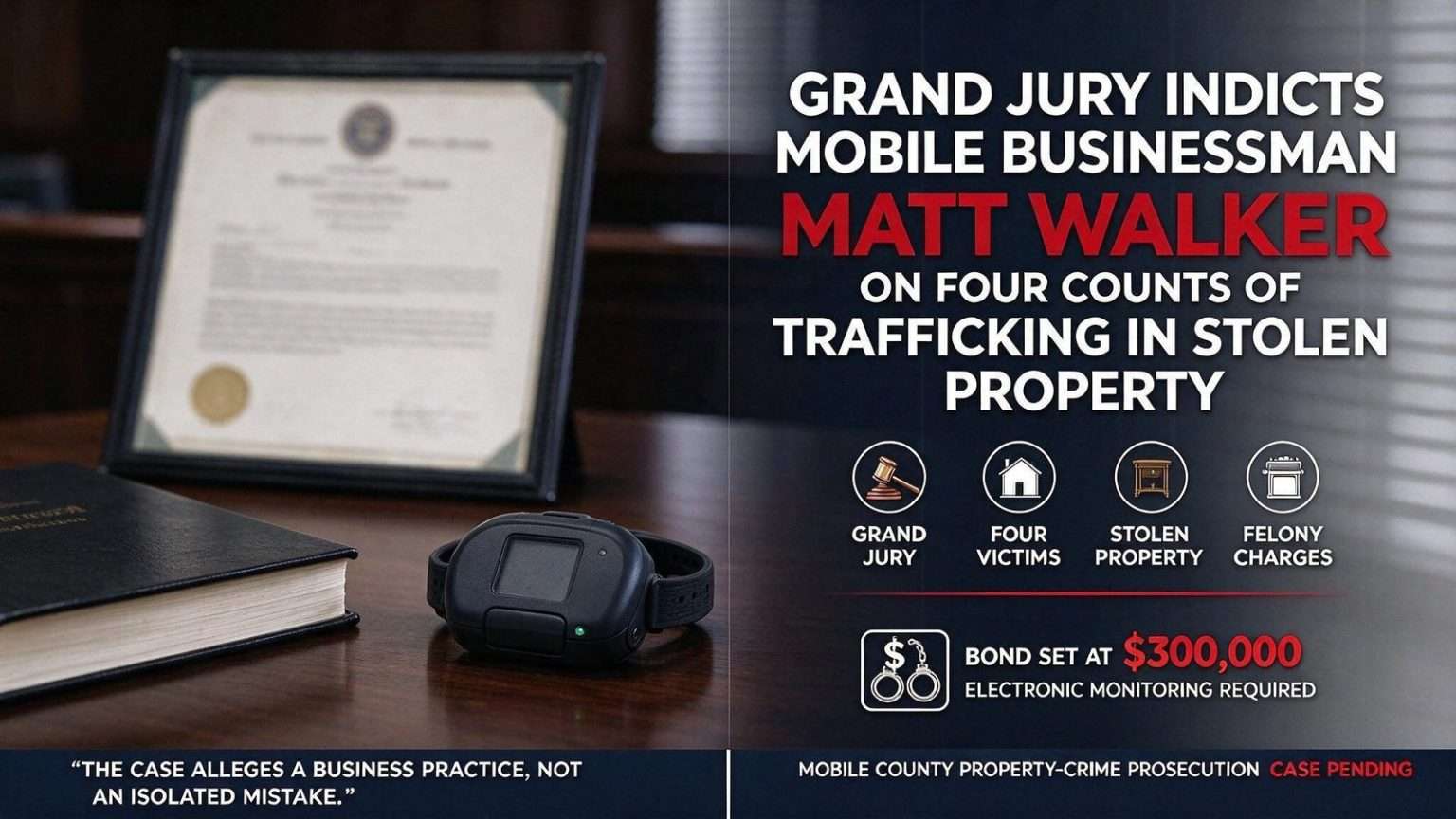
A Mobile County grand jury has returned a four-count indictment charging Mobile businessman Matt Walker with trafficking in stolen property. The charges, laid out count by count in the indictment returned by the grand jury, allege that Walker dealt in stolen antiques, furnishings and appliances belonging to four different owners — a pattern that prosecutors will present as a business practice rather than an isolated mistake, and that puts the case among the more closely watched property-crime prosecutions in Mobile County’s circuit court.
Each count follows the same form. According to the indictment, Walker: “Did intentionally receive, retain, or dispose” of stolen antiques and household furnishings belonging to Thomas Langan; “Did intentionally receive, retain or dispose” of stolen Viking appliances and an LG flat-screen television belonging to John Freeman; “Did intentionally receive, retain or dispose” of stolen antiques and household furnishings belonging to Sally Wall; and “Did intentionally receive, retain or dispose” of stolen antiques and household furnishings belonging to Laura Cooper. The repeated language is standard drafting — each count is a separate offense, one per owner — but the list of victims and the kinds of property involved give the case its particular shape: high-end household goods of the sort that pass through secondhand markets where provenance is often loosely checked.
Trafficking in stolen property is a felony under Alabama law. The offense does not require proof that the defendant committed the underlying theft — only that he knowingly dealt in property he had reason to know was stolen. That distinction matters for how such cases are fought: the state does not have to prove who originally stole the antiques or appliances, only that the defendant received, kept or sold them knowing, or with reason to know, their origin. Defenses typically attack that knowledge element, and the evidence that surrounds each transaction — cash sales, missing serial numbers, the sheer volume of goods — becomes the battlefield.
The Counts and the Law
Alabama’s trafficking statute was written to reach the middle of the stolen-goods pipeline — the dealers and fences who make theft profitable — rather than only the burglars and thieves at its edges. By targeting the receiving and reselling of stolen property as its own felony, the law attacks the market that gives residential theft its economic motive. Prosecutors in Mobile County have used it in cases involving everything from construction equipment to jewelry, and a four-count version built on four separate owners signals a case assembled with care.
The property named in the counts is distinctive in ways that matter at trial. Antiques and household furnishings are exactly the category of goods whose ownership can be documented through photographs, estate records, family recollections and the distinctive marks of age and use — and Viking appliances and a flat-screen television, by contrast, carry model and serial identifiers that investigators can trace. The four victims named in the indictment will each connect their losses to specific items, and the paper trail of where those items surfaced — a shop, an auction, a private sale — is where the knowledge element will be argued.
Neither the trial judge nor a trial date had been assigned as of the indictment’s return. The case now enters the administrative stage that follows every grand jury return in Mobile County: assignment to a circuit judge through the court’s rotating system, scheduling of an arraignment, and the setting of the pretrial calendar that will govern motion practice and, if the case goes the distance, trial.
The Lawyers and the Conditions of Release
Mobile County Assistant District Attorney Geoff Alexander is prosecuting the case for the state. Mobile attorney Buzz Jordan is defending Walker against the charges. The pairing sets up the standard contest in a trafficking prosecution: a district attorney’s office presenting the transactional record and the victims’ identifications, against a defense that will press on what the state can actually prove about Walker’s state of mind when each piece of property changed hands.
Walker remains free on bonds totaling $300,000, though he has been ordered to wear an electronic monitoring device on his ankle — an unusual condition of release in a property crime case, and one that suggests the court had concerns beyond the ordinary. Electronic monitoring is typically reserved for cases involving flight risk, alleged witness contact or public safety concerns, and its imposition here marks the case as one the court is watching closely. The $300,000 total bond, spread across the four felony counts, also sits at the high end for property offenses in Mobile County, where bonds of that scale more often accompany violent charges.
The conditions mean Walker’s freedom until trial comes with boundaries. An ankle monitor reports location continuously, restricting movement and flagging any contact with prohibited places or people, and violations can return a defendant to custody before trial. For a businessman facing charges that go to his livelihood — the purchase and sale of goods — the restriction on daily movement shapes how a defense is even prepared, and it signals to the community that the court treated the allegations with a seriousness the charges’ category alone would not require.
What Comes Next
An indictment is not a finding of guilt. It reflects a grand jury’s determination that the state has presented enough evidence to proceed to trial, a threshold considerably lower than the proof beyond a reasonable doubt that a trial jury would require. Grand jurors hear only the state’s side of the case, presented by a prosecutor, without a defense presentation or a judge ruling on evidence, and their true bills answer a single question — probable cause — not the ultimate one. Walker’s presumption of innocence remains intact through every stage that follows.
Walker will be arraigned before the assigned circuit judge, where he will enter a plea. From there the case follows the ordinary course of a felony prosecution in Mobile County: discovery, pretrial motions and, if it is not resolved by agreement, a trial. Discovery in a trafficking case is document-heavy — receipts, transaction records, photographs of the property, and investigators’ notes — and the motions that follow usually turn on what the state must disclose and what the defense can suppress. A majority of felony prosecutions end before trial, but a four-count indictment with four named victims and a high bond gives both sides reasons to prepare as if the trial date will arrive.
The case has drawn attention in Mobile in part because of the property involved. Antiques and household furnishings taken from private homes represent a category of theft that residents of the city’s older neighborhoods have long worried about, and one that depends on a market willing to accept them. It is the existence of that market that the trafficking statute is designed to attack. In districts where century-old homes are filled with pieces collected over generations, the loss of identifiable family property carries a weight beyond its resale value — which is why victims in such cases follow prosecutions closely.
The Stakes for Both Sides
For the prosecution, the case is an opportunity to demonstrate that Mobile County will pursue the reselling end of property crime, not just the break-ins. Assistant District Attorney Geoff Alexander’s presentation to the grand jury evidently persuaded the jurors on all four counts, and a conviction at trial would carry sentencing exposure that accumulates across the counts. Trafficking convictions in Alabama can bring prison terms measured in years, and with four counts the potential consequences compound — a structure prosecutors use precisely to bring the reseller class of defendant to the table.
For the defense, Buzz Jordan’s task begins with the knowledge element. Alabama law requires that the defendant dealt in property he knew — or had reason to know — was stolen, and the state of mind of a buyer at a secondhand counter is a question the state must prove with circumstance: the price paid, the seller’s story, the conditions of the sale, and what a reasonable dealer would have suspected. Defense attorneys in trafficking cases also examine how investigators linked the goods to each victim, and whether the chain of custody for each identified item holds up.
The bond conditions will be revisited as the case develops. Defense counsel typically return to court to seek modifications — relaxed monitoring, reduced bond — once the initial urgency passes, and prosecutors respond with the court’s assessment of flight risk and the case’s gravity. Until then, the image the case presents to Mobile is an unusual one: a businessman moving through the city on an ankle monitor, presumed innocent, waiting for a circuit judge to be assigned and a trial date to be set on four felony counts that allege his business was built, at least in part, on other people’s stolen property.
Meanwhile, the four victims named in the indictment — Thomas Langan, John Freeman, Sally Wall and Laura Cooper — watch from the civil side of a criminal process that moves at its own pace. Their property, if recovered, becomes evidence held until the case concludes; if not recovered, its documented loss will be presented through photographs and records at trial. Either way, their identifications of the antiques, the appliances and the television are the foundation each count stands on, and the hearings ahead will determine whether the state can build the rest of the case around them.