The Best Year and the Worst: A Mobile Broker Remembers November 1958
Part six of a memoir of a bygone Mobile: the year the author's production soared was also the year he lost the mother who had raised three children on a secretary's salary.
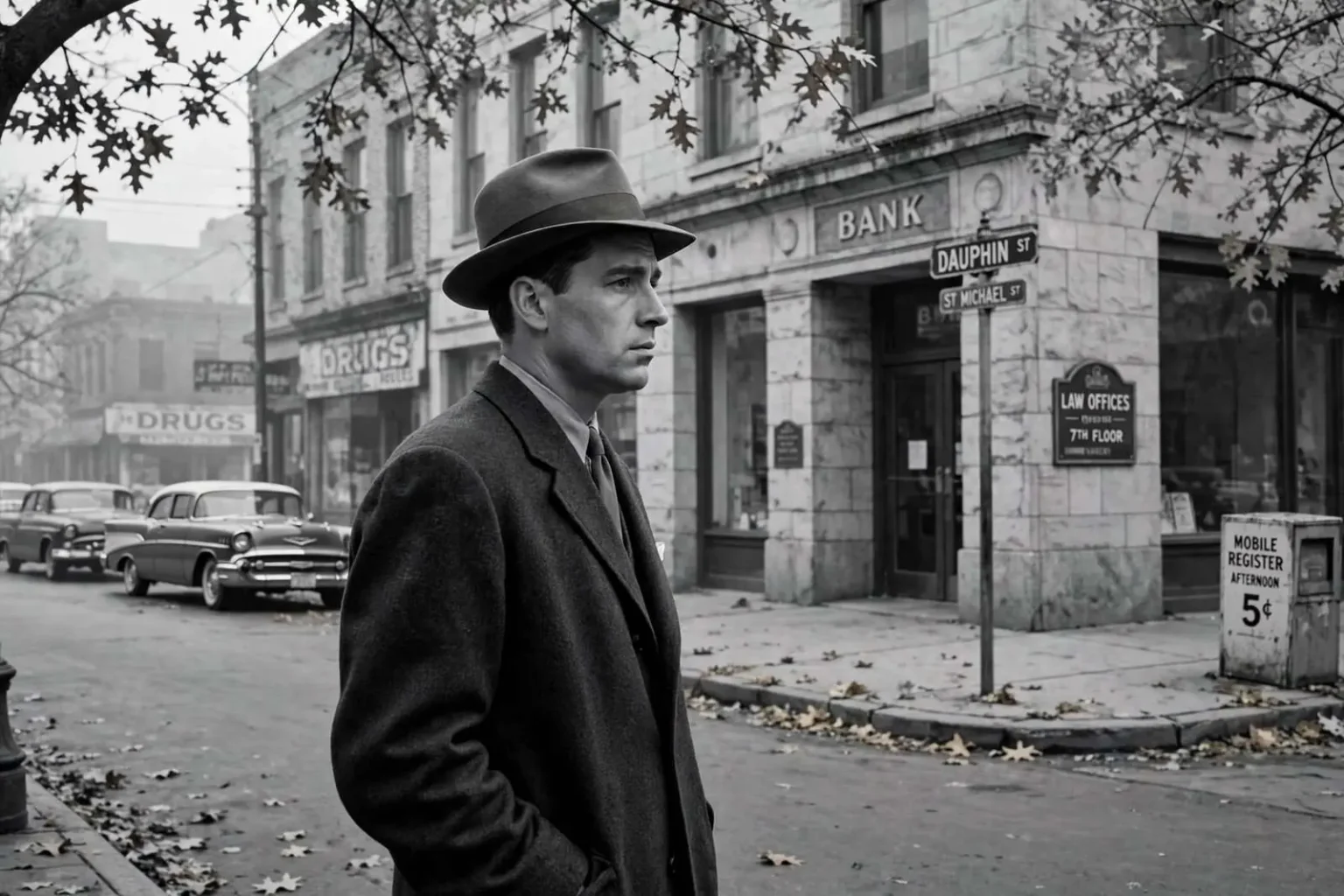
The sixth installment of a serialized memoir of a bygone Mobile is the hardest of the series to read, and plainly the hardest to have written. The year 1958 was, in the author’s accounting, far and away his best in business and far and away the saddest of his life. His production climbed and his pay climbed with it. And then, on the morning of Monday, Nov. 17, his mother died.
The memoirist — a Mobile real estate broker whose serialized recollections have walked readers through the city’s midcentury streets — wrote this chapter sixteen years after the events it describes, in the mid-1970s, with the detail of a man who had replayed the season many times. The juxtaposition he builds is the chapter’s architecture: the best professional year of his life and the worst personal month of it, occupying the same autumn, in the same small world of downtown Mobile offices.
A widow, three children and $35 a month
She had seemed indestructible to her children, he writes, largely because she had always been there. His father died in 1925, leaving her with three young children, no job training and very little in the way of resources. There was no Social Security. The Depression was ahead of her, and it would push her secretary’s salary as low as $35 a month. She prevailed anyway.
The arithmetic of her situation was stark. A widowed secretary in Mobile in the late 1920s and 1930s had no safety net to fall into — no unemployment insurance, no survivor’s benefits, no pension — and the Depression that followed within a few years cut secretarial wages to a level that barely covered rent and groceries for a family of four. That she raised three children through it, and kept them intact enough to remember her as indestructible, is the quiet achievement at the center of the chapter.
She raised the three of them herself, and at the time of her death she was still doing things for her children and grandchildren, who were her whole life. She would have turned 59 that Christmas Day. She died on the anniversary, to the day, of her husband’s death 33 years earlier — a coincidence the memoirist turns over without pretending to resolve. He records it and lets it stand, the way families record such dates without drawing conclusions from them.
Five days
She had taken sick on Nov. 12, ill enough to leave the law office where she worked and go home at midday. A doctor examined her that evening and told her she had a virus, then going around, and assured her that the chest pains she described were not coming from her heart. The diagnosis relieved her, though not entirely.
Writing sixteen years afterward, the author still faults himself for not insisting on an electrocardiogram. At her age, with those symptoms, he believed it should have been indicated. His self-reproach is specific and technical, the grief of a son who had learned enough about medicine to know what question he failed to ask — and it is sharpened by the era’s context: electrocardiography was an established diagnostic tool by the late 1950s, available in Mobile, and a chest-pain complaint in a woman approaching sixty was exactly the presentation modern cardiology would have tested.
A few evenings before she fell ill she had been in a minor automobile accident that left her with a badly bruised knee. She showed it to the doctor, who was not concerned. It remained the memoirist’s unshakeable conviction that a clot from that bruise caused the coronary occlusion that killed her five days later.
He admits he has no medical training, and he notes that in later conversations he could never get a firm opinion from doctor friends — it is a rare physician, he observes, who will suggest that a colleague made a faulty diagnosis. He holds the theory anyway, with the admission built in: it is not a diagnosis, he concedes, but the only explanation that makes the week make sense to him.
He saw her for the last time on the afternoon of Saturday, Nov. 15, sitting in a chair on the front porch of her home, still ill but feeling somewhat better, giving him a wan smile as he left for the evening shift at the newspaper four blocks away. The image — a son waving goodbye to a mother on a porch, four blocks from his desk — is the chapter’s still point, the ordinary moment that turned out to be the last one.
Monday morning he had been at the brokerage only a few minutes when one of the lawyers she worked for telephoned. Come right over, he said. Your mother’s sick. I’m afraid she’s dead.
He bolted out the door, passing a customer who asked where he was going in such a hurry. “I’m afraid my mother’s dead,” he heard himself answer, in the tone a man uses to say he left his umbrella in the car. The sentence he had not yet absorbed left his mouth with the flatness of routine, and the memoirist dwells on that flatness — the way shock borrows the voice of normalcy until the fact arrives.
The law office was on the seventh floor of a bank building two blocks away. He fumed at the elevators, nodded to a friend crossing the lobby, rode up, ran the length of the hall and found her on the floor beside her desk. He felt for a pulse, found none, and tried mouth-to-mouth resuscitation. He shouted for a doctor, a dentist, a nurse, anybody, and an ambulance.
He prayed on the ambulance ride as he never had before or since, promising God whatever he had to promise. His sister and brother met them at the emergency room at Providence Hospital, where the last hopes ended.
Providence Hospital — the Catholic institution on Springhill Avenue that served Mobile for most of a century — was the city’s principal general hospital in that era, and the emergency room scene he describes carries the particulars of 1958: a family of adult children arriving separately, a corridor, and a verdict delivered without the machinery of modern resuscitation. Coronary occlusion in 1958 offered little of what cardiology offers today; there was no intensive coronary care unit culture, no thrombolytics, and an arrest outside a hospital was very often final.
Afterward
It was, he writes, the first great tragedy of his life and remains the greatest. He had no memory of his father or his father’s death. His grandfather’s death had struck him hard but was not unexpected and did not touch the immediate family circle. The hierarchy of grief he sketches is precise: a grandfather’s death was a loss; a mother’s was a rearrangement of the world.
Tributes followed, including a front-page story in the afternoon paper written by a friend at the Register. The Mobile Register’s afternoon editions carried such notices in that era, and the friend’s story — a colleague writing about a colleague’s mother — gave the family’s private loss a public paragraph in the city’s paper of record.
For about ten years afterward he dreamed at night that his mother was gravely ill but was going to survive — the mind, he supposes a psychiatrist would say, refusing the fact of death while conceding a serious illness. The dream, in which she was sick but recoverable, let him visit the fear without crossing into the fact, and he notes the pattern continued for a decade before it faded.
For years, whenever he had a venture in mind, he would catch himself thinking he had better talk it over with his mother, and then remember that he could not. The reflex outlasted the dreaming — the impulse to consult the one person who had always been there, and the second impulse that corrected it, arriving together for years.
The tears came, too, in private, though it had been several years by the time he wrote this down since he had last cried over her memory. He reports the drying-up of grief without boasting of it and without pretending it was anything but time doing what it does.
Time heals, he concludes, whether we want it to or not. The sentence is the chapter’s last word on the matter — an acknowledgment that the healing was not requested and not entirely welcome, delivered by the same calendar that had carried him through his best year in business.
Next in the series: Biddies, bawdies, and a landlord’s education.
Read in sequence, the chapter also documents something larger than one family: the texture of Mobile professional life in 1958, when a broker’s office, a law firm and an afternoon newspaper stood within blocks of each other downtown, and when a family’s emergency moved through that grid on foot — two blocks, four blocks, a porch, an elevator, a seventh-floor corridor — in the space of a single morning.