Mobile Republicans Wanted a Governor, a Southerner, or Condoleezza Rice on McCain’s Ticket
Asked whom John McCain should choose as a running mate, Mobile and Baldwin County Republicans named Charlie Crist, Mitt Romney, Haley Barbour, Condoleezza Rice — and, more than once, an Alaska governor few had heard of.
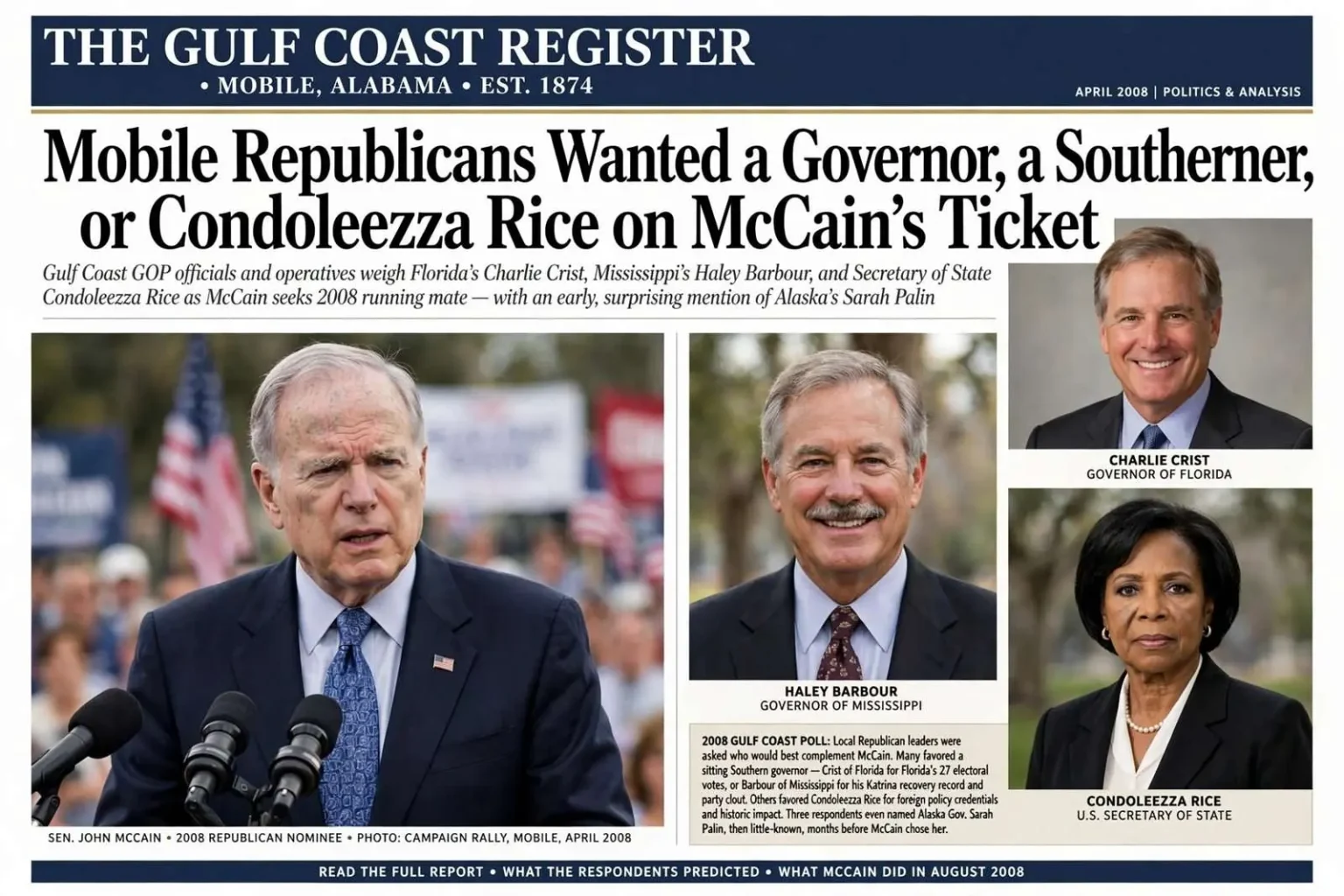
The vice presidency, in the memorable estimate of one former occupant, is not worth “a bucket of warm spit.” That has never stopped anyone from agonizing over who should have it. In the spring of 2008, with Sen. John McCain, R-Ariz., the settled Republican nominee, a group of Mobile and Baldwin County Republicans, officeholders and political professionals were asked a single question: who would best smooth the nominee’s rough edges and extend his reach?
The question was put to the Gulf Coast’s Republican establishment at a moment of unusual clarity: the primary fight was over, McCain had locked the nomination months earlier than anyone in the party had expected, and the only live question left was the ticket. That timing explains the answers that follow — respondents thinking as political analysts, not as campaign partisans, since the winner of the primary was no longer in doubt. (The running quip about the vice presidency, by the way, belongs to John Nance Garner, Franklin Roosevelt’s first vice president, though it is usually garbled into a coarser version.)
Their answers ranged across the Republican bench of the day. Several of them, read now, are remarkable chiefly for what the respondents could not have known.
The governors of Florida and Mississippi
The most common answer was a sitting governor of a state McCain had to win. “McCain can’t win without winning Florida. He should choose Charlie Crist, governor of Florida. He’ll get the rest of the South anyway,” said Baldwin County developer Fleet Lane.
Lane’s electoral geography was the consensus of the moment. Florida, with its 27 electoral votes, its enormous retiree population and its history of razor-thin presidential margins, was the one Southern state genuinely in play; the rest of the region could be assumed. A running mate who could put the biggest swing state away was therefore the rational first choice, and Crist — newly elected, personally popular, and fresh off a high-visibility tenure as the state’s attorney general — fit the description.
GOP consultant Chris Brown ranked Crist first for the same reason — the governor’s endorsement had helped push McCain over the top toward the nomination — and put Haley Barbour of Mississippi second, crediting him with “instant national credibility” and a record of governing through crisis after Katrina. “But you know should and will are two different things,” Brown added.
Barbour’s second-place standing rested on a different asset than Crist’s. The Mississippi governor had managed his state’s recovery from Hurricane Katrina into a national showcase of executive competence, and his decades as a national party operative — chairman of the Republican National Committee, White House political director, Washington lobbyist — gave him the credibility Brown described. The caveat in Brown’s closing line reflected a practical reality: governors rarely leave their states mid-term for the second spot, and both Crist and Barbour had just begun their terms.
Retired newspaperman Ray Jenkins also predicted Crist. “Age, geography, and demonstrated competence favor him. He’s also a GOP moderate, to some degree. A possible hurdle: He’s unmarried.”
Jenkins’s hurdle was the one political professionals actually whispered about in 2008 — a bachelor nominee for national ticket’s second slot was, by the customs of American campaigns, an untested proposition, and Crist’s personal status drew commentary precisely because everything else about him looked ideal.
The case for a young executive
New York investment banker Bragg Van Antwerp built a checklist first — relative youth, executive experience, stronger conservative credentials than McCain, and the ability to convince voters he could assume the presidency instantly — then applied it to two 47-year-old governors, Tim Pawlenty of Minnesota and Mark Sanford of South Carolina. He gave the edge to Pawlenty “simply because he has been with McCain from Day One, and stood by him even when McCain was on political life support. Loyalty, I would think, would be a tremendously valued quality in a running mate.”
Van Antwerp’s method was the most systematic in the group — a written specification applied to candidates — and his loyalty criterion was one campaigns actually weigh. Pawlenty had endorsed McCain in 2007, when the campaign was out of money, short on staff and written off by most of the party’s establishment; Sanford had not. A nominee who had survived the summer of his own collapse was unlikely to forget who had stood there with him.
Huntsville businessman Sage Lyons simply wrote: Mark Sanford.
Lyons’s one-line answer required no elaboration because Sanford’s credentials as a conservative executive were, in party terms, self-explanatory: a congressman turned governor, a persistent budget cutter, and a South Carolinian from a state the party always had to carry.
The evangelical calculation
A government analyst argued the entire question turned on turnout. “What these guys need to be hearing is that whoever McCain picks better be someone that the evangelicals will get excited about,” the respondent said, citing the 24 million evangelical voters of 2004 and the Senate seats that followed. The suggested names were J.C. Watts or Sanford — and then, in a next tier that included SEC chairman Chris Cox and Sen. Tom Coburn of Oklahoma, “possibly the governor of Alaska (Sarah Palin).”
The analyst’s arithmetic recalled the 2004 election, in which evangelical turnout — measured by post-election surveys at roughly 24 million voters — was widely credited with carrying Bush’s re-election and the Senate gains that came with it. The argument followed directly: McCain, the nominee least trusted by that constituency, needed a running mate who could activate it, and the list of names that could was short. Cox and Coburn belonged to the tier of credible conservatives; the Alaska mention was, in the spring of 2008, an almost offhand footnote.
It was not the only mention. Broadcaster Jim Koblas said McCain “should give strong consideration to Gov. Sarah Palin, Alaska,” with Barbour as an alternate. And Baldwin County Republican Chip Brown, after making the case for a McCain-Romney ticket, added that Palin “might not be a household name outside of the Northwest” but would bring youthful energy and help with the female vote.
McCain chose Palin that August.
Three separate Gulf Coast respondents had thus named, months before the announcement, a first-term Alaska governor whose selection stunned the political world — one of them as a low-tier afterthought, one as a primary suggestion, one as a footnote to a different argument. None had argued she was the likely choice, and none could have known what the selection would do to the campaign. But the mentions are the retrospective oddity of the whole survey: the eventual pick appeared in three Gulf Coast answers before almost anyone outside Alaska was discussing her.
Romney, Rice and the rest
Former state GOP chairman Marty Connors made the most systematic case, for Mitt Romney: the best candidate on a pending recession, the only one with significant private sector experience, capable of putting Michigan and New Hampshire in play, and a proven fundraiser. “McCain needs to strengthen the turnout within the base of the Party,” he said.
Connors’s argument ran on economics and geography. Romney had spent his career at the consulting firm Bain & Company and its private equity successor Bain Capital before governing Massachusetts, making him the field’s only genuinely private-sector candidate; Michigan, where his father George Romney had been governor, and New Hampshire, next door to his own state, were the two presidential maps where a Romney candidacy could plausibly move the needle. The fundraising point was a practical one for a McCain operation that had nearly gone broke the year before.
Republican state committeeman Les Barnett made the most impassioned case, for Secretary of State Condoleezza Rice. “To me, foreign policy is very important right now,” he said. “They (McCain and Rice) would make a powerful team, two no-nonsense pro-America Americans.” Rice, he argued, would send a message to the world about a civilization built on equality. “Condi is, in every way, the most qualified person I am aware of to be V.P., and I would even argue, President.”
The Rice argument was the survey’s most emotionally invested. The secretary of state was, at that moment, one of the most prominent foreign policy figures in the country — a Soviet specialist who had been national security adviser through two wars and then the administration’s chief diplomat. Barnett’s framing, with its emphasis on what her presence on a national ticket would say to the world, treated the selection as a statement of national character rather than a vote-getting calculation, which is why he rated her fit for the presidency itself.
Rice, for the record, consistently declined interest in the office, saying publicly she had no desire to run for any elective post.
State Rep. Jim Barton, R-Mobile, went with former Wisconsin Gov. Tommy Thompson, “the father of welfare reform,” with Florida Sen. Mel Martinez second. Retired Navy Cmdr. Pete Riehm named former Maryland Lt. Gov. Michael Steele. Contractor Bob James liked J.C. Watts — “Baptist, conservative, young, intelligent, business owner” and a former football player — as a counter to Barack Obama and Hillary Clinton, calling him “a younger Colin Powell.”
The long tail of answers maps the bench of the day. Thompson had made his national name by reshaping welfare as a governor, and was at that moment running for president himself; Martinez, the freshman Florida senator who had chaired Bush’s housing department, embodied the party’s outreach to Hispanic voters; Steele, a former Maryland lieutenant governor, would months later be elected chairman of the Republican National Committee; and Watts, the former Oklahoma congressman and University of Oklahoma quarterback, was the retired star whose profile — conservative, Baptist, athletic, in business — James calculated as the exact counter-image to the Democratic ticket’s novel appeal.
Real estate executive Starke Irvine thought out loud and landed on Barbour first, Alabama Gov. Bob Riley second, and wondered about Newt Gingrich. “I must say after doing all this thinking,” he concluded, “I like Barbour #1 and Riley #2.”
Irvine’s ranking of his own governor second was the local patriotic touch in a survey full of them. Riley, whose second term coincided with the tanker competition and Alabama’s economic development push, was a national figure within the party, and Gingrich — the former speaker still shaping the party’s ideas from outside office — was the name every such list of the era carried as an idea more than a candidacy.
What the survey ultimately documented, read across all its answers, was the Republican Party of 2008 thinking out loud about its own future — weighing governors, executives, conservatives and a set of historical firsts, and in at least three cases naming, without fanfare, the one candidate the nominee would actually choose.