The Day a Newcomer Called Zenith to 300 and Stopped a Mobile Office Cold
Part five of a memoir of a bygone Mobile: brokers gave a suspicious Northern newcomer a wide berth, until the day he staged a trading feat nobody in the office ever forgot.
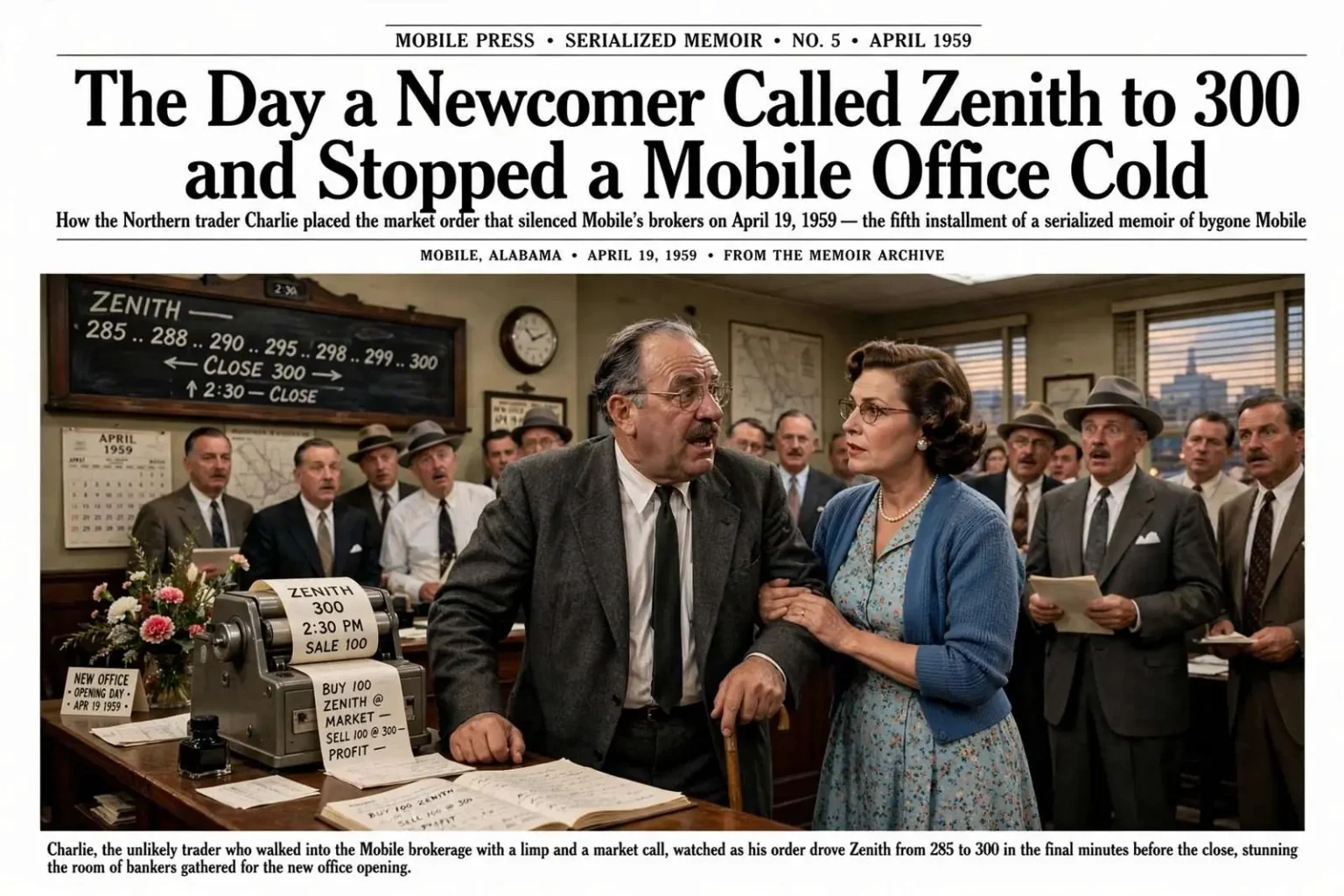
The fifth installment of a serialized memoir of a bygone Mobile is a study in first impressions, and in how badly they can mislead. The man had been coming into the downtown brokerage office almost every day for a month before he opened an account.
He was a Northerner, short and stout, with a limp and a large nose, sharp in speech and, to Mobile ears, suspicious in manner. He was also obviously knowledgeable about the market, which made him more worrying rather than less.
The brokers gave him a wide berth. They had all heard stories about sharp operators who came down from the North and took brokers in small country towns, and Mobile in the 1950s was, by Wall Street’s reckoning, a small country town.
It fell to the memoirist to inherit him. He accepted the man’s first small order without enthusiasm and waited nervously for the check to clear.
A trader who did not go broke
The newcomer — Charlie, in the memoir — turned out to be the most fortunate thing that ever happened to the author’s career. He was a trader, and he belied the old rule that traders always go broke.
He had an eye for the tape and could see things on it that nobody else in the office could see. He had two rarer qualities as well: he could make a decision promptly, and he could reverse it just as promptly when it proved wrong.
He was blunt to the point of profanity, which made his wife wince. She was almost always with him; he had difficulty driving, and, the memoirist writes, he probably would have died years earlier without her care.
Diabetes had left its mark, and he stood about five feet five. Charlie contributed a large share of the memoirist’s business over the following years, but he did something more valuable than trade: he brought in new customers and pushed the existing ones to act.
One difficult client — a chronic ditherer who could never make up his mind — became a case study. Charlie would sit down near him, whisper something to his wife, then walk over and place an order loudly enough to be interesting but quietly enough to be mysterious.
The other man could not stand it. He would ask what Charlie was buying and be told, in a voice audible down the street, that it was none of his business, that somebody had to pay the light bill, that this was not a welfare office, and that he could get off his dead butt and buy it if he was told.
Shamed, the man would buy. It was usually a wise decision.
It was wise so often that the client eventually left a standing order: whenever Charlie bought something, buy 100 shares for me without calling, and when he sells, sell mine.
Opening day, and a show
Charlie’s finest hour came on April 19, 1959, the day the firm opened a new office in a fancy new building.
The place was banked with flowers and full of visitors, many of them from the local banks. Because New York was on daylight time and Mobile was not, the market was still open when the crowd arrived after lunch.
Charlie came to the memoirist’s desk and announced that he was going to put on a show for the opening. Then he called out, loudly enough for the room to hear: buy 100 Zenith at the market.
Zenith was selling around 285. In Mobile, a market order of that size commanded immediate attention, particularly from bankers.
The room began to buzz. Who was this squat little stranger nobody had ever seen?
The order went back to the wire room. Confirmation came at 2:18, twelve minutes before the close, at a price of 285.
Charlie turned and called out again: now sell it at 300. Nobody left.
Lunch hours were long since over and the visitors stayed anyway. The stock climbed on the tape — 288, then a large block at 290, then a crawl as the clock bore down on the 2:30 close.
It touched 295 at the bell, and then the runoff, the final string of late trades that printed after the close, carried it on: 296, 297, 298, 299, and finally, in a burst, 300. Charlie rose from his seat, bowed to the left, to the center and to the right, and sat back down.
He made a lot of believers that day. Anyone could have done it, a skeptic might say.
The memoirist does not believe it. Charlie did not hope Zenith would move in the last few minutes, he writes.
He knew it would. How, the memoirist could never say.
The $1,500 profit meant little to him. He took it, of course, but he had said — and the memoirist believed him — that he had no ambition to make a fortune in the market.
He had always made enough for himself and his wife to live well, and that was all he wanted. The ugly stranger everyone hoped would not open an account became, in the end, the man the memoirist came to love.
A delightful man, he concludes.
The time gap Charlie exploited was a product of the era. Before the Uniform Time Act of 1966 set national rules for daylight saving time, states and cities chose for themselves whether to observe it, so New York could run on daylight time while much of the South stayed on standard time.
Next in the series: Profits, and a great loss.