Former Council Members Deliver a Verdict on Mobile’s Abandoned Pay Raise: Public Service Is Not a Career
After the Mobile City Council retreated from a steep pay raise under public scorn, former council members offered a blunt assessment in January 2005: the job is part-time, and police and firefighters come first.
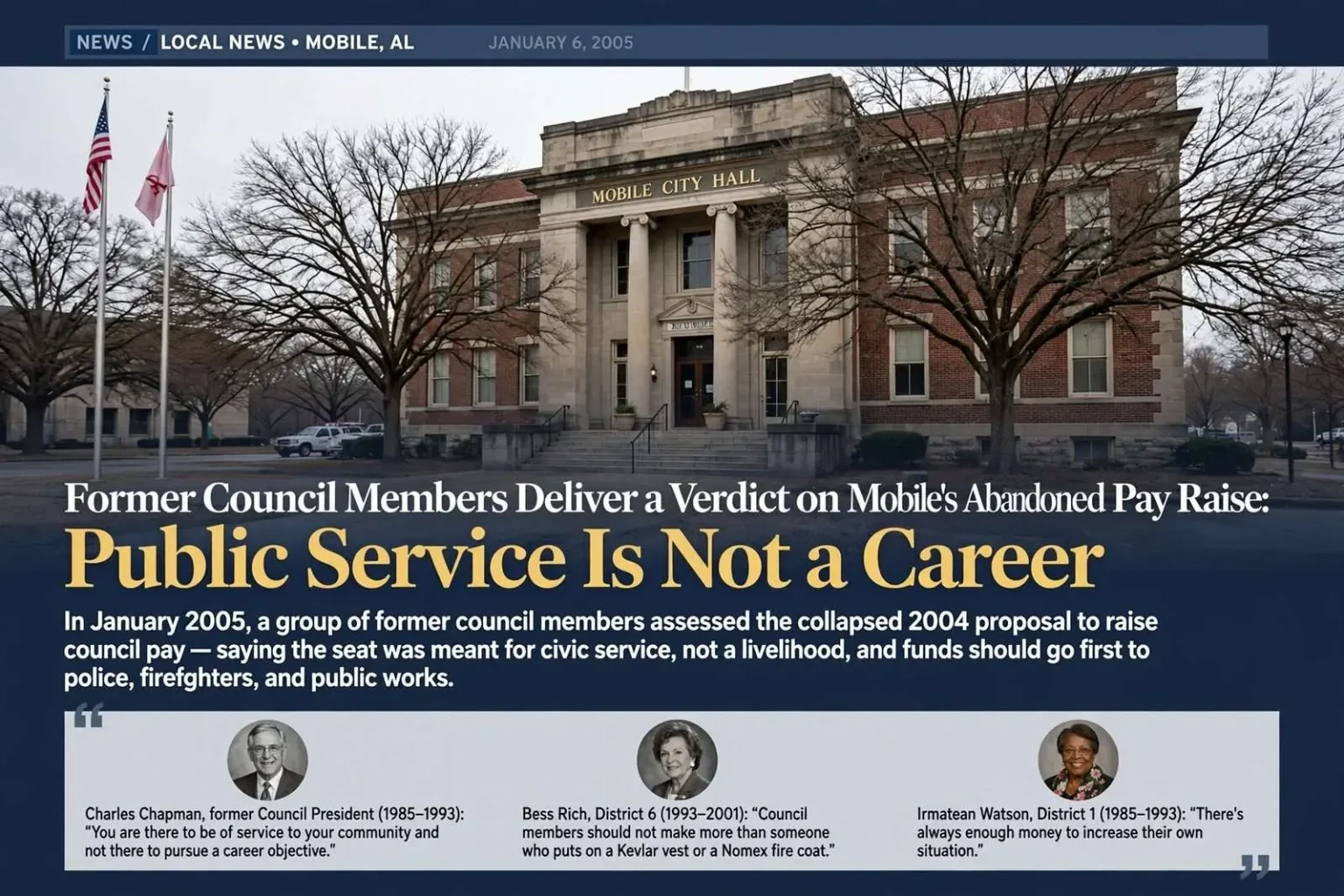
The Mobile City Council’s short-lived attempt to raise its own pay collapsed in December 2004 under a wave of public scorn. In January 2005, a group of former council members offered their assessment of what had gone wrong — and two themes ran through nearly every answer.
The first was that the council seat was created as a part-time opportunity to contribute to civic betterment, not a livelihood. The second was that if the city had money to spend on salaries, it belonged first to the police officers, firefighters and public works employees who do the physical work of running Mobile.
What the Council Proposed
The abandoned plan would have raised council pay from about $32,800 to $49,000 for part-time service; the council president’s compensation from about $38,800 to roughly $56,200; and the mayor’s full-time salary from $89,000 to $125,000. None of the increases would have taken effect until after the August 2005 city elections and the seating of a new council.
‘A Community Service’
Charles Chapman, who represented District 4 from 1985 to 1993 and served as council president, recalled that first-term pay was somewhere around $18,000. He said the current level appeared adequate.
“There should also be — how do you phrase this? — a community service associated with that job,” Chapman said.
“You are there to be of service to your community and not there to pursue a career objective.” He recalled the early battles over compensation structure. The Legislature set the initial pay for the first council; thereafter, an outgoing council set the pay for the incoming one.
Some members, he said, wanted their compensation fixed whether they attended meetings or not, a prospect that worried him. The council settled on a per-meeting amount, a fixed monthly expense allowance of about $325, and a base figure.
Cell phones were discussed and rejected as unnecessary.
‘Not More Than Someone Who Puts On a Kevlar Vest’
Bess Rich, District 6 councilwoman from 1993 to 2001, was among the sharpest critics and appeared before the sitting council to say so.
She recalled the roughly 32 percent increase adopted in 1997 that brought pay to $32,800 — a raise she voted against and whose proceeds she pledged back to the police and fire departments. “I felt very strongly that council members should not make more than someone who puts on a Kevlar vest or a Nomex fire coat,” Rich said, noting that council pay already exceeded the starting salary offered to public safety personnel.
Mobile’s council members, she said, were the highest paid in Alabama, in a city that by most measures ranked third. She also argued for term limits.
“This is not a career,” she said. “It is an honor to serve.”
‘There Is Always Enough Money’
Irmatean Watson, District 1 councilwoman from 1985 to 1993, was blunter still.
The perquisites of office, she argued, were themselves a form of compensation: paid travel, a reserved parking space, invitations to civic events. “It would gall me for them to have enough money to increase their own salaries for just sitting around reading stuff, and these people hustling for the city can’t get a raise because there’s not enough money,” she said.
“But there’s always enough money to increase their own situation.” The trouble begins, she said, when the seat is treated as a profession.
‘Based on What?’
Charlie Waller, District 7 councilman from 1993 to 2001 and a former finance chairman, made a productivity argument.
For some members the job is genuinely part-time; for others, particularly committee chairmen with real workloads, it approaches full-time. “For a council person to say, ‘I should have a raise,’ I say, ‘Based on what?’” Waller said.
He suggested members keep records of their meetings and constituent work so voters could judge. “If you don’t contribute, you don’t get paid.”
A Case for the Mayor
Mabin Hicks, District 4 councilman from 1993 to 2001, declined to name a fair council figure without research, but argued forcefully that the mayor’s salary needed to rise.
At $89,000, he said, Mike Dow was earning less than some of his own employees and less than mayors of far smaller cities. “I think a fair figure for our mayor of $125,000 would certainly be reasonable,” Hicks said.
“To get a highly motivated person to do that job, you’ve got to pay that person.”
Tie It to the Employees
Vivian Figures, who served on the council from 1993 to 1997 and was by then a state senator, called the proposal “excessive. Very excessive.” Her preferred solution was a formula: give council members and the mayor the same percentage cost-of-living increase granted to city employees.
Stephen Nodine, District 7 councilman from 2001 to 2004 and by then a county commissioner, agreed. He called the raise ill-timed while public safety and public works employees were still fighting for increases, and argued for consistent annual raises for those workers before any adjustment for elected officials.
“You hold public office for the sake of committing yourself to the well-being of the community, not to be enriched,” Nodine said.
‘It’s Absurd’
Jane Conkin, formerly Jane Q. Baxter, who represented District 6 from 1985 to 1993, offered the shortest verdict of all. The proposal was a mistake, and a big one.
The council was designed to be part-time, compensated by a stipend, a per-meeting fee and expenses. “If they are not happy with the money they’re making, let somebody take their place,” she said. “Maybe it’s time for that.”