Mobile to Open Arlington Park on the Bay Front With Kayak Launch
The Alabama State Port Authority and the City of Mobile prepared to cut the ribbon on Arlington Park, a newly constructed bay front park with a launch for kayaks and canoes.
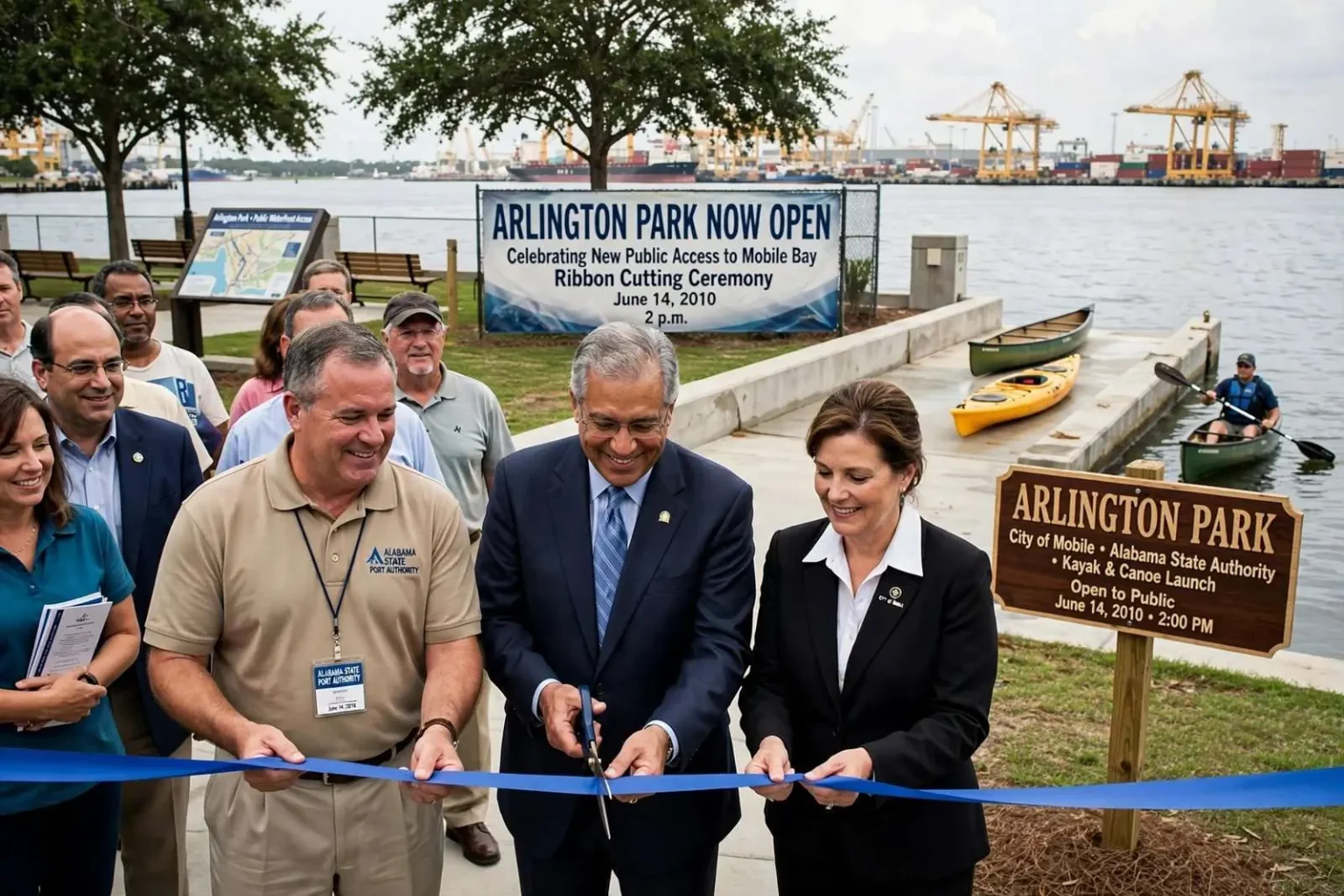
The Alabama State Port Authority and the City of Mobile scheduled a ribbon cutting for Monday, June 14, at 2 p.m. to officially open Arlington Park, the city’s newest bay front park. Mayor Sam Jones, members of the Mobile City Council and the public were expected to attend, and area kayak enthusiasts planned a demonstration of the park’s new kayak and canoe launch as part of the ceremony.
The opening gave Mobile a new point of public contact with Mobile Bay, a shoreline that residents have long had limited ways to reach. The joint ceremony put the city’s top officials alongside the port’s leadership on the same platform, an image that carried its own significance for anyone who has followed the two institutions’ history on waterfront questions.
Public access to the water
For a city built on a bay and a river, Mobile has historically offered its residents surprisingly few places to simply walk down to the water. Much of the waterfront is given over to working port facilities, shipyards, rail lines and industry — the economic engine of the region, but not a shoreline the public can use. Generations of Mobilians have driven across the bay to the Eastern Shore’s public parks to do what their own city’s shoreline could not accommodate: put a kayak in, cast a line or picnic at the water’s edge.
Arlington Park was built to close a piece of that gap. The kayak and canoe launch in particular signaled an intent to make the park usable rather than merely scenic, giving paddlers a place to put in on Mobile Bay without driving to the causeway or across to the Eastern Shore. For the growing paddling community along the Gulf Coast, a launch on the western shore opened new routes along the bay’s shoreline and up the Mobile River’s tributaries.
The value of that access goes beyond recreation. Waterfront public spaces shape how residents relate to the water their city is named for, and cities across the country have found that parks on working waterfronts — placed carefully so they coexist with industrial operations — become among the most used public spaces a community has. A launch, a green space and a view of the bay give Mobile residents a daily connection to the resource that shipping built the city around.
A partnership with the port
That the Alabama State Port Authority co-sponsored the park is itself worth noting. The port and the city have not always found their interests aligned on questions of waterfront land use, and a jointly opened public park represented a form of cooperation that had been in short supply in earlier decades. Where residents might once have expected a working shoreline to remain closed to them, the ribbon cutting signaled a different arrangement — one in which the port’s land holdings could serve recreation as well as cargo.
The Port Authority operates the deepwater terminals and inland docks that make Mobile one of the busiest ports on the Gulf, and its footprint shapes what is and is not possible along the city’s shoreline. Container terminals, coal docks and breakbulk facilities demand waterfront acreage, rail connections and channel depth, and nearly every expansion of public access along the water must be negotiated with that reality in mind.
Parks like Arlington demonstrate that the two purposes can share a shoreline. A paddler launching at the park operates within sight of the working port — the ships, the cranes, the terminals that employ thousands — and that adjacency is part of what makes such sites distinctive. Cities that have grown their public waterfront access in recent decades have generally done it through exactly this kind of collaboration between port authorities and municipal government.
Opening in a difficult season
The timing gave the ceremony an undercurrent. In mid-June of 2010, the Deepwater Horizon well was still leaking into the Gulf of Mexico, and coastal Alabama was bracing for oil. Beaches to the south were fielding cancellations, the seafood fleets were tied up, and the mood along the water was anything but celebratory. The spill, set off by the April explosion aboard the drilling rig, had become the defining environmental and economic event on the Gulf Coast, and every community along the bay was calculating what it meant for tourism, fishing and the waters themselves.
A new park on the bay front, with a launch for small boats, offered something modest but real in that moment: a reason to be on the water that had nothing to do with the disaster, and a reminder that the bay remained the city’s great asset even as oil concerns mounted offshore. The kayakers demonstrating the launch represented the kind of low-impact, local connection to the water that communities increasingly treasured as the spill’s effects rippled through the coast.
The contrast was not lost on observers. While booms and skimmers worked the passes south of the bay and fishermen waited out closed waters, a city ceremony celebrated new public access to the same waters — access that would matter in the months ahead, when residents’ relationship with the bay would be tested by what the spill left behind.
Mayor Sam Jones, who was in his second term at the time, had made quality-of-life investments part of his administration’s agenda, and the park opening fit that theme. The city council’s participation underscored the municipal side of the project, while the Port Authority’s role reflected the institutional cooperation that made the site possible at all.
What the launch meant for paddlers
For the kayak and canoe community, the new launch addressed a practical gap. The Causeway along the northern edge of the bay had long served as the region’s primary put-in point, and the Eastern Shore’s parks drew paddlers from the western side, but launches directly on Mobile’s bay front were rare. A launch inside the city shortened trips for residents across Mobile and opened shoreline paddling that had previously required trailering boats across the bay.
Small-craft access points have a way of building communities around them. Paddling clubs, fishing kayakers and casual weekend paddlers organize around convenient launches, and each new access point tends to increase the number of people on the water. For a city trying to market its waterfront lifestyle, the launch was a small facility with an outsized symbolic role: proof that the bay was not just something to look at from a causeway bridge.
The ribbon cutting itself
The ceremony’s details — a 2 p.m. start on a Monday, officials and residents gathered at the water’s edge, kayakers demonstrating the new launch as part of the program — reflected the practical character of the project. Rather than a purely symbolic event, the program showcased the park in use from the day it opened, with paddlers on the bay while officials spoke.
Public attendance was encouraged, and for the neighbors who had watched the site take shape, the ribbon cutting marked the moment a construction project became a community asset. Parks of this scale come together through planning commissions, funding decisions and construction seasons, and the ceremony is the point at which all of that work becomes something residents simply use.
The joint sponsorship also established a template for future conversations. A port authority that co-opens a public park on the bay has, in effect, acknowledged that public access and port operations can share the shoreline, and that precedent gives weight to later proposals — for greenways, for additional launches, for any future request to open more of the water’s edge to the people who live beside it.
A small park with a long view
Arlington Park opened in a summer when the Gulf Coast’s relationship with its water was under strain, and it represented the quieter, longer-term thread in that story: a city steadily working to give its residents back their shoreline. The Deepwater Horizon disaster would dominate the region’s headlines for months and its recovery discussions for years, but the everyday work of building public access continued through it.
The park’s opening day combined both threads — kayakers demonstrating a new launch on a bay whose health everyone present was worrying about, officials celebrating cooperation on a shoreline mostly given to industry, and a community gaining one more place to reach the water. In the years that followed, the kinds of partnerships the park represented would remain essential to how Mobile grows along its waterfront, balancing one of the nation’s busiest ports with the simple, persistent public desire to get to the water.
For the paddlers who demonstrated the launch, the meaning was simpler. On a June afternoon in a difficult summer, Mobile had a new place to put a boat in the bay — and for the first time in a long while, it was in the city itself.