Demeranville Florist Closes After 121 Years in Downtown Mobile
A downtown Mobile fixture since 1889, Demeranville Florist shut its doors on Memorial Day, ending a family business that began on Bienville Square and outlasted three centuries of the city's history.
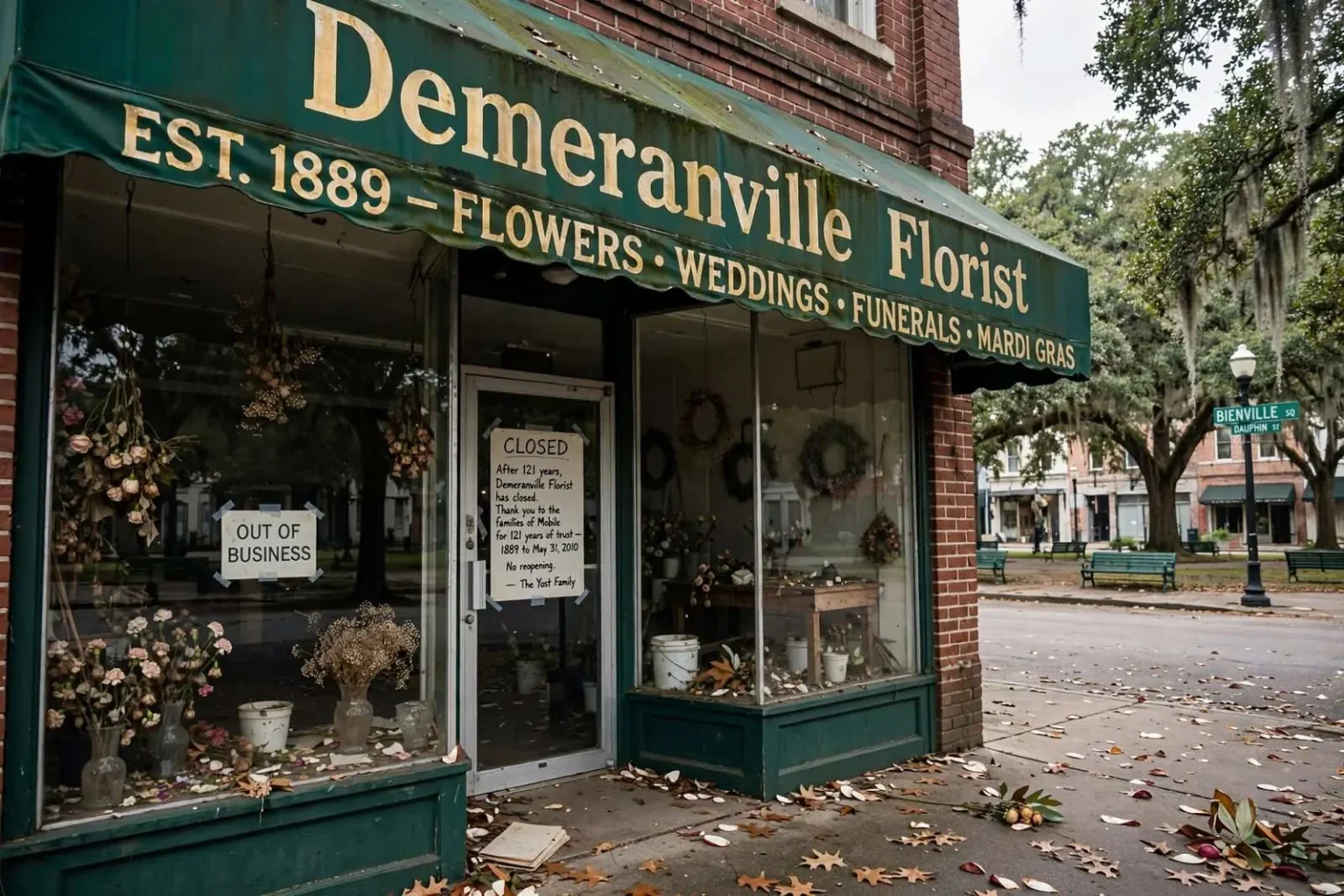
Demeranville Florist, a presence in downtown Mobile since 1889, closed its doors on Memorial Day, ending a run of 121 years and removing one of the oldest continuously operating businesses from the heart of the city. There was no closing announcement, no farewell event. The shop simply did not reopen after the holiday, and one of the quiet fixtures of downtown was gone.
A business that survives 121 years in the same trade, in the same part of town, is a rarity by any measure. Demeranville had been selling flowers in Mobile longer than most of the city’s churches had stood in their current buildings, longer than the skyline that now rises over the river, longer than the memory of anyone who walked through its doors. Its closing marked the end of a kind of enterprise that American downtowns once took for granted and now rarely see.
Three centuries of one family
The business was launched on Bienville Square by the grandfather of its most recent owner, Bill Yost, in the closing years of the nineteenth century. Yost had been at the shop for something on the order of 50 years — long enough to have arranged flowers for the weddings, funerals, debuts and Mardi Gras balls of several generations of Mobile families. In many households, the same hands had made the bouquets for a grandmother’s funeral and her granddaughter’s wedding.
That continuity is what separated Demeranville from a shop. In a city as ritual-minded as Mobile, where Mardi Gras societies, church calendars and funeral customs run deep, the florist occupied a place in the social fabric that few other businesses touch. Flowers here are not an occasional purchase; they are infrastructure for the occasions that mark a life. Every major event in a family’s history passed through the shop’s workroom, and the staff knew the names, the dates and the expectations that came with them.
A florist that stays open for 121 years becomes, in effect, a kind of civic archive. Its ledgers and order books traced births, deaths, debutante seasons and Carnival balls across three centuries of Mobile families. When the doors closed, that record of the city’s private life — the part that never makes the newspaper — closed with it.
Bienville Square, where the business began, was the commercial heart of Mobile when the first Demeranville opened its doors. The park was ringed by shops, offices and hotels, and the flower shop drew its customers from the daily life of the blocks around it. Over the following century the square’s character changed around it, but the shop stayed put, adapting its trade to each new version of downtown.
What closed with it
Demeranville outlasted the yellow fever era, two world wars, the Great Depression, the transformation of downtown Mobile from a commercial center to a district of offices and restaurants, and the long decline and partial revival of Dauphin Street. It opened when Bienville Square was the commercial heart of the city and closed when the square was mostly a shaded park bordered by law offices. Few institutions anywhere in Alabama could claim a similar span of unbroken operation through so many upheavals.
The yellow fever epidemics of the late nineteenth century, the hurricanes that have repeatedly battered the Gulf Coast, the Depression, wartime shortages and the mid-century flight of retail to the suburbs each took a toll on downtown businesses. Demeranville survived them all. The pressures that finally closed it were quieter, and they were national in scope rather than local catastrophes.
The closing also reflected pressures felt by independent florists across the country in that period: national wire services and online order-gatherers taking a cut of local deliveries, big-box and grocery-store flower counters undercutting prices, and a long slide in the habit of sending flowers at all. A customer who once telephoned the shop directly could now place an order through a national website, which routed the request back to a local florist only after keeping its own percentage. Discount bouquets sold beside the produce at warehouse stores taught consumers to think of flowers as a commodity rather than a craft.
For a family shop whose value lay in design skill and personal knowledge of its customers, those shifts eroded the business from both ends. Margins narrowed on every order that passed through a third party, and the volume of orders itself declined as social habits changed. Sympathy flowers and wedding work remained the backbone of the trade, but even those occasions faced competition from alternatives that a previous generation would not have recognized.
Independent florists across the country told the same story through those years. The neighborhood flower shop, once as standard a feature of a downtown as the drugstore or the bakery, grew scarce. Mobile held onto Demeranville longer than most cities held onto theirs, a function of the loyalty of its customers and the persistence of the family behind the counter.
What’s next for Yost
Yost was not retiring to a porch. He planned to begin work as an instructor at Auburn University in August, taking decades of practical expertise in the floral trade into a classroom. The move sent one of Alabama’s most experienced florists from the sales floor to the front of a lecture room, at the state’s land-grant university.
Auburn’s horticulture programs have long drawn on working professionals to teach the applied side of the discipline, and a florist with a half-century behind a design table has a curriculum’s worth of knowledge that no textbook supplies — sourcing, seasonality, the mechanics of arrangement, and the particular art of knowing what a grieving family actually needs when they walk through the door. Students in floral design and horticulture stand to inherit craft that in most places dies with the last practitioner.
For Yost, the classroom work also represents a form of continuation. The shop on Bienville Square is gone, but the skills that sustained it for four generations will now be passed to a new cohort rather than ending with the family. Florists trained in Auburn’s programs will carry methods learned from a man whose grandfather was selling flowers before the Spanish-American War.
A quiet loss
There was no ceremony. The shop simply did not reopen after the holiday. Downtown Mobile in 2010 was in the middle of a slow rebuilding — new restaurants on Dauphin Street, the RSA tower on the skyline, a cruise terminal at the river — and the loss of a business that predated all of it registered mostly among the people who had used it for years and now had to find someone else.
Those losses accumulate quietly. A city’s character is carried in institutions like Demeranville: not landmarks exactly, but fixtures, the sort of place whose absence is felt only the next time someone needs one. The new downtown rising along the river has added attractions and residents, but it will not add another 121-year-old florist.
For the families who depended on it, the closing means one more errand rerouted to a suburban shop or a national website, one more link between the city’s past and its present severed without notice. For downtown Mobile, it is a reminder that revival and loss travel together — and that the oldest businesses are the ones least able to be replaced once they are gone.
The mathematics of the floral trade had shifted against small shops for a generation before Demeranville’s last day. Fresh flowers are perishable inventory, bought in bulk several times a week, and a slow week means stock that must be marked down or thrown away. A family operation carried that risk entirely on its own books, while its new competitors spread it across thousands of stores or pushed it back onto the local florist who filled their routed orders. What had been a comfortable trade for a disciplined family became a narrow one, and eventually an untenable one.
The timing of the closing carried its own poignancy. Memorial Day, when the city’s cemeteries fill with flowers and the church calendars turn toward summer weddings, was for a century and more among the busiest stretches of the floral year in the South. A shop that had supplied Mobile families for every such occasion for 121 years closed on the holiday itself, a final symmetry that the family could not have scripted and surely would not have chosen.
Bienville Square itself tells the story of downtown in miniature. Named for the French colonial founder of the city, the park sits at the heart of the old business district, and for decades it anchored a commercial corridor where the city’s leading merchants kept their shops. As commerce moved west to the suburbs and then south to the Eastern Shore, the square’s surroundings turned first to offices, then, in the revival years, to the restaurants and condos of a new downtown. Demeranville’s storefront watched each version arrive, and each version kept buying flowers.
In the end, the shop’s run can be measured in more than years. Four generations of one family worked behind its counters. Its arrangements marked the passing of an era of downtown retail in which the proprietor knew the customer by name, and its closing leaves Mobile with fewer such places than it had. What the shop leaves behind is a standard: proof, written in a century of continuous operation, of what a family business can mean to a city when it lasts long enough to become part of the city itself.