Recount to Decide Byrne’s Runoff Rival for Governor
Alabama Republicans moved toward a statewide recount of their June 1 primary for governor after Tim James trailed Robert Bentley by just 167 votes for the second runoff spot behind Bradley Byrne.
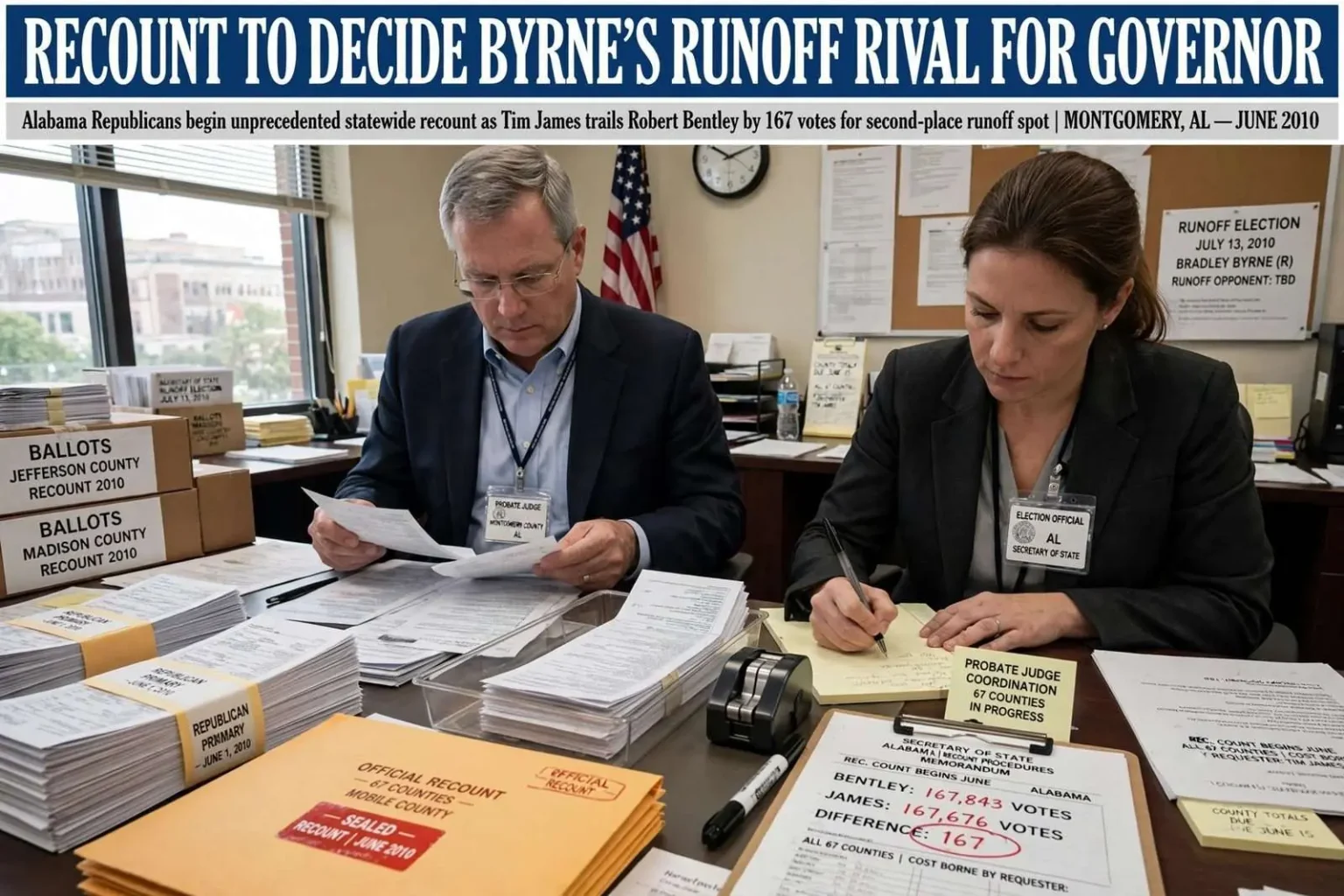
Alabama Republicans were headed for an unusual statewide recount of their June 1 primary for governor, a step meant to settle which candidate would advance alongside front-runner Bradley Byrne into the July 13 runoff.
Secretary of State Beth Chapman confirmed that state and county election officials would proceed with the count after Greenville businessman Tim James trailed Tuscaloosa physician and state Rep. Robert Bentley by only 167 votes for the crucial second-place finish. James, who agreed to bear the cost of the review, had petitioned for it, and party leaders, the attorney general and Chapman all signed off.
A rare recount, by mutual agreement
Chapman said the recount was, in an ordinary sense, the responsibility of the Republican Party rather than her office. But with what she called an unprecedented situation, she said she felt obligated to take a leadership role.
“Mr. Tim James petitioned for a recount. The Republican Party chairman agreed to a recount, the attorney general agreed to a recount, I have agreed to a recount,” Chapman wrote in a memorandum to state GOP Chairman Mike Hubbard, Bentley and James.
Probate judges from across the state and many county party chairmen had already met to prepare, she noted. An attorney general’s opinion held that provisions governing procedures after a recount would apply only if the new tally differed from the June 1 result. Chapman said the best course was simply to proceed, since no one disputed that James was entitled to a recount before the runoff.
The mechanics of the review were considerable. A statewide recount means every county’s ballots — more than 490,000 votes cast in the Republican primary — run again through the tabulation process, with poll watchers and party representatives on hand. Probate judges, who double as county chief election officials in Alabama, coordinate the work, and the candidate requesting the recount pays the cost, a bill that runs into the tens of thousands of dollars across 67 counties. James’ agreement to shoulder that expense was the threshold requirement; without it, there is no recount to plan.
The stakes were unambiguous. The second-place finisher advances to the runoff against the first-place vote-getter; the third-place finisher goes home. A 167-vote margin across a statewide primary is a fraction of a percent — close enough that mechanical errors, miscounted precincts or uncounted provisional ballots could plausibly change the outcome, and therefore close enough that the law owed James the review he requested.
The larger story in the numbers
Beyond the razor-thin margin, the primary pointed to a striking shift in Alabama’s politics. On June 1, about 319,000 Alabamians voted in the Democratic primary compared with roughly 492,000 in the Republican primary — the first time the GOP had drawn even a single voter more than the Democrats in the state’s history.
Analysts who examined the returns said the average Alabama county saw the share of voters choosing the Democratic ballot continue its long decline, with the shift concentrated in the growing suburban counties around Huntsville, Birmingham and Mobile that have anchored Republican gains for a generation.
The crossover phenomenon told the rest of the story. Alabama does not register voters by party, so each voter picks a ballot in the primary — and in 2010, thousands of voters who had long marked Democratic ballots crossed over to the Republican race, where a wide-open gubernatorial contest and a chance to influence the state’s direction drew them in. On the Democratic side, the incumbent’s decision not to seek reelection left a primary without the same pull.
For the Republican field, the turnout surge raised the stakes of the recount. The party’s nominee would emerge from a primary that had just demonstrated its new dominance, and the second-place slot — the one James and Bentley were contesting — was the ticket into a July runoff before an electorate that had just voted Republican in historic numbers.
The candidates and the road to July 13
Bradley Byrne entered the runoff as the first-place finisher, a former two-year college system chancellor and U.S. attorney whose campaign had made cleaning up Montgomery its centerpiece. The recount would decide only which rival joined him: Bentley, the Tuscaloosa state representative and physician running on a low-key outsider campaign, or James, the Greenville businessman and son of a former governor whose blunt campaign ads had made him the race’s most talked-about candidate.
Whatever the recount produced, the winner would face a compressed calendar. A July 13 runoff left roughly six weeks from the primary — barely enough time to raise money, build a statewide organization and introduce a candidate to voters who had chosen someone else on June 1. For the recount’s loser, the arithmetic was brutal: no runoff spot, no path, and a campaign ended by fewer votes than a single precinct holds.
That asymmetry is what made the mutual agreement matter. Bentley’s campaign accepted the recount without treating it as an affront; the party and the state’s top election official endorsed it; and the attorney general’s opinion smoothed the legal path. In a state where recount fights have occasionally hardened into litigation, the 2010 process ran on cooperation — every party with a stake agreeing, in effect, to let the ballots answer the question.
What a recount can and cannot change
Election officials cautioned against expecting drama. A recount of machine-tabulated ballots usually reproduces the original count within a handful of votes, because the machines read the same ballots the same way twice. The margins that move in recounts tend to come from the edges: ballots counted by hand, provisional ballots resolved late, precincts whose totals were misreported on election night and, in rare cases, optical-scan ballots whose marks the scanner read differently on a second pass.
That is why the attorney general’s opinion mattered. If the new tally matched the June 1 result — the most likely outcome — the post-recount procedures never triggered, and the original count stood as certified. If the tally differed, the law’s recount machinery would govern what came next. By clarifying that in advance, the opinion let all sides agree to the process without committing anyone to a contested endgame.
The cost, meanwhile, was James’ alone to bear. State law places the expense of a requested recount on the requester if the outcome does not change — a provision meant to deter frivolous demands while keeping the remedy available for genuinely close races. A 167-vote margin in a 490,000-vote primary is precisely the case the provision was written for.
History in the turnout columns
Whatever the recount decided, the primary had already made history in its turnout columns. The Republican primary’s 492,000 voters against the Democrats’ 319,000 marked the first GOP advantage in a head-to-head primary turnout comparison in Alabama history — a milestone that political observers read as confirmation of the state’s realignment rather than a one-cycle anomaly.
The reversal was decades in the making. A state that once boasted Democratic majorities in every constitutional office had, election by election, shifted its down-ballot loyalties, its suburban growth and finally its primary turnout to the Republican column. The 2010 governor’s race, with a competitive Republican field and an open Democratic seat, was the first statewide test of where the parties stood — and the answer was unambiguous.
For the campaigns, the lesson was strategic: the runoff electorate, and the November electorate behind it, would be dominated by voters who had just participated in the Republican primary in record numbers. For the state’s Democrats, the numbers posed the harder question of what a path back to competitiveness would look like.
County officials on the front line
Whatever the campaign rhetoric, a statewide recount is run by county officials, and Alabama’s probate judges had already begun preparing by the time Chapman’s memorandum circulated. The judges — who serve as the county election officers, custodians of the ballots and conveners of the county canvassing boards — met with party chairmen to walk through the logistics: security of the ballots, scheduling of the count, staffing the tables and managing the poll watchers both campaigns were entitled to send.
The county-level detail explains why Chapman emphasized that judges and chairmen had met to prepare. A statewide recount touches all 67 counties, each with its own equipment configurations, storage arrangements and staffing realities. Small counties might finish their count in a day; large ones — Jefferson, Mobile, Madison, Montgomery — would need multiple days of supervised tabulation. Coordinating that while both campaigns watched required a shared plan, and the meetings Chapman referenced were where it was built.
Mobile County’s own role was outsized. As the state’s second-largest county by population and a reliable source of tens of thousands of primary votes, its recount would be among the largest single jobs in the process — and its margins could matter in a contest separated by 167 votes statewide.
The unusual cooperation behind the process
Recounts in close elections more often arrive accompanied by lawyers, accusations and filings. This one, by every account, proceeded on agreement at every level: the requesting candidate petitioned and paid, the rival accepted, the party chairman signed on, the attorney general supplied the legal framework, and the secretary of state — whose office could have stood aside as a neutral referee — chose instead to organize and lead.
Chapman’s memo captured that posture in a single sentence listing who had agreed, addressed simultaneously to the party chairman, both candidates and, implicitly, the public. In an office often defined by the boundary between partisan service and election administration, her decision to take a “leadership role” in an “unprecedented situation” was itself a judgment call — one made easier, she indicated, by the fact that no one disputed James’ entitlement to the recount.
The cooperation carried its own payoff. A process that all parties had endorsed in advance could not easily be litigated afterward, whatever the count produced. Each side had seen the ballots run the same way, under the same supervision, with the same observers — which is, in the end, the only standard a contested margin can be measured against.
What came next
Once the recount confirmed — or overturned — the June 1 count, the party’s path to its July 13 runoff was fixed. The certified second-place finisher would join Byrne for six weeks of campaigning, and the primary’s strange arithmetic — a third-place candidate only 167 votes from the runoff, an electorate that had just made turnout history — would give way to a head-to-head contest.
The episode also left its mark on the state’s electoral practice. A peaceful, agreed-upon statewide recount in a marquee race demonstrated that Alabama’s machinery could absorb a 167-vote margin without crisis: petition, agreement, legal opinion, county preparation, count. However the July runoff ended, the recount itself became the story’s quietest achievement — a close election resolved the way election manuals say it should be, one county at a time, with everyone watching.