One Vote Short: Mobile’s Sales Tax Standoff Hardens Into Political Chicken
With an $18.5 million deficit and a five-vote requirement, Mayor Sam Jones fell a single council vote short of a one-cent sales tax increase, leaving three members holding extraordinary leverage.
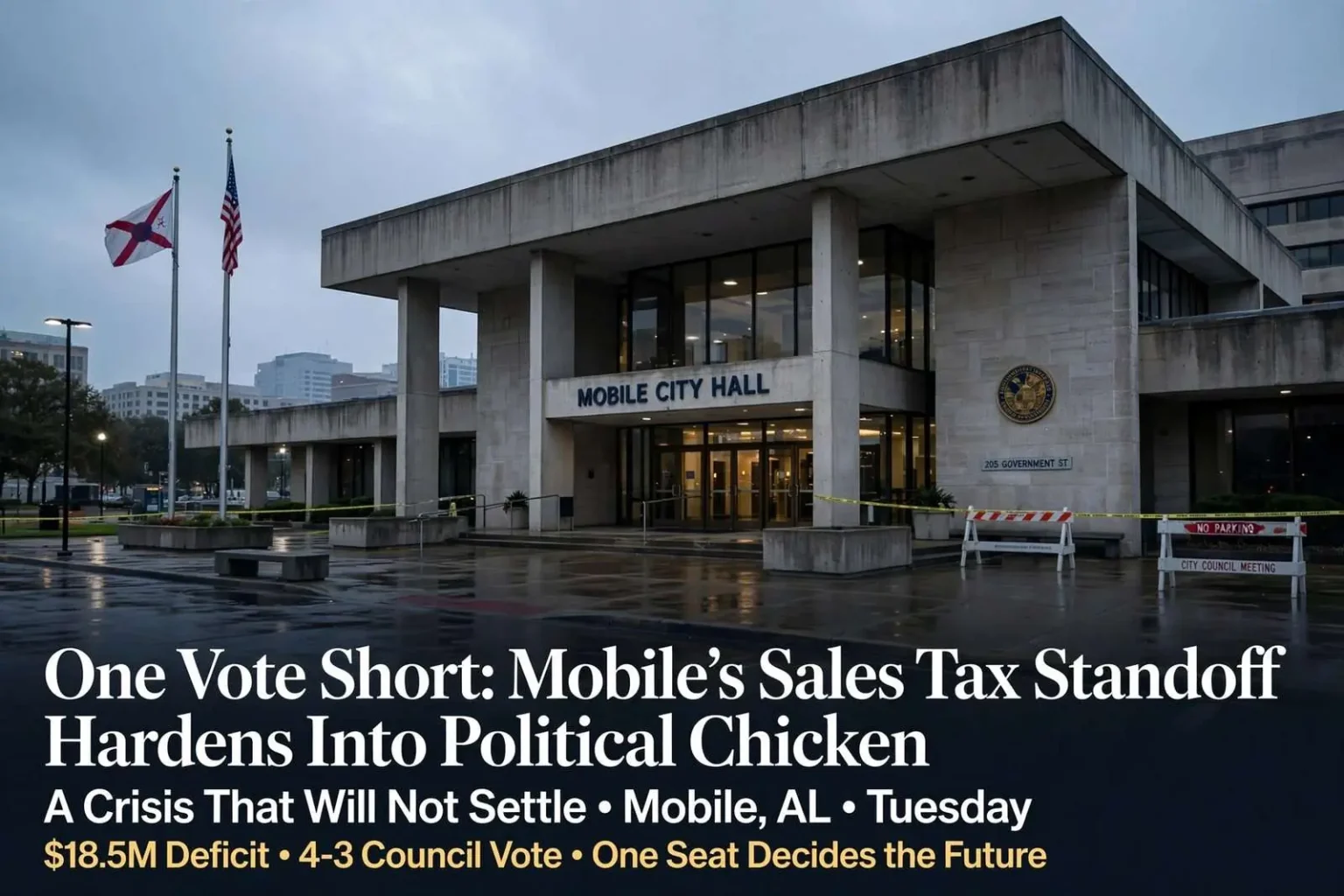
A Crisis That Will Not Settle
The financial crisis that detonated at Mobile’s City Hall earlier this month is not settling. It is spreading — politically, civically and commercially — and Tuesday’s sessions ended with the parties further apart than they began, with nothing tangible on the table beyond hope on one side and fear on the other.
The arithmetic is not in dispute. An $18.5 million deficit in a roughly $208 million budget requires, at minimum, an immediate $5 million patch in the current fiscal year, whether through new revenue or reduced spending. Next year’s gap promises to be considerably harder to close.
Those numbers explain why the dispute has proven so resistant to the usual remedies. A deficit of that size, measured against a budget of just over $200 million, is too large to absorb through attrition or trimming, and too large to defer into the next fiscal year, where it would collide with an even bigger gap. Whatever the council ultimately does, the choice will be consequential, and every faction at City Hall understands that the first decision will define the ones that follow.
For three weeks — or, for some at City Hall, since last summer — officials circled the problem without agreeing on a solution. Then Mayor Sam Jones, Council President Reggie Copeland, three other council members and a substantial contingent of city employees lined up behind a proposed one-percent increase in the municipal sales tax. It fell one vote short.
Because Mobile’s council operates under a super-majority rule requiring five votes to act, four is not enough. Councilwoman Gina Gregory, whose support City Hall’s vote-counters had believed was secured after a Sunday afternoon conference at Copeland’s home, instead positioned herself alongside the council’s two most committed opponents of a tax increase, Connie Hudson and John Williams.
Together, the three constitute a rare display of minority resolve on the Mobile council — a body not historically inclined to cross a sitting mayor, the business establishment and a simple majority all at once. In the quarter-century history of Mobile’s mayor-council form of government, the occasions on which that has happened can be counted on two hands.
The super-majority requirement is itself a defining feature of the city’s government. Adopted when Mobile reorganized into its mayor-council structure, the rule forces coalitions rather than permitting slim majorities to act, which in ordinary times encourages consensus and in moments like this one hands enormous power to whatever small bloc holds out against it. A council that cannot reach five votes cannot pass a budget amendment, cannot raise revenue and cannot close a deficit by ordinance.
Leverage, and the Cost of Losing It
The super-majority rule cuts both ways. Standing together, the three hold enough leverage to force a compromise built from any number of cost-saving or revenue-producing alternatives to a full one-cent hike. If one of them defects, the other two are politically stranded, and the tax passes.
That reality defines the pressure now bearing down on Gregory. She faces constituents and business interests urging her to hold the line. She also faces a coordinated appeal from civic leaders whose organizations depend on the city’s performance contracts — the Chamber of Commerce, the Convention and Visitors Bureau, the Exploreum, Penelope House, the Boys and Girls Club and others — along with city employees and their families, who see the tax as the option that does not imperil their jobs, pay or benefits.
The competing constituencies map almost perfectly onto the competing solutions. The city’s contract-funded civic institutions, from the science center on the riverfront to the shelter serving battered women and the youth programs operating across the city, depend on municipal appropriations that a deficit-driven budget would cut. Their leaders have thrown their weight behind the tax because, for them, the alternative is not savings but contraction. On the other side stand taxpayers and businesses, represented by the council’s holdouts, who see a permanent sales tax increase as a burden that outlasts the crisis it is meant to solve.
City employees occupy a third position, and in some ways the most exposed one. For them, the tax debate is not abstract: a budget closed through spending cuts is a budget closed through positions, and every week the standoff continues is another week of uncertainty about pay, benefits and employment.
What Jones Is Weighing
The mayor’s calculation is its own kind of trap. Jones has described the one-cent increase as the city’s only viable path, and has treated across-the-board layoffs as something close to unthinkable. But if no fifth vote appears, roughly 300 or more of the city’s approximately 2,500 employees could be cut. Can the administration survive that politically? Perhaps — particularly if the blame can be made to settle somewhere else, on Gregory, or on Hudson and Williams.
That is the unstated proposition behind much of the current maneuvering, and it explains why the pressure on the swing vote has been so relentless. A mayor who presides over layoffs of that scale absorbs the damage himself; a mayor who fought for the tax and was blocked by three named council members can direct the narrative instead. City Hall’s vote-counters understand this, which is why the appeals to Gregory have been so public, and so coordinated.
By keeping every option open, including the sales tax, Gregory has not done everything she might to deflect that pressure. A cynic would read her posture as a bid for a better price. The more likely explanation is simpler: a desire to appear, and to remain, a reasonable and open-minded representative who has not foreclosed a solution.
Under either reading, her position is the fulcrum. As long as she refuses to rule out the tax, the administration retains hope of a fifth vote and holds off on the deeper cuts that would make the deficit math work without one. The moment she commits either way, the standoff resolves — and one side of the dispute loses everything it has been bargaining for.
Two Sincere Arguments
Underneath the maneuvering, the dispute reduces to two propositions, and the difficulty is that both are held in good faith. For the tax: it is one penny, weighed against the risk of gutting police protection, fire coverage and the civic institutions that give the city its character. Against the tax: it is a $28 million annual tax increase imposed on residents and merchants during the worst economic downturn in seventy-five years.
Both sides can be right. Both sides cannot win. Unless somebody moves, the energy at City Hall shifts from the difficult work of managing spending to the easier work of assigning fault.
The annual figure is what gives the opponents their strongest argument. A one-cent sales tax sounds small on a single purchase, but across a year of transactions in a city of Mobile’s size it produces roughly $28 million in new revenue, permanent revenue that will remain on the books long after the deficit that justified it has been closed. Critics ask what institution, once funded by a permanent tax, ever gives the money back. Supporters answer that the services the tax protects, police response, fire coverage and the city’s contract-funded institutions, are permanent too, and must be paid for every year regardless of the economic cycle.
The timing deepens the dispute. An economic downturn of historic severity has already squeezed household budgets across Mobile, and a sales tax falls hardest on the residents least able to avoid it, because sales taxes tax consumption rather than income. Merchants, meanwhile, watch every added cent at the register as a competitive disadvantage against jurisdictions that decline to raise theirs. Those realities have not swayed the tax’s supporters, who argue that the alternative, hundreds of layoffs and deep service cuts in a downturn, would simply move the pain from the checkout line to the unemployment line.
What happens next depends on which pressure breaks first. The administration can hold out for a fifth vote, accepting the political risk of continuing the standoff while the deficit clock runs. The three holdouts can maintain their veto and force the budget debate toward cuts, testing whether the public’s tolerance for reduced services exceeds its tolerance for the tax. Or one side can blink, in a compromise that blends a smaller revenue increase with spending reductions, the kind of package the super-majority bloc has the leverage to demand.
Each path carries its own political arithmetic. A tax passed over sustained opposition follows its supporters into every future election. Layoffs of 300 employees, with the service reductions that accompany them, follow the entire council. A compromise, the outcome most experienced City Hall observers would predict from a body that has historically found five votes when it needed them, spreads the pain and the credit across all parties, but only if both sides conclude that the alternative is worse.
What the standoff has already demonstrated is the fragility of consensus in Mobile’s form of government. The mayor-council structure requires five votes for nearly everything, and the coalition that governs comfortably in ordinary years turns out to be a single council member deep in a crisis. That is the structural lesson of the past month, whatever the outcome: in a city that governs by super-majority, the whole budget debate runs through the person least committed to either side.
Fairness will have little to do with how any of it is resolved. As an old politician once put it, if you are looking for fair, you have come to the wrong place — fair is out on the edge of town, near the Ferris wheel. The City Hall version of that wisdom is playing out now: the outcome will be decided by leverage, votes and pressure, not by which argument deserves to win, and the residents and employees of Mobile will live with whichever coalition proves more durable.