University of South Alabama Calvert
Boom, Boom, Boom: Mobile Counted Its Winnings in the Summer of 2008
Steel at Calvert, tankers at Brookley, a new container terminal and a downtown tower: in mid-2008, Mobile leaders argued the long-promised boom had finally arrived, while cautioning it was not yet in hand.
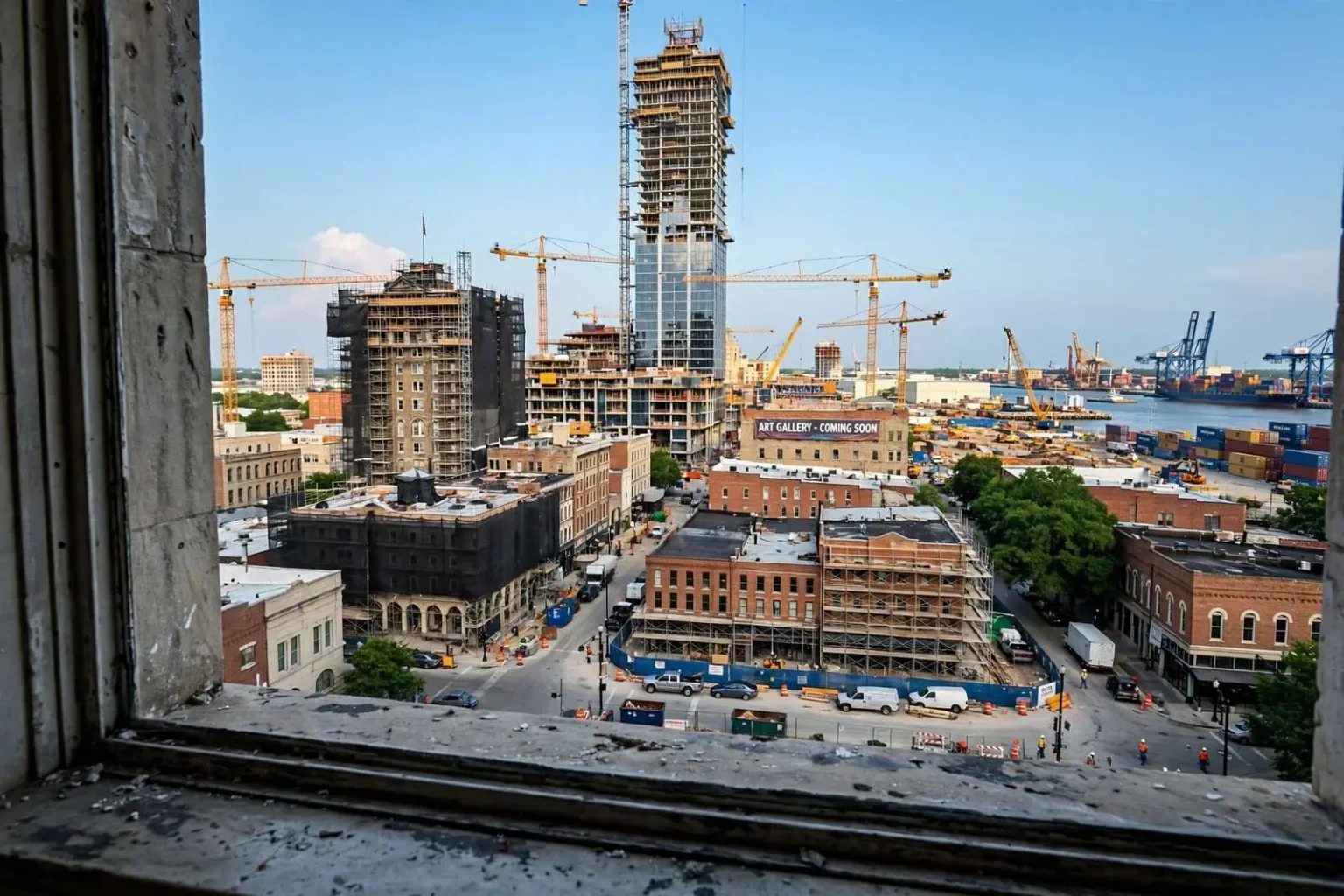
From his eighth-floor office in the Mobile County Courthouse in the summer of 2008, Circuit Judge Rick Stout could see something he said he had not seen in seven years at that window: cranes, scaffolding and construction.
“I see more activity in looking out of this window right now than I’ve seen in the past seven years combined,” Stout said, counting five older buildings under renovation, a new art gallery in the back of a former newspaper building, a hotel going up, and the 35-story RSA Battle House Tower, then the tallest building in Alabama.
The judge’s window framed the change better than any statistic could. Mobile’s downtown had spent decades as a skyline of handsome but aging buildings — early twentieth-century commercial blocks that survived the city’s mid-century decline but sat largely vacant above the street level. Renovation cranes around Government Street, Royal Street and Dauphin Street meant those upper floors were coming back into use, and the new tower rising beside the restored Battle House hotel had redrawn the skyline for the first time in a generation.
A long list of wins
The city that had been called, with affection and impatience, the city of perpetual potential was in the middle of an extraordinary run. Recent arrivals and expansions included Singapore-owned ST Mobile Aerospace Engineering, Australian shipbuilder Austal USA, IPSCO Steel and Berg Pipe.
Each of those wins represented a different piece of the Gulf Coast’s industrial transformation. ST Mobile Aerospace Engineering turned the old Brookley airfield’s hangars into one of the country’s busiest commercial aircraft overhaul operations, putting Mobile’s wartime aviation infrastructure back to work. Austal USA brought high-speed military and commercial catamaran construction to the riverfront, eventually growing into one of the region’s largest industrial employers. IPSCO Steel and Berg Pipe added steelmaking and large-diameter pipe production to the industrial corridor north of the city, feeding the energy construction boom along the Gulf.
Larger still was German steelmaker ThyssenKrupp’s multibillion-dollar plant taking shape north of the city near Calvert, with thousands of permanent jobs promised. The project — one of the largest single industrial investments in American history at the time of its announcement — had been recruited in a nationally publicized competition among Gulf states, and its construction camp alone reshaped the economy of north Mobile County.
Above it all hung the aerial refueling tanker contract. A Northrop Grumman and EADS team had won a fiercely contested Air Force competition worth up to $40 billion; Boeing had protested, and a Government Accountability Office ruling was expected June 19. If the award held, an assembly line at Mobile’s Brookley complex would have made the city one of the few places on earth where large jetliners are built.
Quieter victories at the water’s edge
Nearly lost in the noise, business leaders said, was a $300 million container terminal at the port, designed to eventually handle 800,000 containers a year, and the Alabama Cruise Terminal, whose home-ported Carnival ship was sailing full. The container terminal gave the Port of Mobile a modern gateway for the intermodal cargo era, and the cruise terminal — converted on the riverfront downtown — had instantly added a tourism industry the city had never had at scale, with thousands of passengers embarking weekly.
Also in the pipeline were the University of South Alabama’s Mitchell Cancer Institute, a motorsports park north of the city and a maritime museum planned for the waterfront. The cancer institute marked the university’s biggest research investment to date, giving the region a research-medical anchor it had long lacked, while the museum and motorsports projects spoke to the city’s new willingness to invest in amenities as well as industry.
Alabama State Port Authority director Jimmy Lyons said cargo through the public terminals had climbed from 20 million tons in 2002 to 27 million tons in 2007, with steel, coal and container volumes all projected to rise sharply by 2010 and 2011. He credited unity: the mayor, the county commission, the university, the airport authority, the chamber and the port had pledged to sit at the same table for every recruitment.
How Mobile got here
Mobile Area Chamber of Commerce president Win Hallett dated the turn to 1985, when a corruption-scarred era gave way to a reorganized chamber, a professionalized recruitment effort and mayors — Arthur Outlaw, then Mike Dow — who pushed both salesmanship and race relations. “We’re an overnight success,” Hallett said. “Yeah, after 23 years, an overnight success.”
The 1985 reference pointed to the federal corruption convictions that had disgraced the city’s commission-era leadership, a trauma that Mobile’s business community treated as a lesson rather than an ending. What followed was a deliberate rebuild: a chamber reorganized around professional economic development, a succession of mayors who marketed the port aggressively, and a conscious effort to heal the city’s racial divisions, which business leaders had come to see as an economic liability every outside company noticed before anything else.
Retirement Systems of Alabama chief David Bronner, whose pension fund had by then invested roughly $500 million in the Mobile and Baldwin County area — the Battle House restoration, the RSA tower, the Grand Hotel at Point Clear, the cruise terminal — brushed off critics who said the fund flooded downtown with office space. New Class A space, he argued, forces older buildings to improve.
Bronner’s argument inverted the usual complaint about public-pension-funded development. In his view the market failure in Mobile was not too much new office space but too little of it: companies would not relocate to a city without modern Class A buildings, and once new towers went up, landlords of older stock were forced to renovate rather than coast. His immediate priority, he said, was more prosaic: silencing the train whistles that woke hotel guests along the waterfront at night — a detail that captured how new downtown Mobile was to hosting overnight visitors at all.
Not everyone was ready to celebrate. Site consultant Jay Garner, once the chamber’s economic development vice president, said the wins traced back to infrastructure — the port, the land, the 9,600-foot runway at Brookley. He also warned that the region was nearing its limits on skilled labor. “Mobile can’t take too much more,” he said, calling it a nice problem to have.
Real estate veterans were more measured. Gavin Bender described the boom as a ship visible on the horizon, not yet in port, and noted that downtown’s office absorption had been largely homegrown. Bernie Heggeman was blunter: “The anticipation is here, but the boom hasn’t happened yet.” He warned that doubling the region’s population without planning for utilities and roads could turn the party into a hangover.
Their caution pointed at the infrastructure gaps already visible in 2008 — school crowding spreading across the county, suburban roads choking with commuters, and a port whose rail and highway connections would need billions in upgrades to handle the cargo growth Lyons was projecting. The skeptics did not doubt the wins; they doubted the region’s capacity to absorb them.
The labor warning cut in two directions at once. For workers, an economy adding thousands of industrial jobs meant rising wages after years in which Mobile’s pay scales had trailed the state’s metro areas; for employers, it meant bidding wars for welders, machinists and electricians that could price the next project out of the region. Chamber officials took to repeating a line that had become the city’s unofficial slogan of the moment — recruit the industry, then recruit the people to run it — and the region’s community colleges and technical programs were being pressed to expand as fast as the plants they were meant to staff.
Shipping executive Mike Lee, of the 116-year-old agency Page & Jones, said port calls could double within a few years and that a new Interstate 10 bridge over the Mobile River was “absolutely critical” to relieving the Wallace Tunnel bottleneck — a debate that would still be unresolved more than a decade later.
The long view
Attorney Palmer Hamilton, long active in preservation, suggested the growth might restore rather than erase the city’s character. Mobile was a cosmopolitan port for most of its history, he said, and a new spurt could return it to those roots. The city had been founded as a colonial port, had traded with the world for three centuries, and had watched its global connections thin as manufacturing and shipping consolidated elsewhere; a rebuilt downtown and a modern port, in Hamilton’s view, were less a transformation than a restoration.
The GAO would soon sustain Boeing’s protest, and the tanker line at Brookley would take years longer to arrive in a different form. But in June 2008, after decades of waiting, Mobile was counting its winnings out loud.
The counting itself was the story. For a city long accustomed to watching Huntsville, Birmingham and Nashville capture the projects and the headlines, the summer of 2008 offered the first sustained stretch in which Mobile’s announcements led the state’s economic news. Whether the momentum would survive the tanker protest, the national recession gathering in the fall and the infrastructure debts Heggeman warned about remained to be seen — but for one season, at least, the city of perpetual potential was, by its own long-suffering measure, delivering.