
Mobile Notebook: A Scarce Mayor, a Promised Rebuttal and a District Meeting in Leinkauf
Mayor Sam Jones's absence from City Hall was raising eyebrows, the camp of former judge Herman Thomas promised a reply to recent allegations, and Councilman William Carroll called a district meeting.
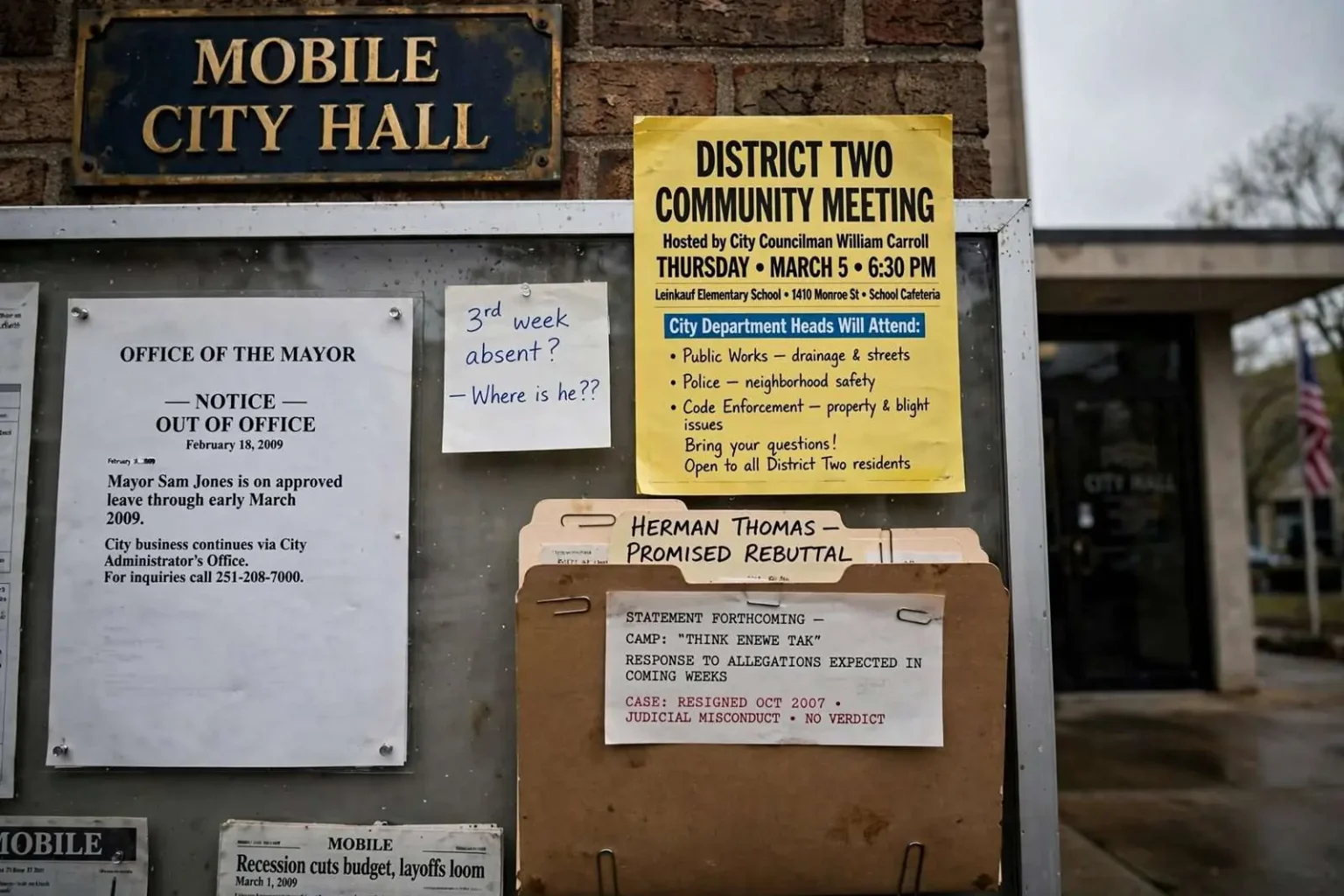
Three items were moving through Mobile’s political conversation in the first week of March 2009. None of them was a full-blown story on its own. Together they said a good deal about the mood of the city.
Where Is the Mayor?
Mayor Sam Jones had been notably scarce around City Hall for several weeks, and the absence had begun to raise eyebrows.
The explanation offered by the mayor’s allies was straightforward: Jones had chosen the Mardi Gras period, when much of Mobile’s official business slows to accommodate the parades, to take an extended vacation. It is a defensible choice in a city where the civic calendar genuinely does bend around Carnival.
The explanation, however, did little to quiet the rumors, which had drifted toward speculation about an unscheduled departure. The chatter had reached a volume at which an official statement clarifying the situation seemed likely to be forthcoming, if only to put the matter to rest.
The timing gave the story its juice. Mardi Gras in Mobile is not a lull; it is the city’s signature season, the weeks when the society pages and the parade routes dominate conversation and the government’s routine work recedes. A mayor stepping away during those weeks could plausibly claim the city would barely notice. But a mayor gone long enough for the absence itself to become the topic of conversation had crossed into different territory, because in Mobile the Carnival season is also when everyone is out and talking — society halls, parade stands, offices — and talk travels fast.
Jones, elected in 2005 as Mobile’s first African-American mayor, had governed through a period of considerable strain, including the budget fight over public financing for the Gulf Coast Classic and the recession that arrived with 2008.
That context mattered to how the rumors were received. The mayor’s first term had included a fight over public money for the Gulf Coast Classic that consumed a full budget season and left hard feelings on the council, followed by a national recession that was squeezing city revenue just as it squeezed everything else on the Gulf Coast. A mayor carrying that load is entitled to a vacation. The political problem was that an extended absence in the middle of a recession — with budgets, layoffs and capital projects all pending — reads to some constituents as detachment, however innocent the explanation.
An extended absence at such a moment invites questions whether or not there is anything behind them, and in local politics the questions tend to expand to fill whatever silence is available.
That is the mechanics of a rumor cycle: each day without a public appearance or a statement lets the speculation sharpen, and by the time an official statement comes, it competes with a week of invention. City Hall watchers in Mobile knew the pattern well, which is why the expectation of a clarifying statement was itself news — an acknowledgment that the silence had become the story.
The Thomas Camp Promises a Reply
Allies of former Circuit Judge Herman Thomas signaled that a response to recent allegations against him should be expected in the coming weeks. Thomas had been the subject of a detailed news article, and by early March his camp was letting it be known that silence would not be the strategy.
The promised reply was described in terms that left little doubt about its intended force.
“Think Enewetak,” said one ally — a reference to the Pacific atoll used in testing the hydrogen bomb.
The reference — an atoll vaporized in postwar nuclear testing — was chosen to suggest nothing subtle: a response that would flatten the ground it landed on. What form that response would take, and whether it would address the specific allegations or the motives of those making them, was not indicated.
Thomas resigned from the Mobile County circuit bench in October 2007, a step that halted a public trial on judicial misconduct charges before the Alabama Court of the Judiciary and left the accusations against him formally unresolved.
That procedural history shaped everything about the moment. The Court of the Judiciary is the body that disciplines Alabama judges, and a public trial before it would have put sworn witnesses and documentary evidence on the record — a reckoning either way, exoneration or conviction, with findings that carry legal weight. Resignation removed the jurisdiction: a judge who leaves the bench takes the charges out of the court’s reach, and the case ended not with a verdict but with a vacancy. For Thomas, the resignation preserved the possibility of contesting the allegations on his own terms and timeline. For the public, it meant the questions raised by the misconduct proceedings were never answered by any institution authorized to answer them — which is why the detailed news article, and the promised reply to it, mattered so much.
The promised response, weeks away, would be the first time the allegations met a counter-narrative in public. Allies framing it with an atomic testing reference were managing expectations toward force — and, perhaps, signaling that the reply would aim as much at the accusers and the reporting as at the substance.
Carroll Calls a Leinkauf Meeting
On the more workaday side of city business, Mobile City Councilman William Carroll set a District Two community meeting for Thursday, March 5, at Leinkauf Elementary School, 1410 Monroe Street, beginning at 6:30 p.m.
Carroll said key city department heads would attend — the detail that distinguishes a useful neighborhood meeting from a symbolic one.
Residents with questions about drainage, streets, police response or code enforcement would have the people who actually direct those functions in the room, rather than a promise that the questions would be relayed.
The difference is not cosmetic. A councilman holding a meeting alone can listen, sympathize and promise follow-up; a councilman who brings the public works director, the police commander and the code enforcement supervisor can get answers on the spot, commitments made in front of witnesses, and a queue of requests that leaves the room with names attached. Neighborhood associations in Mobile had long learned to judge these events by the roster — if the department heads show up, the district’s complaints have a route into the bureaucracy; if they do not, the meeting is theater.
The Leinkauf neighborhood, one of Mobile’s historic districts just south and west of downtown, sits in a part of the city where the housing stock is old, the trees are old, and the infrastructure beneath both is older still.
The neighborhood’s issues followed from that age. Drainage in a district of century-old streets behaves differently than in the suburbs; historic-district rules shape what homeowners can do to aging structures; and code enforcement in a transitioning neighborhood is a constant negotiation between preservation and blight. Carroll’s district — covering a broad stretch of the city’s core — contained some of the oldest neighborhoods in Mobile, and the demands on the city’s maintenance budgets were correspondingly heavy at the exact moment the recession was cutting those budgets down.
Meetings of this kind are where much of the actual work of a council district gets done, well below the level of anything that would ordinarily be called news.
The Mood of the City in Early 2009
Taken together, the three items sketched a city government in an odd posture that spring: a mayor conspicuously absent, a former judge preparing to fight back, and a councilman doing the unglamorous business of showing up at an elementary school on a Thursday evening.
It was a portrait of Mobile in the first hard year of the recession. The city’s economy — port, shipbuilding, tourism, the chemical and paper industries along the river — was contracting along with the national economy, and every level of local government was managing shrinking revenue. Against that backdrop, the three stories each carried a version of the same question: who is actually attending to the city’s business right now?
The mayor’s absence asked it literally. The Thomas affair asked it institutionally — whether the justice system and the city’s legal establishment had ever really examined allegations that a resignation had waved past without a trial. And the Leinkauf meeting asked it in the most practical terms available: whether, on a given Thursday night in a historic neighborhood, the people who run the city’s drainage, streets, policing and code enforcement would actually sit in a school cafeteria and answer to residents.
Why Notebook Items Matter
Political conversation in a city like Mobile runs on items like these. None of them, alone, moves the municipal machinery; none of them, alone, changes an election or a budget. But each one signals something to the people who watch city government closely — the neighborhood association presidents, the courthouse regulars, the council staff, the reporters who cover the routine.
A mayor’s vacation becomes a test of how his office manages perception. A promised counterattack from a fallen judge becomes a measure of how far the city’s power structure is willing to go to relitigate a case the courts never finished. A community meeting becomes a demonstration of whether a councilman can pull department heads out of their offices and into his district — an early indicator of standing on a seven-member council where coalition matters.
That first week of March 2009 had all three running at once: rumor at the top of the government, unresolved scandal in its legal circles, and routine work being done in a school auditorium. Residents following along could be forgiven for concluding that the third item — the one that produced drainage commitments and code enforcement tickets — was the only one with any immediate effect on their lives. The other two belonged to the season’s conversation, and both would return to the front pages in time.
The notebook form suits a city like Mobile precisely because its politics run this way: not in a single dominant story but in a hum of small items, each of which tells its regulars where the pressure is building. In that particular week, the hum said a mayor needed to come home, a judge was about to swing back, and in the Leinkauf district, at least, the work went on.