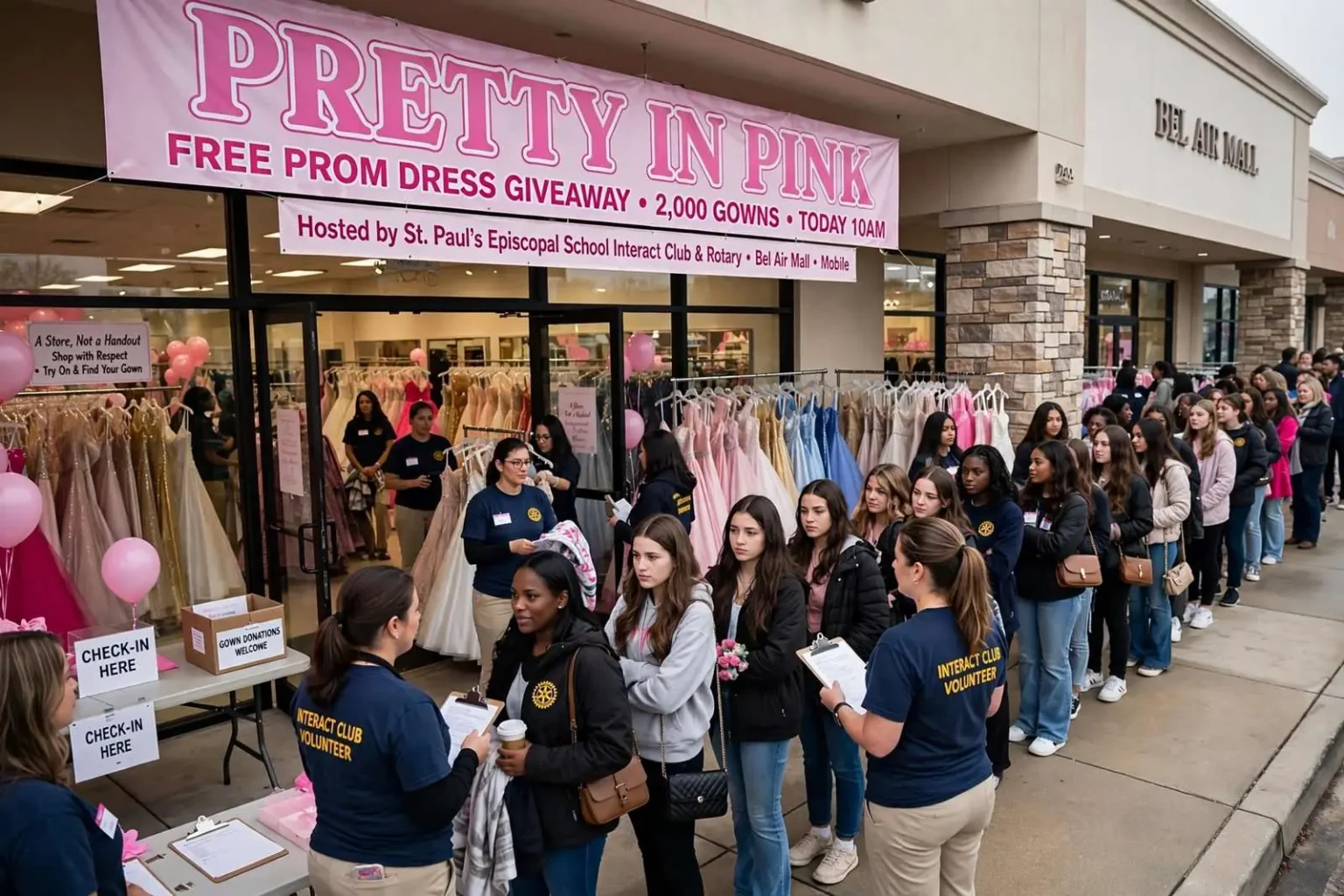
Rows of formal prom gowns hanging on a boutique rackAbout 2,000 donated gowns were arranged on racks at Bel Air Mall, staffed by student volunteers acting as personal shoppers.

The city of Mobile, founded in 1702, sits at the head of Mobile Bay on the Gulf Coast and serves as the regional hub for much of southwest Alabama.

The doors opened at 10 a.m. By 8 that morning, a hundred people were already waiting.

Mobile has a population of roughly 188,000 residents and is the seat of Mobile County, one of the largest counties in the state by population.

The “Pretty in Pink” boutique at Bel Air Mall in Mobile, a one-day giveaway of donated formalwear organized through the St. Paul’s Episcopal School Interact Club and its Rotary sponsors, distributed roughly 300 prom dresses on Saturday to girls who could not otherwise have afforded them.

The Port of Mobile, operated by the Alabama State Port Authority, is one of the largest seaports in the country by tonnage, handling containers, coal, steel and forest products.

Organizers did not close the shop until everyone in line had a chance to look. The girls came from Mobile and Fairhope, from Loxley and Gulf Shores, and from as far away as Pensacola, Biloxi and New Orleans.

Downtown Mobile has been the focus of significant redevelopment in recent years, with new apartments, restaurants and event venues reshaping the Central Business District.

Only five went home without a gown. A Store, Not a Handout The organizing principle, according to community services director Leslie Lerner, was that the event should feel like shopping rather than charity.

The University of South Alabama, Spring Hill College and the University of Mobile anchor the city’s higher education landscape.

Background and Context

Some 2,000 gowns — a few of them retailing for as much as $500 — were arranged on racks the way they would be in a high-end store. Interact Club volunteers worked the floor as personal shoppers, pulling sizes, fetching mirrors and steering the undecided.

Mobile’s Mardi Gras season, the oldest in the United States, draws visitors from across the country and provides a significant boost to the local economy each year.

“The girls were awestruck,” Lerner said. One twirled in front of a mirror and announced, “I feel like Cinderella.” Another moment stayed with the organizers.

The city’s healthcare sector is anchored by USA Health, Infirmary Health and Springhill Medical Center, which together employ thousands of residents.

See also  Four Mobile Graduates Credit Community Center Program for Shaping Their Paths

A mother who had lost her job six months earlier hugged Lerner with tears in her eyes; she had not known how she would pay for a dress for her daughter’s senior prom. Recession Timing The event landed in the worst months of the recession, when unemployment along the Gulf Coast was climbing and household budgets had no room in them for a dress worn once.

Mobile’s manufacturing base includes shipbuilding at Austal USA and Huntington Ingalls Industries, as well as aviation manufacturing at the Airbus final assembly line in Brookley.

A prom gown is the kind of expense that quietly disappears from a family’s spring when a paycheck does — and the kind of absence a teenager feels acutely. That, Lerner said, is the point of the project.

Local schools include Mobile County Public Schools, the city’s largest public system, along with a network of private and parochial schools serving families across the metro area.

Local Reaction

“Giving a girl the gift of a gown is so much more than simply providing a beautiful dress,” she said. “It builds her self esteem, self worth, and makes her feel like someone special.” She offered the volunteers a line about things that cannot be seen or touched, only felt with the heart.

Mobile’s history as a port city means that issues affecting the waterfront, the shipping channels and the surrounding neighborhoods often take on outsized importance.

By the end of the day, several of them said, the sentiment had stopped sounding like a slogan. Bigger Next Year Bel Air Mall agreed to partner with the group again in 2010, and organizers set a target of at least 500 dresses.

The Mobile area is home to several historic neighborhoods, including Oakleigh Garden District, DeTonti Square, the Village of Spring Hill and the historic districts of midtown.

The mall space matters more than it might seem: a boutique of that scale needs racks, fitting areas, floor staff and a location families already know how to reach. Lerner credited a long list of volunteers for making the day work, among them Heather Normand, Rachel Graham, Emily Callaway, Catherine Vulevich and Linda Wettermark, along with the Interact Club members and the school’s Service Leadership Class.

Sports are a major part of life in Mobile, with the Senior Bowl each January, the Reese’s Senior Bowl practices each week, and a thriving high school and college football scene.

See also  Former Officer Ron Wallace Weighs a Run for Mobile Mayor

How Interact Fits In Interact is Rotary’s service club program for high school students, and the St. Paul’s chapter has become one of the more visible youth service groups in Mobile County.

Local media outlets covering Mobile include several television stations, daily and weekly newspapers, and a robust digital news ecosystem.

The Bigger Picture

The prom dress project is its signature effort — a program that requires a year of collecting, sorting, cleaning and storing donated gowns before a single girl walks through the door. Adults who volunteered described the day in terms usually reserved for much larger charitable undertakings: hours of stories exchanged in line, mothers and daughters waiting together, and a steady procession of girls emerging from behind a curtain to a small round of applause.

Mobile County’s population includes a significant African-American community whose history is closely tied to the founding of Africatown.

Anyone interested in donating gowns or volunteering for the 2010 boutique was asked to contact the organizers through the club. The communities and regions mentioned in this report are part of Alabama’s diverse geographic landscape.
Local officials have stressed the importance of community engagement as the situation continues to develop.

Mobile and surrounding areas share interconnected histories, economic ties, and cultural traditions that shape local developments. Understanding the broader regional context helps illuminate how individual events and decisions resonate across community boundaries.

Residents with questions or concerns have been encouraged to reach out to their elected representatives.

Institutions such as School play pivotal roles in their respective communities, providing essential services, employment, and civic leadership. Their decisions and developments often have ripple effects throughout the region, affecting families, businesses, and local governance structures.

The story is one of several similar situations playing out across the region in recent months.

What Comes Next

The timeline referenced in this coverage spans 2010, a period that encompasses significant social, economic, and political transformations in Alabama and the broader Gulf Coast region. Events from this era continue to influence contemporary community dynamics, policy decisions, and regional development patterns.

Anyone following local news will recognize many of the names and places involved.

This coverage addresses themes of government and civic affairs, education and schools and business and economic development, reflecting issues that directly impact residents’ daily lives and the long-term trajectory of their communities. Local reporting on these topics serves a vital function in keeping citizens informed about decisions that affect their neighborhoods, families, and livelihoods.

See also  32 Residents Apply for Five Seats on Gulf Shores' New School Board as District Split Takes Shape

Local civic organizations have begun organizing meetings to discuss the implications.

The interconnected nature of these issues means that developments in one area often have implications for others, creating a complex web of community dynamics that thoughtful journalism helps untangle. Local news organizations serve as essential chroniclers of community life, documenting the decisions, events, and human stories that shape the places we call home.

Business owners and residents alike say they will be watching closely.

Through consistent coverage of government proceedings, school board meetings, business developments, and community initiatives, these publications create a historical record that preserves institutional memory and enables informed civic participation. The work of local journalists—attending meetings, requesting records, interviewing stakeholders, and synthesizing complex information—forms the backbone of an engaged and accountable democracy at the community level.

The situation underscores how decisions made at the local level can have far-reaching consequences.

Community leaders have called for patience and for a commitment to working through the issues in a transparent manner.

Several local churches and faith groups have offered to host discussions about the topic in the coming weeks.

Public comments at recent meetings have reflected a wide range of opinions.

Local reporters will continue to follow the story and to update readers.

Anyone interested in learning more is encouraged to attend upcoming public meetings.

The outcome of the situation could shape similar discussions in other communities for years to come.

Local historians note that similar issues have surfaced in the past.

Looking Ahead

The story continues to develop, and residents across the region will be watching for additional updates in the coming weeks.