Suspended Judge Herman Thomas Adds Mobile Counsel as Ethics Case Stalls
Suspended Mobile County Circuit Judge Herman Thomas hired Mobile attorney Billy Kimbrough to help defend him before the Judicial Inquiry Commission as a second round of complaints scuttled plans for mediation.
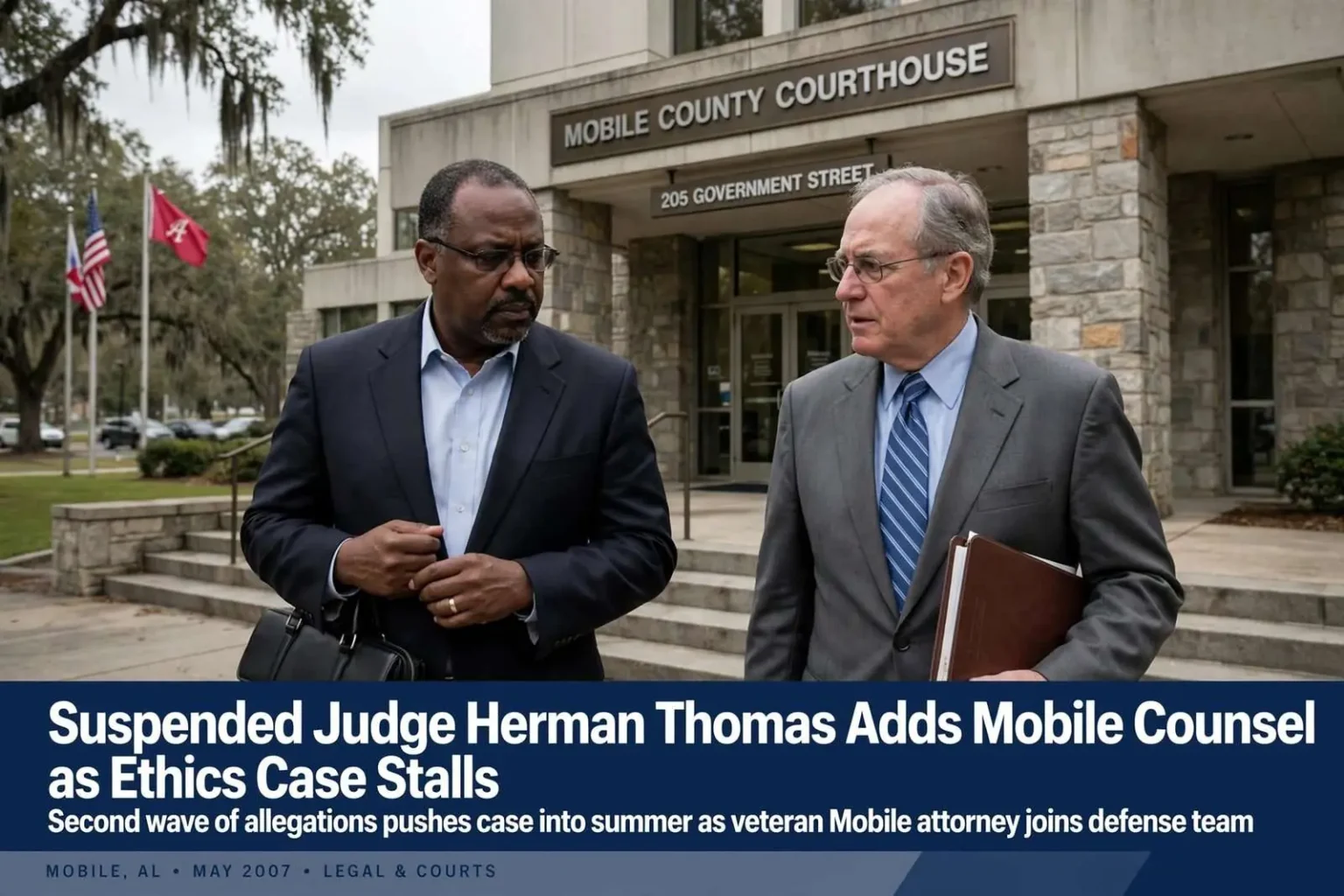
Suspended Mobile County Circuit Judge Herman Thomas brought a well-known Mobile attorney onto his defense team as a second wave of allegations pushed any resolution of his ethics case well into the summer.
Thomas engaged Billy Kimbrough, a veteran Mobile lawyer who served as U.S. Attorney here during the Carter administration, to join Dave Boyd of the Montgomery firm Balch & Bingham in defending the judge against charges brought by the Alabama Judicial Inquiry Commission.
The addition of Kimbrough doubled the local weight of the defense. Boyd brought the institutional experience of Alabama’s largest firm and prior appearances before the state’s judicial tribunal; Kimbrough brought two decades of standing in Mobile’s legal community, including the federal prosecutor’s post, at the moment the case’s most important audience — the local bench and bar — was watching closely.
A second complaint upends the timetable
The immediate complication was a fresh barrage of allegations referred to the commission by what amounted to the entire circuit bench in Mobile County — an extraordinary step for judges to take against one of their own.
Under the commission’s procedures, a judge facing charges is entitled to demand mediation. Mediation in the original case had been expected to take place in Montgomery, with Thomas present. The new complaint scuttled those plans.
The reason lay in the rules governing the process. Under the commission’s alternative dispute resolution provisions, statements a judge makes in mediation are “privileged and inadmissible as either substantive evidence or impeachment evidence against the judge.”
With a second, uninvestigated complaint pending, the commission was reluctant to mediate the older charges, because anything Thomas said could later be off-limits and could compromise its ability to build the newer case, according to a person familiar with the commission’s thinking. Thomas, for his part, was thought likely to prefer having both matters disposed of together rather than piecemeal.
The standoff was structural, not tactical. Mediation privileges exist to make candid settlement possible, but they cut both ways when two cases share a subject: a judge can speak freely in mediation about the first complaint, then carry what he learned into the defense of the second. For a commission preparing to investigate the newer allegations, mediating first risked donating its evidence to the judge. And for the judge, resolving only the older case while the second hung over him would leave his career in limbo regardless.
The referral by the full bench also changed the case’s political character. Disciplinary systems depend on judges policing judges, and complaints from colleagues carry a credibility that outside grievances do not. A united circuit bench formally accusing a peer made a quiet, low-visibility exit from the process nearly impossible.
How the process was to unfold
The commission works through an investigative arm housed in the office of the Alabama Attorney General. That office was to examine the allegations contained in the letter from Thomas’s Mobile colleagues and decide whether a formal complaint was warranted.
If a complaint were lodged — possibly at the commission’s June 15 meeting — Thomas would have 30 days to answer. A faster response could conceivably allow the commission to consolidate the two cases and mediate them together at its meeting the following month.
The sequencing mattered to everyone involved. Consolidation would let the judge answer everything at once and give the commission a single mediation covering both complaints — the outcome Thomas’s side was thought to prefer. Divergence would mean parallel tracks, with the original case aging toward trial while the new one was still being investigated.
Should mediation fail, the matter would go to trial before the Alabama Court of the Judiciary, the nine-member panel that hears disciplinary cases against Alabama judges and includes two lay members. Mobile Mayor Sam Jones and Sue H. McInnish of Montgomery remained listed on the court’s roster at the time, though their terms had expired.
Even a shadow of expired terms on the roster carried procedural risk. The court’s voting rules — unanimity for removal, supermajorities for lesser sanctions — assume a full complement of nine, and any challenge to the panel’s composition would add delay to a case already stretching past the season when it began.
Context for a case that consumed the local bench
Thomas had been suspended that spring while the commission investigated. The charges against him would eventually run to some 30 counts of ethical misconduct, centering on accusations that he used his office to favor friends, relatives and the politically connected, and that he pulled cases from the dockets of fellow judges in order to alter their outcomes.
Either species of allegation strikes at the core of what a trial judge does. Favoring connected parties is the oldest form of judicial corruption; docket manipulation is subtler and rarer, because it requires seizing cases assigned to other judges — an act visible to the entire courthouse the moment it happens. It was the docket allegations that most directly implicated his colleagues, and that help explain why the bench acted collectively.
The dispute was notable not only for its substance but for the unanimity of the judge’s colleagues. Rather than allow the commission to settle the matter quietly, the Mobile bench pressed for the allegations to be aired in a public trial — a posture that made a negotiated resolution far harder to reach.
Discipline that ends in confidential settlement is the norm in judicial misconduct cases nationwide; public trials are the exception. The Mobile judges’ insistence on the exception signaled how deeply the allegations had corroded working trust inside the courthouse. A mediation would have ended the case with an agreement; only a public airing, in their view, could restore confidence in the docket itself.
Thomas, a Democrat first elected in the 1990s, had been an ascending figure in Mobile County’s legal and civic life. He had, in fact, chaired the local judicial selection committee, the very body that would later convene to help choose his replacement.
The case did not go to trial. Thomas resigned in the fall of 2007, a step that stripped the Judicial Inquiry Commission of jurisdiction and ended its proceeding before the Court of the Judiciary could hear it.
Resignation is the exit that reshapes such cases. Once a judge leaves office, the disciplinary machinery loses its subject — sanctions exist to reach sitting judges — and the public never receives the adjudicated account of the allegations that the bench had demanded. What remains is the documentary record: the complaints, the answers, and the unanswered counts.
Criminal investigations continued afterward. He was later tried on charges arising from his conduct on the bench and acquitted of the counts he faced in 2009.
The acquittal closed the criminal chapter without resolving the ethical one. Alabama’s dual-track system — a civil disciplinary tribunal for sitting judges, criminal courts for conduct that may be prosecutable — reaches different conclusions by different standards, and the sequence in Thomas’s case produced both an unanswered ethics file and a clean criminal verdict.
The two outcomes could coexist because they measure different things. A criminal jury must find guilt beyond a reasonable doubt on specific counts; a judicial tribunal weighs whether conduct unworthy of the bench occurred, by a far lighter standard, on a record the judge’s resignation had frozen in place. The acquittal restored his legal standing; it did not restore his judgeship or answer the counts the commission never got to try.
In May 2007, however, none of that was settled. What was clear was that a judge suspended from the bench was assembling a serious legal team, that his fellow judges had turned decisively against him, and that the machinery for disciplining Alabama’s judiciary was moving slowly through a case with no obvious precedent in Mobile County.
The pace itself was part of the story. A suspended judge collects no docket, but a circuit short a judge does: his civil and criminal assignments were redistributed among colleagues already carrying full loads, and each month the process stretched, the courthouse absorbed the cost. The commission’s calendar — a June 15 meeting, a month to the next — measured in bureaucratic increments a crisis that the county was living through daily.
For Mobile’s legal community, the spring of 2007 was an education in how the state’s judicial discipline system actually works: who investigates, who mediates, who tries, and how slowly each step turns. The system had been designed for the occasional misdeed of an obscure judge; it was now processing an allegation by an entire bench against one of its most prominent members, with the outcome — mediation, consolidation, trial or resignation — still unwritten.
The Kimbrough engagement also reflected the case’s dual audiences. Before the commission and court in Montgomery, the defense needed procedural mastery; in Mobile, where Thomas’s reputation and eventual reentry into practice would be settled, it needed counsel whose name carried weight in the rooms where Mobile lawyers actually talk. Hiring a former U.S. Attorney addressed both at once.